Soldier Story: Akio Nishikawa
Soldier Story
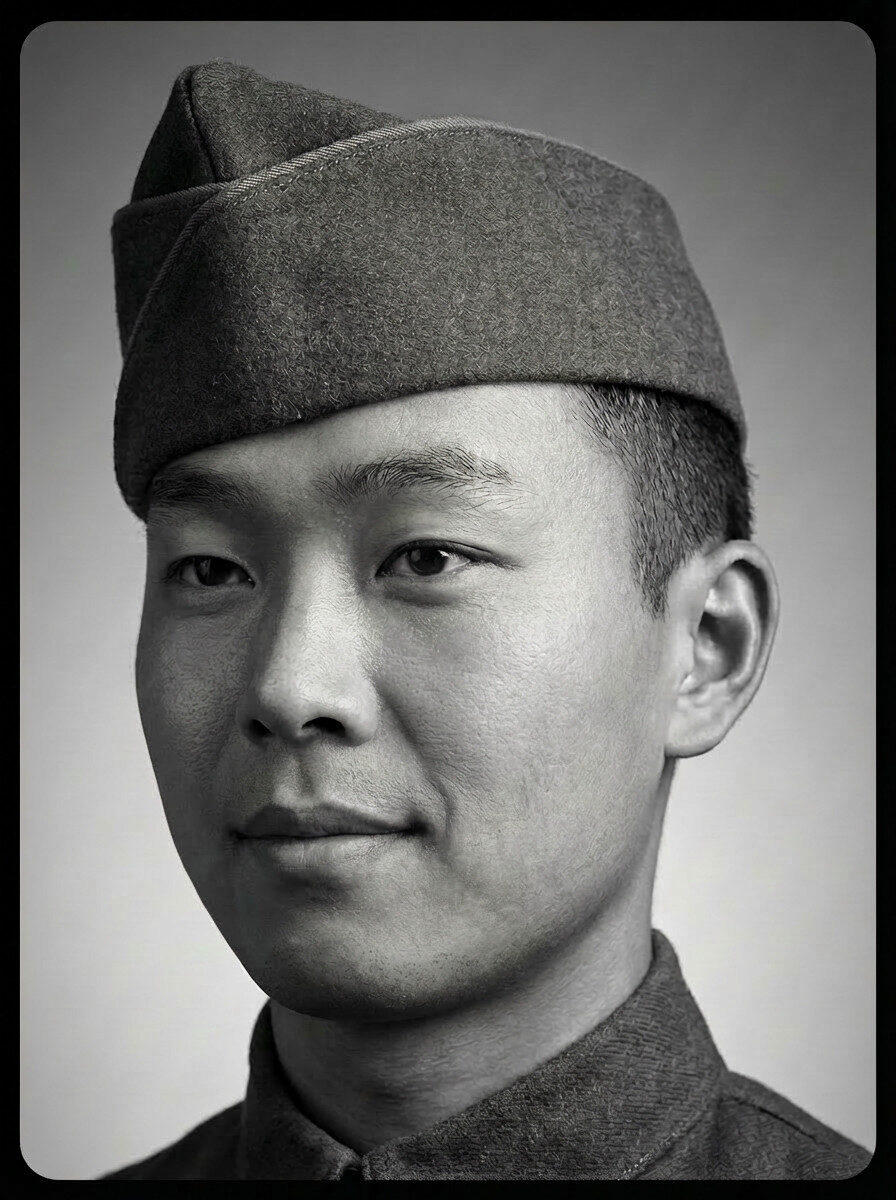
Akio Nishikawa
Private
Regimental Medical Detachment
442nd Regimental Combat Team
Akio Nishikawa was born on October 15, 1922, in Paia, Maui, Territory of Hawaii. He was the youngest child of Heigoro and Shige (Ono) Nishikawa. His siblings were brother Hirayuki (born and died in March 1911) and sisters Ichiye, Kimie, and Mitsuko.
Father Heigoro emigrated from Kumamoto Prefecture, Japan, in 1896 and mother Shige in 1908 from Kumamoto.
In 1930, the family lived on Japanese School Road Camp in Paia, Makawao District. Heigoro worked for the sugar plantation. By 1940, they were at the same place – now called School Camp Road – and Heigoro was the night watchman for the sugar plantation camp store.
Akio was educated at Paia School. In 1940, as a member of the Paia YBA (Young Buddhists Association), he was among a group of 16 who spent a few days as guests of the Lanai YBA in Lanai City. The boys in the group were housed at the Lanai Judo House.
After graduating from Maui High School, Akio moved to Honolulu to attend the University of Hawaii (UH) where he was an ROTC cadet. On December 7, 1941, immediately after Pearl Harbor was attacked by Japan, Akio and all ROTC cadets were told to report for duty, armed with Springfield rifles and five bullets each, and sent out to engage Japanese paratroopers who were thought to have landed. After searching for 6 or 7 hours, they received official orders from the Military Governor (Hawaii was then under Martial Law) converting them into the Hawaii Territorial Guard (HTG). Their mission was to protect vital installations on the island from the feared impending invasion by the Imperial Japanese Army.
Six weeks later, on January 19, 1942, Akio and the other ethnically Japanese cadets were discharged from the HTG as they were then classified 4C – “enemy aliens” – and were ineligible to serve in the military due to suspicion of their loyalty to Japan. Now came the long and courageous battle to prove Americans of Japanese ancestry were just as loyal as those of other ancestral origins.
On February 23, 1942, after their successful petition to the Hawaii Military Governor Lieutenant General Delos C. Emmons, Akio and the other expelled cadets were assigned to a 169-man auxiliary unit called the Varsity Victory Volunteers (VVV). They helped with various construction projects at military installations around Oahu. Their steady and reliable performance played a significant role in assuaging the doubts of the Army leaders and President Roosevelt.
Akio Nishikawa signed his draft registration card in Honolulu on June 30, 1942, Local Board No 3 in Honolulu, His residence was 2243 Hoonanea Street. His point of contact was his father Heigoro Nishikawa at Box 381, Paia. At the time, he was working for the 34th Engineers at Schofield Barracks as a member of the Varsity Victory Volunteers Company of Engineers Auxiliary. He was 5’3” tall and weighed 120 pounds.
In early 1943, when the 442nd Regimental Combat Team was formed, the VVV requested to be disbanded in order to join it.
Akio enlisted in the U.S. Army on March 24, 1943. His civilian occupation was listed as “Carpenters.” He had attended one year of university. He was sent to the “tent city” know as Boomtown at Schofield Barracks with the other new volunteers. On March 28, the new soldiers of the 442nd Regimental Combat Team were given an aloha farewell ceremony at Iolani Palace.
They departed Hawaii on the S.S. Lurline on April 4 for the mainland. After arrival in Oakland, California, the men were sent by train across the country to Mississippi for training. After arrival at Camp Shelby, Nishikawa was assigned as a medic in the 442nd Medical Detachment.
Following this was a year of basic, unit, combat, and specialized training and field maneuvers. He was also sent to an Army General Hospital for two months of medical combat training during this time. The Combat Team’s medics were each detailed to a specific battalion and company. Our research did not reveal Pvt. Nishikawa’s particular company assignment.
Nishikawa left Camp Shelby with the 442nd on April 22, 1944, for Camp Patrick Henry, Virginia. While there, he likely was among the other 442nd medics as they administered typhus and smallpox shots to the troops. They then sailed in a convoy of over 100 ships on May 2 for the Theater of War.
On May 1, they left Camp Patrick Henry on a shuttle rail to the nearby Hampton Roads Port of Embarkation, whereupon they boarded Liberty ships. These ships accommodated the soldiers in 5-high, bunk-bed-style structures. They sailed on May 2, and crossed the ocean navigating in a defensively protective zigzag movement.
The 442nd arrived at Naples, Italy, on May 28. They spent the next 10 days in bivouac at nearby Bagnoli. They left Naples on June 6 by LSTs for Anzio, and then were trucked through the recently liberated city of Rome to a large bivouac area near Civitavecchia.
The 442nd entered combat on June 26, 1944, near Suvereto – with their objective of the seaport city of Livorno 50 miles north. Over the next 16 days, the 442nd steadily pushed the Germans north along the western side of the Italian peninsula. The towns they captured, liberated, or – in the case of unopposed entry – were the first to enter, were: Suvereto and Belvedere on June 26, Sassetta on June 27, Molino a Ventoabbto on July 3, Hill 140 in the vicinity of Castellina on July 9, and Pastina on July 11.
The Combat Team saw especially fierce fighting just north of the Cecina River at Hill 140 beginning on July 3. Captured Germans from the 36th SS Regiment reported that they had been ordered to “hold until the defenses at Pisa were completed.” On July 9 in the vicinity of Casale, they faced determined resistance with the enemy using their terrain to full advantage. A map taken from a dead German indicated that they had every hill, house, and terrain feature zeroed in from prepared gun positions, with azimuth readings, ranges, and fields of fire elaborately developed. This knowledge was possible because of their long occupation of the ground they were defending.
On the night of July 10, the 442nd attacked and moved about 1,000 yards. On the 11th, 2nd Battalion remained in the vicinity of Hill 147, subjected to heavy shelling, which also struck in the 3rd Battalion reserve area and caused heavy casualties.
Private Akio Nishikawa was killed in action on July 11, 1944, in the vicinity of Casale. Six other 442nd men were also killed that day. He was buried at the U.S. Military Cemetery at Follonica, Plot E, Row 52, Grave No. 613. The Army had just opened the cemetery on June 29.
On August 13, his family held a memorial service for Akio at 10:00 a.m. at the Paia Hongwangji Mission on Maui.
For his military service in World War II, Private Akio Nishikawa was posthumously awarded the following: Silver Star Medal, Bronze Star Medal, Purple Heart Medal, Good Conduct Medal, American Campaign Medal, European-African-Middle Eastern Campaign Medal with one bronze star, World War II Victory Medal, and Combat Medic Badge. He was also posthumously awarded the Congressional Gold Medal on October 5, 2010, along with the other veterans of the 442nd Regimental Combat Team. Conferred by the U.S. Congress, the award states: “The United States remains forever indebted to the bravery, valor, and dedication to country these men faced while fighting a two-fronted battle of discrimination at home and fascism abroad. Their commitment and sacrifice demonstrate a highly uncommon and commendable sense of patriotism and honor.”
The posthumous Silver Star citation for Private Nishikawa reads:
…for conspicuous gallantry and intrepidity against the enemy as a Medical Aidman while serving with the 442nd Infantry Regiment, attached to the 34th Division on 11 July 1944, in the vicinity of Pgio. Casale. When one of his comrades was wounded on the forward slope of a bald hill, Private Nishikawa ran a distance of a hundred yards through concentrated 88mm artillery and mortar shellings to render first aid. Although advised by others in the platoon to wait until the enemy ceased shelling, he paid no heed to the warnings and proceeded to rescue the man with the words, ‘Gotta go!’ Finally reaching the wounded man, he proceeded to administer first aid. It was while so engaged that he was mortally wounded by a shell fragment from an 88mm shell.
The outstanding devotion to his country and his gallantry in the face of enemy fire has won him the profound admiration and respect of the men of his company.
Headquarters, 34th Infantry Division, General Orders No. 92, 3 September 1944
On December 3, 1944, the Army presented Pvt. Nishikawa’s Purple Heart Medal to his father in a ceremony held at the YBA Hall on Lower Vineyard Street in Wailuku, Maui, at 2:30 p.m. The event included sixteen Purple Heart Medals and one Bronze Star Medal to Maui soldiers killed in action. The Maui Emergency Service Committee assisted Army officials in the ceremony.
On June 12, 1945, the University of Hawaii paid tribute to its 60 former students who were killed in the war, when a moment of silence was observed during the commencement exercises at 4:30 p.m. in the outdoor theater on campus. At the time, there were 1,204 members of the faculty and student body in active service.
On April 21, 1946, the former VVV members held a memorial service for their seven members who were killed in action during the war. The ceremony was held at 3:00 p.m. at the Church of the Crossroads. Services were held for Daniel Betsui, Grover Nakaji, Howard Urabe, Akio Nishikawa, Robert Murata, Jenhatsu Chinen, and Hiroichi Tomita, all former UH students. The Reverend Mineo Katagiri of Nuuanu Congregational Church, presided. Hung Wai Ching, former secretary of the UH YMCA, was the speaker. The service included presentation of specially printed and framed certificates for Gold Star Mothers. All former VVV members, friends, and the ASUH (Associated Students of UH) were invited.
In 1947, the US began to close many of the overseas wartime military cemeteries. Families were given the option of having their loved one reburied at one of the few cemeteries that would remain or sent to the cemetery of their choice in the US. The Nishikawa family requested that Akio be returned home. His remains were among the 34 others of deceased soldiers that arrived on the USAT General Arlo L. Olsen on July 11, 1949, at 9:00 a.m. at Honolulu Harbor. A large throng of family and friends was there to greet the ship and attend the memorial service, at which Acting Governor Oren E. Long said, “We are proud to have such sons.” The service was conducted by USARPAC Chaplain E.L. Kirtley with prayers by Catholic Chaplain E.L.A. Fisher of the U.S. Army and Protestant Chaplain K.D. Perkins of the U.S. Navy. Afterwards, the flag-draped caskets were stored at the Army mausoleum at Schofield Barracks pending funeral arrangements by the families.
On August 15, 1949, Pvt. Nishikawa was buried at 11:00 a.m. at the National Memorial Cemetery of the Pacific at Punchbowl, Section D, Site 503. That day, he with eighteen World War II soldiers found their final resting place at Punchbowl.
When father Heigoro Nishikawa died in 1964 in Pukalani, Maui, his survivors included daughters Ichiye Nonaka (Mrs. Kotaro Nonaka) of Pearl City, Oahu, and Mitsuko (“Mitzi”) Abe (Mrs. Masamitsu Abe) of Pukalani, six grandchildren, and four great-grandchildren.
Postscript. On May 14, 2012, the 70th anniversary of the formation of the Varsity Victory Volunteers, the University of Hawaii awarded posthumous degrees to the seven ROTC cadets, including Private Akio Nishikawa, who were killed in action during World War II while serving with the 442nd Regimental Combat Team. The diploma reads:
The Regents of The University of Hawai’i on the recommendation of the Faculty of University of Hawai’i at Mānoa have conferred upon
Akio Nishikawa
the degree of Bachelor in Memoriam with all its privileges and obligations
Given at Honolulu, Hawai’i, this twenty-fifth day of March, two thousand twelve
———-O———–
Researched and written by the Sons & Daughters of the 442nd Regimental Combat Team in 2025.