Soldier Story: Alvin Joseph Meier
Soldier Story
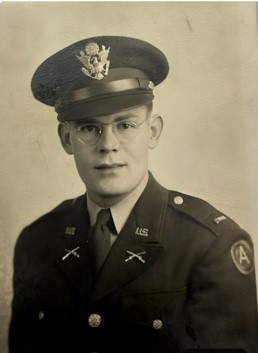
Alvin Joseph Meier
Captain
Antitank Company
442nd Regimental Combat Team
Alvin Joseph Meier was born on July 26, 1919, in St. Marys, Elk County, located in northwestern Pennsylvania. He was the second son of the eleven children of Frank Richard and Philomena Margaret (known as “Minnie”) (Gerber) Meier. His siblings were five brothers: Richard Herman, Pirmin Hubert John, Francis (known as “June”), Donald L. (known as “Brownie”), Robert Joseph; and five sisters: Ruth Margaret, Erma Agnes, Martha Mae (known as “Marcie”), Valerie R., and Joan M.
Father Frank’s parents were born in Bavaria, Germany, and arrived in the US in 1881 and 1869, respectively. Wolfgang Meier, Frank’s father, arrived on the S.S. Hammonia of the Hamburg-American Steamship Line on August 28, 1883.
In 1920, the family was living at 427 Spruce Street in St. Marys. Frank was employed by the railroad as a coach carpenter. By 1930, they had moved to 613 Center Street in St. Marys. Frank was employed as a carpenter for a house builder/repairer business. In 1935, he began working for Corbett Cabinet Factory.
During the Great Depression, Alvin quit school in 10th grade, and in 1935, he also began working as a cabinet maker for Corbett Cabinet Factory. In 1940, the family was living at 669 Center Street and Frank had his own carpentry business. Alvin, age 20, was a crew foreman at Corbett Cabinet factory and he machined and assembled cabinets, window frames, stair parts, and all kinds of building materials.
Alvin signed his draft registration card on October 16, 1940, Local Board No. 2, in the Luhr Building, St. Marys. He lived with his family at 669 Center Street. His mother was his point of contact. Alvin was employed by Corbett Cabinet, Inc., located at Box 274, Chestnut Street. He had brown hair and brown eyes, and was 5’10” tall and weighed 149 pounds. He was a member of the St. Marys Council No. 567, Knights of Columbus.
Meier was drafted and entered the U.S. Army on June 3, 1942, in Erie, Pennsylvania. His civilian occupation was listed as “Foreman, manufacturing.” He had completed two years of high school.
Beginning on November 11, 1942, Meier attended Officer Candidate School (OCS) at Fort Benning, Georgia. He graduated in Class #176 in 1943, was commissioned a Second Lieutenant, and ordered to active duty on February 19 as part of the 3rd Student Training Regiment pending further assignment. That same day he was assigned to the Infantry Replacement Training Center (IRTC) at Camp Wheeler near Macon, Georgia.
On March 3, 1943, after the activation of the 442nd RCT, Lt. Meier was assigned to it and sent to Camp Shelby, Mississippi. He was assigned to be part of the training cadre as a platoon leader for 2nd Battalion, F Company. The training cadre arrived individually during the first two weeks of February 1943.
Upon arrival, among the standard military articles issued to Lt. Meier by the Quartermasterwere: canvas field bag, bed roll, two shelter pole tents with the items to assemble it, First Aid pouch, pistol belt, two magazine pockets, knife/fork/spoon, cup and canteen, suspenders, two wool blankets, cotton-filled comforter, and steel helmet. In addition, as part of the training cadre, he was issued the Master Program list of subjects, Field Manual text references, and number of hours per week of instruction that was required.
Basic training for the 442nd soldiers began on May 10 and lasted until August 23. Meier was then sent with F Company to the prisoner of war camp in Daleville, Alabama, as the men were assigned to guard German POWs as they harvested the peanut crop. Back at Camp Shelby, on October 20 platoon and company training began and lasted about one month – however, Meier was granted a 12-day leave beginning on October 27. Afterwards, the training continued in the field as they all learned to coordinate and work together. On January 15, 1944, 2nd Lt. Meier was officially assigned to 2nd Battalion, F Company as a platoon leader.
The final phase of training before maneuvers involved working in the field with the artillery. Finally, on January 28, 1944, the “D” Series maneuvers began in the DeSoto National Forest in Mississippi, conducted by the 69th Infantry Division. During these maneuvers, the 442nd worked through six “problems” – playing part of the Division during the first three problems and playing the enemy part during the last three. By late February, everyone was back at Camp Shelby again.
On February 21, 1944, Lt. Meier was transferred from 2nd Battalion’s F Company to the 442nd’s Antitank Company as 1st Platoon leader, as was Lt. Ben W. Rogers Jr. They were replacements for Lt. Saburo Maehara and Lt. Boon E. Takagi who had been sent as replacements to C Company in the first and second waves to the 100th Infantry Battalion (Separate) in Italy. [Note: Lt. Rogers, Lt. Maehara, and Lt. Takagi were later killed in action.]
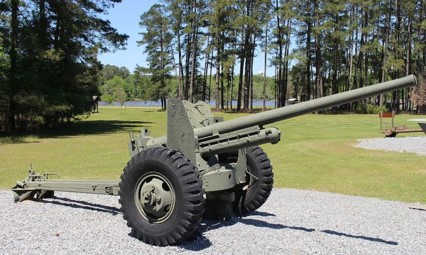
Below: 57mm antitank gun at Camp Shelby
After a year of basic, unit, specialized, and combat training and field maneuvers, Lt. Meier left with the Combat Team by train on April 22, 1944, for Camp Patrick Henry, Virginia. They sailed from nearby Hampton Roads on May 2 in a convoy of about 100 ships that had taken two days to form. Antitank Company sailed on the Liberty Ship S.S. Thomas Nelson Paige, where they shared a hold area of four-tiered bunks with the 442nd Service Company. The Combat Team arrived at the war-torn port of Naples, Italy, on May 28.
After arriving, the Combat Team spent a week at a staging area in nearby Bagnoli before leaving on LSTs (Landing Ship Tanks) for Anzio on June 6. From the Anzio beachhead, they marched five miles inland to a bivouac area. On June 9, the 442nd was trucked through the recently liberated city of Rome to a large bivouac area near Civitavecchia, 44 miles north of Rome. There, they underwent additional training and final preparations for movement to the front lines.
On June 26, 1944, the 442nd RCT moved forward to the front lines for their first combat engagement near Suvereto – in the Rome-Arno Campaign. Each of Antitank Company’s three gun platoons was attached to one of the 442nd’s three infantry battalions. At times, however, the mountainous terrain made it impossible to use Antitank Company’s guns. When this happened, the Antitank men were used as litter bearers and ration carriers.
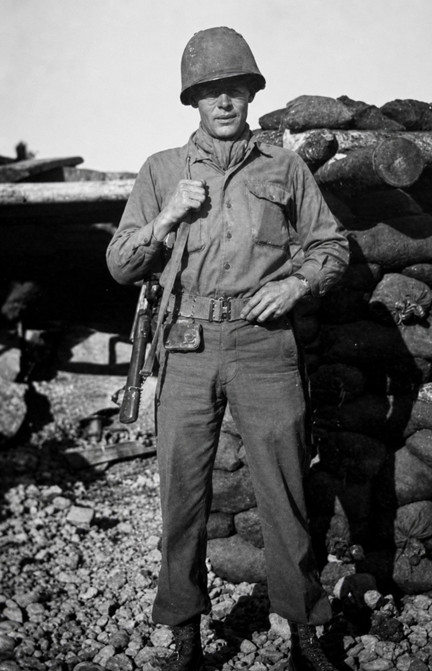
Below: Lt. Meier, 1944-1945
One success after another saw the 442nd RCT continuously pushing the Nazis north 29 miles to the Cecina River.
On July 14, Antitank Company was pulled out of the battle lines and assigned to participate in the invasion of southern France, known as “Operation Dragoon.” They were sent to bivouac near Lido di Roma, where they bivouacked at Gallera Airfield. They first underwent physical training to harden the men for an airborne invasion. On July 28, Antitank Company moved to Marcigliana Airfield north of Rome for final glider training. British Antitank 6-pound guns were substituted for their own 57mm guns, which were not suitable for glider loading, lashing, and unloading.
On August 3-4, the entire Antitank Company completed two tactical flights and was certified as glider troops, eligible to wear the Glider Badge. On August 5, they moved to another bivouac area south of Rome at Frascati. There, they awaited further orders and were officially attached to the 517th Parachute Infantry Regiment of the First Airborne Task Force.
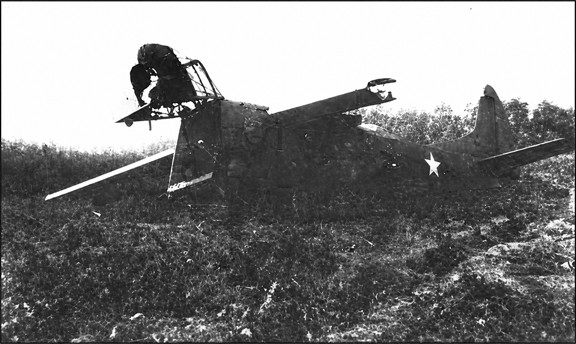
On August 15, 1944, they took to the air in 44 towed glider planes. The three platoons were split up to support different elements of the 517th. As they reached the coast of France, at 3,000 feet – rather than the prescribed 100 feet – the gliders were cut off from their C-47 tug planes. Many pilots discovered as they approached the ground that all was not as shown in the aerial photos during the pre-flight briefing. This caused considerable confusion during landing. The ground was covered by grape arbors constructed of stout timber and the hedgerows were much higher than anticipated. This produced rough landings with nine men injured. The general opinion of the Antitank men was that:
It was a good thing that we didn’t know what we were getting into, because if we had to do it all over again you couldn’t get us to ride those flying boxcars.
Below: One of the gliders after landing the 517th and Antitank Company in France
Right after landing near Les Arcs and Le Muy, crews unloaded and proceeded to the pre-arranged assembly area. There, the company was hastily regrouped by Lt. Alvin J. Meier and Lt. John M. Scotland Jr. On August 16, contact was made with the 7th Army’s 36th and 45th Divisions, which were the seaborne units of the invasion. Antitank Company’s mission was to protect the wide area of the exposed right flank of the 7th Army. All three battalions of the 517th were committed, with one Antitank Company platoon for each battalion. Antitank Company’s mission from this time on was to give anti-mechanized protection to the 517th.
On September 11, the 517th was overlooking the Maritime Alps town of Sospel, which was heavily defended by the Germans.
Meier was recommended for Combat Promotion by Major William J. Doyle, 1st Battalion, 517th Parachute Infantry. The recommendation stated that after being assigned to Doyle’s unit, Meier did the following:
…Meier put his guns on road blocks toward Les Arcs and Le Muy. The Antitank guns were not fired because there were no targets for their type of fire. Both road blocks were fired on by German patrols, which were driven off by our own men and the Antitank Company men under 2nd Lt. Meier. We moved out from the area of Les Arcs on 18 August 1944, and moved to an area near Les Puget, France. We stayed there two days and moved on through Callian, St.-Cézaire, St.-Vallier, crossed mountains above Grasse, went to Bézaudun, Le Cros-d’Utelle, and to St.-Jean la Rivière. The Antitank platoon under 2nd Lt. Meier came with us whenever possible and found other roads when we took to the hills, and they caught up with us by road later.
Although the Antitank guns have not been fired, the guns have been well-emplaced with us on our road blocks and men all set to fire. 2nd Lt. Meier and men of his platoon have always been cool and calm under the small arms fire we received. One of the Antitank Company drivers while on S-2 patrol with our men was shot and wounded by German machine gun fire. Although wounded, he got back in the jeep three times and tried to get his jeep and other wounded men out to the hospital. His actions are typical of the rest of the men in the 1st Platoon, Antitank Company, 442nd Infantry Regiment. 2nd Lt. Meier and two of his men and some of our 1st Battalion men were on the bend in the road to help us fight our way back from where the Germans ambushed the jeep.
On October 12, 1944, 2nd Lieutenant Meier was promoted to 1st Lieutenant. This was the combat promotion recommended above and was accompanied by the following citation:
Lt. Alvin J. Meier has at all times demonstrated his leadership and ability to control his Platoon under any difficult condition. He has often placed himself in unnecessary personal dangers to make reconnaissance and be an example to his men. On D-Day, 15 August 1944, in the vicinity of Les Arcs, France, 2nd Lt. Meier thought it necessary to personally lead a patrol to relieve a trapped party of 517th Infantry Paratroopers. His action and quick thinking enabled the wounded members of that patrol to be brought back for evacuation. This act is typical of his personal courage, initiative, and other leadership qualities.
[Le Muy is 34 miles southwest of Cannes and Les Arcs is 6 miles west of Le Muy.]
Antitank Company was engaged in combat until October 20 when they were relieved by the 552nd Antitank Company. They were withdrawn from the front lines and sent to a bivouac area on the coast near Nice. Two days later, they convoyed north to the Vosges Mountains.
On October 24, Meier and the Antitank Company rejoined the 442nd RCT for the battles in the Rhineland-Vosges Campaign in the Vosges Mountains of northeast France. They reached Bruyères on October 27 and were bivouacked next to the 442nd Service Company. Almost immediately, they were committed to action.
Due to the hilly, forested, snow-covered terrain, the use of their anti-tank guns was not feasible. Antitank Company was used as litter bearers, supply and ammunition packers, and even front-line riflemen. They suffered more casualties during their three weeks of combat in the Vosges than during the rest of the time during the war – three killed and 15 wounded. On November 12, Antitank Company was honored to serve as the Color Guard for the 442nd citation ceremony at Lépanges, five miles southwest of Bruyères.
By this time, the 442nd had suffered such high casualties that it was no longer combat-effective. Thus, they were sent to the south of France for the Rhineland-Maritime Alps Campaign from November 1944 to March 1945. This was primarily a defensive campaign to guard the Franco-Italian border from incursion by the enemy forces in Italy. On November 19 Antitank Company was back on the road to the province that it had helped to liberate while attached to the 517th Parachute Infantry. Meier and his 1st Platoon were assigned to support the 100th Battalion high in the mountains above the seaside town of Menton, the last French locality before the Italian border.
Below: Lt. Meier, Menton area, Maritime Alps Campaign, France 1945
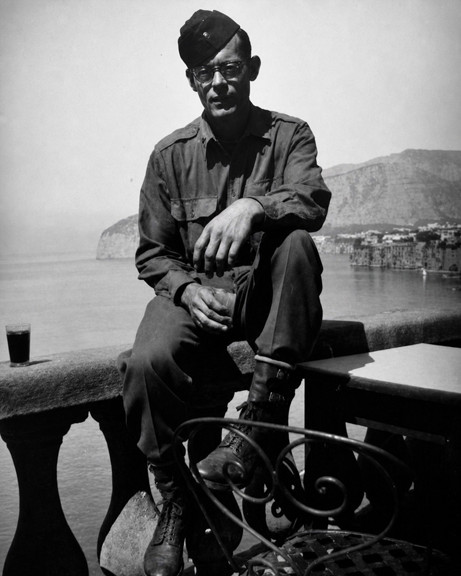
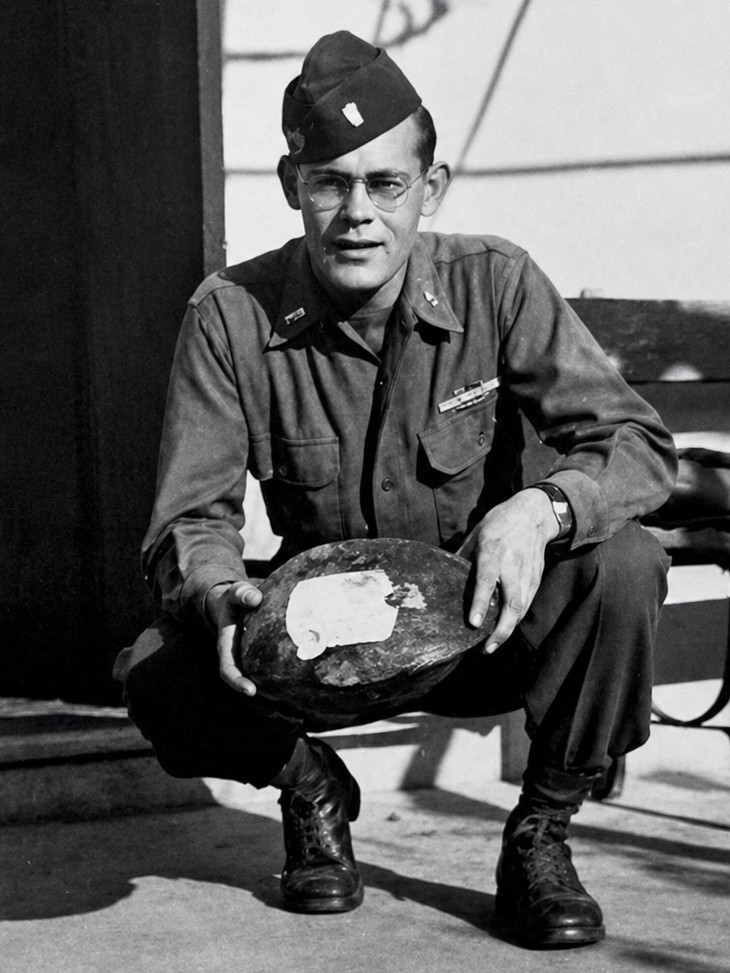
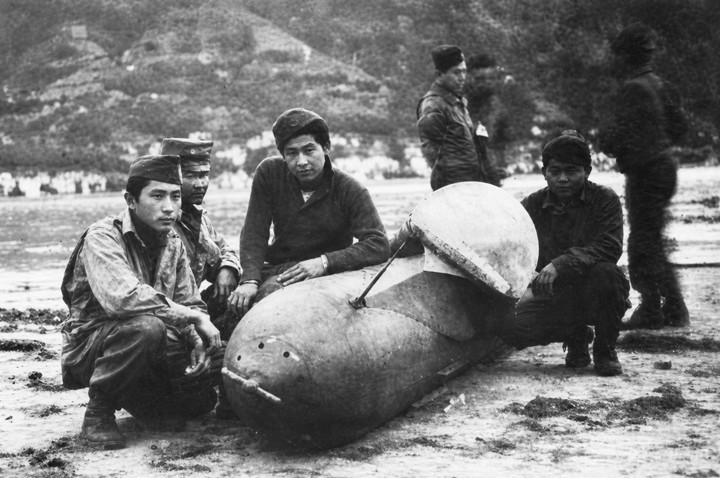
While Lt. Meier was stationed along the French Riviera, on December 19, 1944, his platoon was at the Antitank Company observation post in Menton when they spotted a small submarine heading toward the shore. They contacted Lt. Meier who rushed down from the Command Post (CP) with reinforcements and deployed his men for the capture. They had a 57mm gun, a BAR (Browning Automatic Rifle), and numerous small-arms weapons. The submarine had the ability to fire one torpedo, and the lone operator was seated under a plexiglass turret and equipped with an oxygen mask. The German corporal who was manning the sub had thought he was entering the bay at Ventimiglia, seven miles away on the German side in Italy. However, he had become confused and entered the wrong harbor and was soon stuck on a sandbar. With some difficulty, the Antitank men managed to make the hapless German soldier exit his submarine.
As Lt. Meier later said:
My men first thought it was a large fish and were going to grenade it – then we saw it wasn’t a fish. We watched it and realized it couldn’t fight back – so the men just waded out and captured it.
Below: Captured enemy submarine in Menton
By March 1945, the 442nd was again combat-ready and was sent back to Italy for the Po Valley Campaign. Their deployment there was conducted as a closely guarded secret.
The mission of the 442nd was to conduct a surprise attack on the western end of the Gothic Line, a heavily fortified and defended line that ran across the Italian peninsula. The objective was to cause the Nazis to commit reserve forces in defense, thereby weakening their ability to withstand the subsequent main thrust of the Fifth Army to break through the Gothic Line and capture Bologna.
The Combat Team (without its 522nd Field Artillery Battalion that had been sent to fight in the Central Europe Campaign in Germany) arrived at the Peninsular Base Section in Pisa on March 25. Antitank Company was issued new 57mm guns and spent time at their bivouac near the walled city of Lucca in test-firing them. However, as the steep mountains meant the use of their guns was not feasible, when they moved to the front lines they were assigned to the infantry battalions as carriers. First Platoon was the 100th Battalion’s litter bearers. Antitank men also served in many other capacities: rations and ammunition carriers to the front lines, mine-sweeping the roads, manning roadblocks, guarding bridges, and even carrying rifles at Hill 706, Mount Pizzacuto, and Mount Uccelliera.
The 442nd was so successful in its initial surprise attack on the Germans that it continued moving north, taking one strongpoint after another. Antitank Company was responsible for blocking the roads leading into the town of Massa from the east. By April 10, the 442nd crossed the Frigido River north of Massa and pushed ahead to occupy the high ground above the town of Carrara. On April 26, the company finally was able to revert to its initial purpose. First and Third Platoons supported the 100th and 3rd Battalions, respectively, in the event of a mechanized enemy attack. Second Platoon went to support 2nd Battalion the following day.
By April 28, the 442nd was in Genoa and the fighting was nearing an end. On May 1, Antitank Company moved 55 miles north to Alessandria and the next day the Germans in Italy surrendered, a week before the rest of the German forces surrendered.
Below: Lt. Meier, Italy 1945
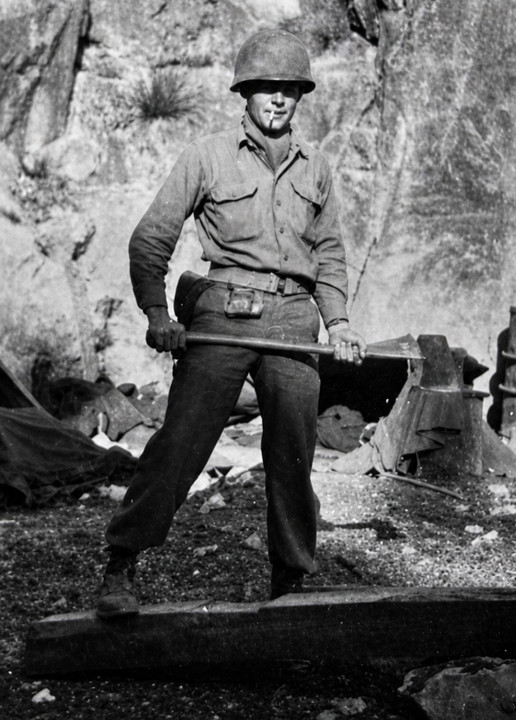
On May 4, the 442nd went into bivouac at Novi Ligure, where the entire Antitank Company occupied Villa Minetta, a large mansion owned by an Italian nobleman. On May 13, they participated in a citations review by Lieutenant General Lucian K. Truscott Jr. and Major General Edward M. Almond.
The 442nd soon was sent to Ghedi Airfield near Brescia and living in their pup tents. While most of the 442nd was assigned to process and guard thousands of German prisoners of war, Antitank Company posted guards in the internal regimental area. In addition, the Army Educational Program and intra-mural sports were instituted. Antitank Company formed a softball team that won the regimental championship.
On June 14, they were sent to Lecco at Lago di Garlate where they enjoyed the lake and the beautiful countryside. This did not last long, however, and Antitank Company was the first group to leave, on July 7. They went by truck 270 miles south to establish a bivouac at Coltano di Pisa, where the rest of the 442nd would soon follow and set up bivouac areas in the Pisa, Livorno, and Tombolo areas. Their occupation duties were to guard military installations in the area and also guard the POWs and supervise their work details.
On September 9, 1945, as a result of departures for the US that left positions open, Lt. Meier became the Antitank Company Executive Officer; and on October 25, he became the company commander. In anticipation of his return to the US, he ceased being company commander on November 6.
Lt. Alvin Meier left occupation duties in Italy three weeks later, on November 26, 1945, and returned to the US. He was discharged from the U.S. Army on February 17, 1946, at Fort Indiantown Gap, 30 miles from Harrisburg, Pennsylvania.
For his military service, Captain Alvin J. Meier received the following awards and decorations: Bronze Star Medal, American Campaign Medal, European-African-Middle East (EAME) Campaign Medal with one silver star and the bronze arrowhead device, World War II Victory Medal, Army of Occupation Medal, Distinguished Unit Badge, Combat Infantryman Badge, and Glider Badge. The silver star device on the EAME Campaign Medal indicated combat in five campaigns and the arrowhead device indicated participation in the glider-borne invasion of Southern France.
Meier was posthumously awarded the Congressional Gold Medal on October 5, 2010, along with the other veterans of the 442nd Regimental Combat Team. Conferred by the U.S. Congress, the award states: “The United States remains forever indebted to the bravery, valor, and dedication to country these men faced while fighting a two-fronted battle of discrimination at home and fascism abroad. Their commitment and sacrifice demonstrate a highly uncommon and commendable sense of patriotism and honor.”
After returning home to St. Marys, Pennsylvania, Alvin Meier married Alice Mary Pichler on July 8, 1946. Brother Primin Meier O.S.B. was the officiant at their wedding. Alice was born in Kersey, Elk County, on September 9, 1924, one of ten children of Matthias and Helen (Antene) Pichler. Matthias was born in Austria, arrived in the US in 1907, and was a farmer in Elk County. Helen’s father had died well before she met Matthias, and her mother was from Bohemia.
On January 16, 1950, Meier applied for World War II compensation from the Commonwealth of Pennsylvania for his 43 months and 45 days of service. He was granted $450 on January 10, 1951.
In 1950, Alvin built the family home at 693 Center Street next to his parents. There the couple raised four sons: Dan, Tom, Ken, and Mark. In 1960 Alvin and his partners founded Suburban Building Center in St. Marys. The business specialized in custom home building and cabinetry. It is still operational today.
Alvin J. Meier died on November 29, 1977, at the age of 58. He was buried on December 2 in Plot C-195, 5 West, at St. Marys Catholic Cemetery. Wife Alice died on May 25, 2002, and was buried next to her husband. Sons Tom and Ken died in 1983 and 2026 respectively. Alvin Meier is survived by sons Dan and Mark, and 10 grandchildren: Brian, Paul, Julie, Matt, Joe, Emily, Megan, Erin, Justin, and Rachel.
During World War II, Alvin’s brothers Rich and Francis served in the U.S. Army, brother Donald served in the Coast Guard, and sister Martha served in the U.S. Navy Waves.
Researched and written by the Sons & Daughters of the 442nd Regimental Combat Team in 2026 with the assistance of family.