Soldier Story: Chester Kengo Abe
Soldier Story
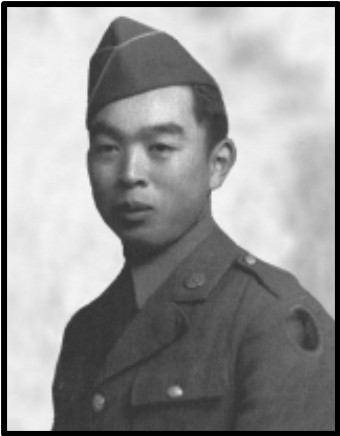
Chester Kengo Abe
Private
442nd Regimental Combat Team
3rd Battalion, M Company
Chester Kengo Abe was born on July 3, 1917, in Sacramento, California, to Niichiro and Asa (Yamasaki) Abe. He was one of eight children: sons Shoichi Bill, Kanji Charles, Makato (died age 17), and Yoshimi Frank; and daughters Hisako Tsugawa, Tokuno Sara, and Amy Sumiko.
Niichiro emigrated from the village of Higashi, Fukuoka City, Fukuoka Prefecture, Japan, arriving in 1901. Asa also arrived in 1901. They were married on November 4, 1904, in San Francisco.
In 1920, the family lived at 1298 Pacific Avenue in Sacramento and Niichiro was working on a berry farm. In 1930, they lived at 2781 Pacific Avenue and Niichiro was the manager of a fruit association.
Kengo was educated at Edward Kelly Grammar School, Stanford Middle School, and Sacramento High School – graduating in 1936. By 1940, father Niichiro was the manager of a Berry Growers Association, Kengo worked on a farm, and brother Kanji was the farm’s operator.
Abe registered for the draft on October 16, 1940, at Local Board 28, Sacramento. His mother was his next of kin and they lived at Route 2, Box 2915, Sacramento. He was 5’6” tall and weighed 128 pounds.
On March 7, 1941, Kengo was drafted into the Army. He was listed as a farm hand with four years of high school. He was sent to Camp San Luis Obispo, where he had basic training followed by parachute training. Our research did not reveal where he was stationed after training.
While Kengo was serving in the Army, his family was evacuated in May 1942 to the Pinedale WCCA Assembly Center in Fresno. They were incarcerated at the Tule Lake WRA Relocation Camp near the Oregon border. His father Niichiro was incarcerated at the Colorado River WRA Relocation Camp, also known as Poston, in southwest Arizona on December 9, 1943. He was released on January 20, 1944, to Ontario, Oregon.
In 1944, Kengo was transferred to Camp Shelby, Mississippi, and assigned to the 171st Infantry Battalion (Separate). The 171st was the 442nd’s training cadre. He received combat training and his introduction into the 442nd. At this time, the 442nd RCT had been in the Theater of War since May 28.
On September 18, 1944, Abe was one of 672 replacements to the 442nd RCT that arrived in Naples, Italy, from a Replacement Depot in Italy. He was assigned to 3rd Battalion, M Company, 4th Platoon, Mortar Section. M Company was the heavy-weapons company for 3rd Battalion.
On September 27, the 442nd sailed to Marseilles, France, arriving on September 30. The next day, they were moved by train to a staging area near Septèmes. After several days, all units were moved by truck – with the exception of 3rd Battalion by train – over a three-day period, north 500 miles along the Rhône Valley. They arrived at an assembly area in Charmois-devant-Bruyères on October 11 for fighting in the Rhineland-Vosges Campaign in October and November. They were attached to the 36th Infantry Division, 7th Army.
Their first objective was to liberate the important road and rail junction of Bruyères in the Vosges Mountains. The intense battles to liberate Bruyères and neighboring Biffontaine lasted from October 16-24. At some point during this time, Kengo was wounded, treated, and returned to duty.
The Combat Team was then put into reserve in Belmont for a brief rest. After two days, on the afternoon of October 26, they were ordered to the front lines again to aid in the rescue of the Lost Battalion – the 1st Battalion of the 141st (Texas) Infantry Regiment. This battalion had gotten ahead of the lines and was surrounded by the enemy. Attempts by the 141st and other units to free it had been unsuccessful, so the 442nd was called in.
The initial objective of the Texas “lost” battalion had been to clear the Germans from the entire long, densely forested ridge where it had become surrounded. After the 442nd was successful in the rescue, 3rd Battalion was ordered to push on down to the end of this ridge. Two days after the Lost Battalion rescue, Private Chester Kengo Abe was killed by intense artillery fire on November 2, 1944.
The fighting would go on until November 9. The German line was completely shattered, but 442nd losses were so great that the Combat Team was temporarily ineffective as a fighting force.
Private Abe was interred at the U.S. Military Cemetery in Épinal, France, about 20 miles from where he died.
For his military service, Private Chester Kengo Abe was awarded the Bronze Star Medal, Purple Heart Medal with oak leaf cluster, Good Conduct Medal, American Defense Medal, American Campaign Medal, European-African-Middle Eastern Campaign Medal with one bronze star, World War II Victory Medal, Distinguished Unit Badge, and Combat Infantryman Badge. Kengo was posthumously awarded the Congressional Gold Medal on October 5, 2010, along with the other veterans of the 442nd Regimental Combat Team. Conferred by the U.S. Congress, the award states: “The United States remains forever indebted to the bravery, valor, and dedication to country these men faced while fighting a two-fronted battle of discrimination at home and fascism abroad. Their commitment and sacrifice demonstrate a highly uncommon and commendable sense of patriotism and honor.
In 1948, the U.S. Army offered families of our war dead who had been buried overseas the option of having their soldier reburied at one of the military cemeteries that would remain in Europe, or brought back to the US. As a result, the coffin carrying the remains of Private Chester Kengo Abe and 4,182 other war dead arrived aboard the USAT Lawrence Victory at 9:00 a.m. on May 7 at the Brooklyn Army Base, 58th Street and First Avenue in New York City. A large group of family and friends was on hand to greet the ship and a brief ceremony was held at the dock at Pier 3. The mayor of New York ordered all flags at public buildings to be lowered to half-staff. Families across the country were notified that their loved one would arrive at each family’s burial location about three weeks later.
Chester Abe was reinterred on June 2, 1948, at the Golden Gate National Cemetery, San Bruno, California, Section C, Site 410.
Kengo’s sister Amy later recalled in an interview that she had a nightmare on November 2, 1944. In her dream, she saw a flash of light and her brother was killed. She awoke and thought to herself, “It’s only a dream.” A month later the family received a letter from the Army with the news of Kengo’s death on the day of Amy’s dream.
Below: Gold Star Mother Mrs. Niichiro Abe is standing on the far left
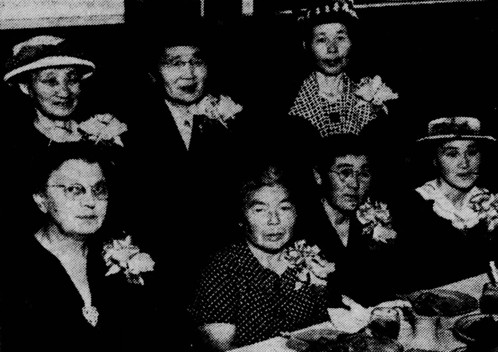
On June 6, 1951, at a dinner held at the Wakano Ura Restaurant in Sacramento attended by about 300 people, eight local sons who lost their lives serving in the 442nd RCT during the war were honored. Their parents, including Pvt. Abe’s mother, were special guests at this event, which was sponsored by the Florin and Sacramento Chapters of the Japanese American Citizens League (JACL) and Nisei Post No. 8985, VFW. Immediately afterwards, at a ceremony on stage at the Senator Theater, the seven mothers and one father of the fallen soldiers were presented a Gold Star, signifying their lost son. The ceremony was followed by the showing of the new film, Go For Broke, starring Van Johnson and several 442nd veterans. William Sakai, a veteran of K Company, was chairman of the theater event. Many dignitaries, including Lieutenant Governor Goodwin J. Knight, State Senator Earl D. Desmond, and Mayor Bert E. Geisreiter, were present and gave remarks. As each Gold Star was presented, the soldier’s story was read. The ceremony concluded with Taps.
Five of the eight men were killed during the “Rescue of the Lost Battalion: Pfc. Cooper T. Tahara, Company I, Corporal Yoshinori Sakai, Company C, Corporal Tadashi Takeuchi, B Company, Torao Hayashi, B Company, and Private Chester Abe, M Company.
Researched and written by the Sons & Daughters of the 442nd Regimental Combat Team in 2022; updated in 2026