Soldier Story: Daniel Den Betsui
Soldier Story
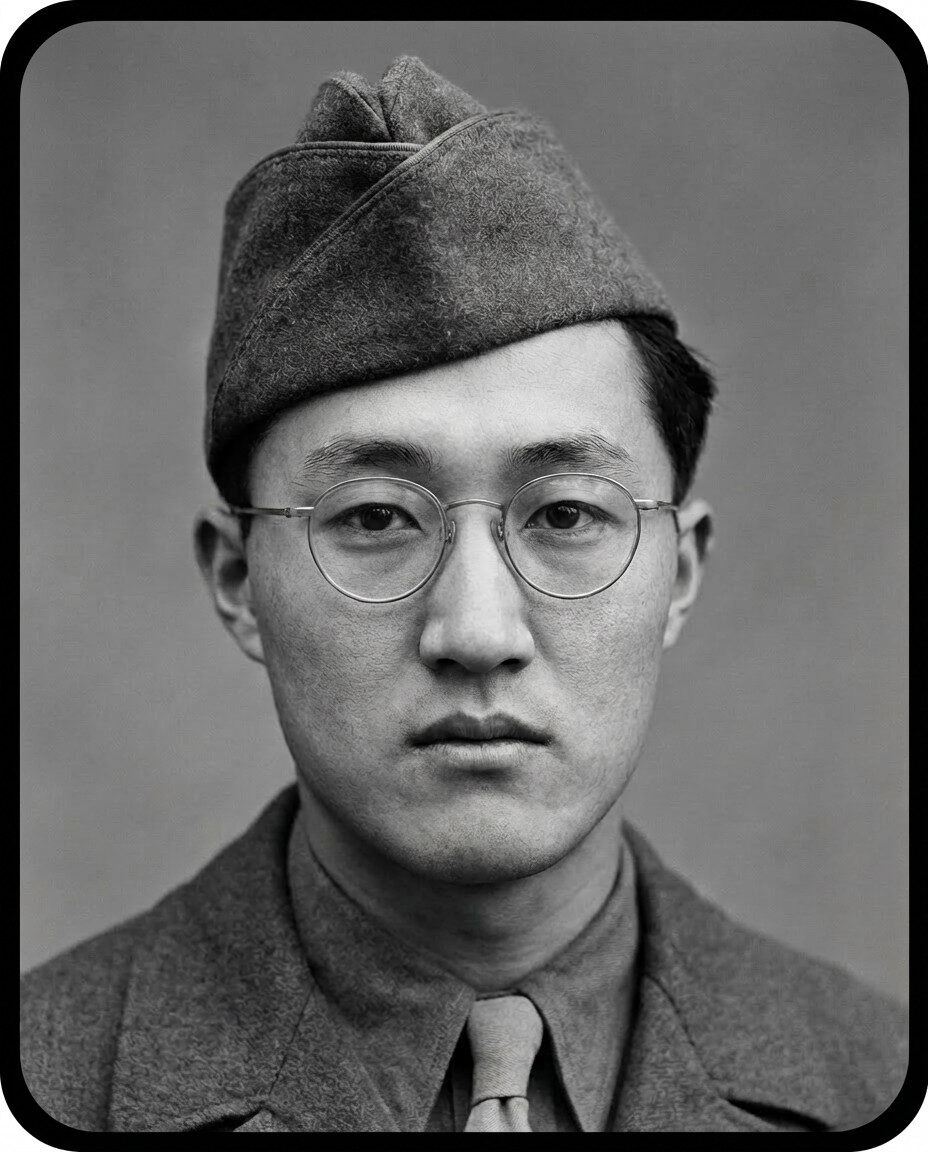
Daniel Den Betsui
Sergeant
442nd Regimental Combat Team
232nd Combat Engineer Company
Daniel Den Betsui was born on September 5, 1922, in Hanapepe, Kauai, Territory of Hawaii. He was the youngest child of Kokichi and Yei (Ishizaki) Betsui. His siblings were George, David Takegi, Gladys Fumi, and Richard Kiyoji. The gap between the birth of Richard in 1909 and Daniel’s birth was 13 years.
Father Kokichi (born 1875) emigrated to Kauai in 1891 from Asahi, Tochigi Prefecture, Japan. He returned to Japan in 1901 and married Yei Ishizaki, also from Asahi. They then sailed to Hawaii, where they lived in Hanapepe andKokichi was a sales clerk. By 1918 when he registered for the World War I draft, he was the manager of a liquor store in nearby Eleele.
In 1930, the family was living in Hanapepe. Father Kokichi was a dry goods salesman. Children Gladys and Richard were school teachers. Daniel graduated from grammar school in Eleele in 1936. He then attended Waimea High School, but soon moved to Honolulu where he attended Mid-Pacific Institute, graduating in 1940.
In 1940, the Betsui family was living on Hanapepe Road and Kokichi was still a dry goods salesman. Son David was a physician in private practice. Daniel was listed as “absent” – as he was attending school in Honolulu. He next enrolled at the University of Hawaii (UH) and was in the pre-medical school program. It was a UH requirement that all males enroll in the Reserve Officers Training Corps (ROTC) for their first two years; therefore, Daniel also was a member of the UH ROTC.
On December 7, 1941, immediately after Pearl Harbor was attacked by Japan, Daniel and all ROTC cadets were told to report for duty, armed with Springfield rifles and five bullets each, and sent out to engage Japanese paratroopers who were thought to have landed. After searching for 6 or 7 hours, they received official orders from the Military Governor (Hawaii was then under Martial Law) converting them into the Hawaii Territorial Guard (HTG). Their mission was to protect vital installations on the island from the feared impending invasion by the Imperial Japanese Army.
Six weeks later, on January 19, 1942, Betsui and the other ethnically Japanese cadets were discharged from the HTG as they had been classified 4C – “enemy aliens” – and were ineligible to serve in the military due to suspicion of their potential loyalty to Japan. Now came the long and courageous battle to prove Americans of Japanese ancestry were just as loyal as those of other ancestral origins.
On February 23, 1942, after their successful petition to Hawaii Military Governor Lieutenant General Delos C. Emmons, Dan and the other expelled cadets were assigned to a 169-man auxiliary unit called the Varsity Victory Volunteers (VVV). The were stationed at Schofield Barracks and helped with various construction projects at military installations around Oahu. Their steady and reliable performance played a significant role in assuaging the doubts of the Army leaders and President Franklin D. Roosevelt.
In 1942, Dan was recording secretary of the YMCA on campus. According to the 1942 Ka Palapala (the UH yearbook), “After December 7, the call of the HTG, the VVV, and defense projects nearly depleted YMCA membership.”
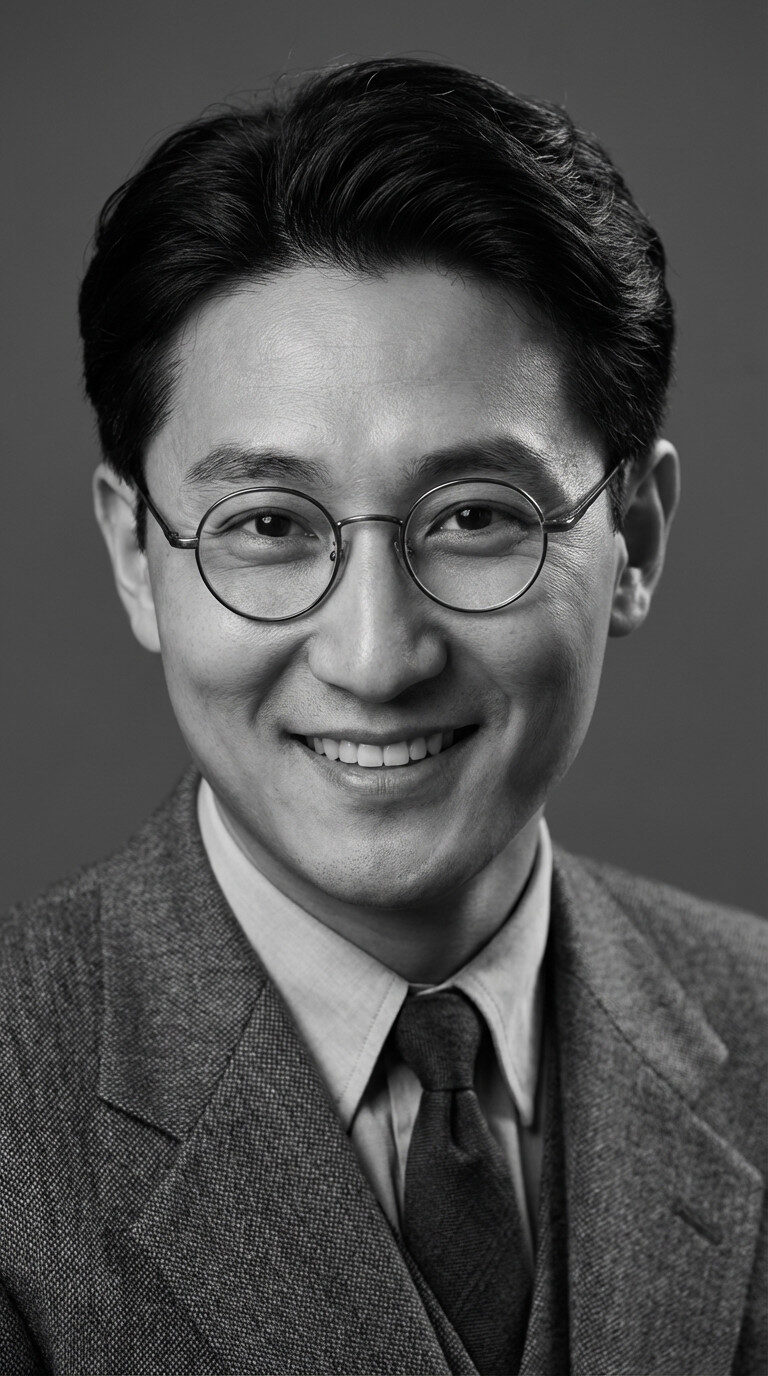
Right: Daniel about 1942
Daniel Betsui signed his World War II draft registration card on June 30, 1942, Local Board No. 2 at 3563 Waialae Avenue. He lived at 957 10th Avenue in the Kaimuki neighborhood of Honolulu. His point of contact was his brother Private Richard K. Betsui at Waialua High School. He was employed by the U.S. Army Corps of Engineers Auxiliary at Schofield Barracks. He was 5’7” tall and weighed 135 pounds. Written in red at the top of the card was the notation “Deceased non-battle, report Nov. 4, 1946.”
Betsui enlisted in the U.S. Army on March 23, 1943, in Honolulu. He had completed two years of college. On March 28, the new soldiers of the 442nd Regimental Combat Team were given an aloha farewell ceremony on the grounds of Iolani Palace. They sailed on the S.S. Lurline for the mainland on April 4.
After arrival in Oakland, California, the new soldiers were sent by train across the country to Mississippi, where the 442nd was being assembled for training at Camp Shelby. After processing, the men were assigned to individual units. Private Betsui was assigned to the 232nd Combat Engineer Company, which was a regimental-level company rather than part of a battalion.
The 232nd Engineer Company, an original unit of the Combat Team, trained next to the infantry and field artillery and learned the same things – the fundamentals of soldiering. But they were also learning to ply their specific trades. The engineers played dangerous games with high explosives – building bridges and blowing them up, building and repairing roads, removing enemy roadblocks, and laying and destroying minefields. They learned how to operate their machines: metal detectors, chainsaws, and bulldozers. There were 204 enlisted men plus seven officers in the 232nd over the course of their service.
When Dan Betsui was at Camp Shelby, his brother Richard was there also. In August 1943, 1st Lieutenant Richard Betsui was sent to the Officers’ Basic Course at the Infantry School at Fort Benning, Georgia.
Basic training for Dan and the other new soldiers of the 442nd ended on August 23 and was followed by five days of intensive testing from Third Army teams. The RCT rated Excellent in physical fitness and Very Satisfactory in all other departments. Next followed a respite of short furloughs to enable men to visit cities such as New York, Chicago, or New Orleans, or to go west to visit their families in internment camps.
On September 7, it was announced in the Hattiesburg American that Private Daniel Betsui had been promoted to Private First Class.
On the weekend of September 18-19, the 232nd entertained about 100 young ladies from the Jerome and Rohwer WRA internment camps in Arkansas. Pfc. Dan Betsui was on the entertainment committee. Saturday featured rides on nearby Leaf River in the 232nd’s assault boats, a picnic in a bivouac area, and games patterned after the Combat Engineers’ wartime tasks. At the dinner/dance at Service Club No. 5 that evening, guests entered over a drawbridge and through a reproduction of a golden castle, which is the Engineers’ official insignia. The ballroom was decorated with red and white streamers – the Engineers’ official colors. Special guests were the 442nd’s Executive Officer Lt. Col. Virgil R. Miller, the 522nd Field Artillery Battalion’s commander, Col. Baya M. Harrison, Executive Officer Maj. William P. Wright, and Public Relations Officer Capt. Oland D. Russell, and their wives. The 232nd men wove special lei for all the attendees. During the evening’s intermission, a Hawaiian hula performance was followed by a crack rifle drill squad exhibition, in which Pfc. Betsui participated. Betsui also directed the 232nd Glee Club that performed.
Platoon and company training began about October 20 and lasted about one month. This was followed by the final phase of training – combined training. Part of this time was spent with the 232nd Engineers demonstrating their abilities in support of the infantry. Several times the regimental commander called on the engineers to execute demolitions and then dig in as infantry to defend them so as to delay an enemy advance.
The entire Combat Team next participated in “D” Series maneuvers beginning on January 28, 1944, in the DeSoto National Forest, Mississippi. The 442nd and the 232nd were attached to the 69th Infantry Division for the maneuvers.
Finally, on April 22, 1944, the Combat Team departed Camp Shelby for Camp Patrick Henry, Virginia. On May 2, they sailed in a convoy of over 100 ships from nearby Hampton Roads for the Theater of War. The 232nd Combat Engineers sailed on the Liberty ship S.S. Thomas Cresap along with the 442nd’s 206th Army Ground Forces Band. They were assigned to bunks in Hold No. 2. During the weeks at sea, the 206th Band entertained with concerts on deck and even in the below-deck quarters in inclement weather.
Dan Betsui, who had been the 232nd “glee club director,” had musical abilities that extended to songwriting. He wrote two songs for which he gained some degree of fame in the 442nd. Dixie Lament was about life at Camp Shelby; and Trip on a Liberty Ship was about the long, cramped, and seasick-inducing voyage across the Atlantic and Mediterranean.
Finally, the Combat Team arrived at Naples, Italy, on May 28. They went into bivouac at Staging Area No. 4 in nearby Bagnoli. The men were busily occupied: unloading and uncrating materiel, removing waterproofing, readying weapons, getting their vehicles and then getting them into working condition. They also underwent strenuous physical conditioning exercises, much needed after the inactivity of the ocean crossing.
On June 6 they left from Naples on LSTs for Anzio, where they marched inland five miles to another bivouac. The 442nd left Anzio on June 9 and were trucked through the recently liberated city of Rome 50 miles north to a large bivouac near Civitavecchia, where final preparations for combat were made.
The 442nd entered combat near Suvereto on June 26 in the Rome-Arno Campaign. Their mission was to push the enemy north to the Arno River and liberate the coastal city of Livorno, about 50 miles north of Suvereto. Towns that were taken by the 442nd in the first couple of weeks included: Suvereto and Belvedere on July 26, Sassetta on July 27, Molino a Ventoabbto on July 3, Hill 140 near Castellina on the north side of the Cecina River on July 9, and Pastina on July 11. Hill 140 was the most fierce fighting they had seen. Captured Germans revealed that they had been ordered to defend at all costs “until the defenses at Pisa were completed.”
In mid-July, Betsui was promoted to Sergeant and became a squad leader. In the last letter he wrote to his parents, he devoted some time to very philosophical thoughts about his role in the war:
I have asked a Kauai boy, a friend of mine in my squad, to mail this letter to you in the event that God may grant that I go to Him. Although how difficult it is to be fatal about life and death – because man is only human and man appreciates life and clings to the instinct of self-preservation. I am trying to prepare myself if anything should happen to me.
Of course, I pray fate will be kind to me and spare me to harvest the fruit of this trying and inhuman period. But I am only an atom, and the cause for which we fight far overshadows the little things. If I were to think only of the cruel end, day in and day out, I wouldn’t be worth anything much as a man, as well as a squad leader.
I have found a remedy, and it is work. Untiring work is a good solid answer, as well as [being] a leader of 12 men whose lives I am entrusted with. I am exerting all my efforts to keep me busy. Looking for work and doing a good job of it helps keep my mind off the unpleasantness. The understanding of the Allied cause and solid conviction in its belief give me my internal push. Knowing that by my efforts I am only hastening the end of this period, which must come to pass.
In the second half of July, the Combat Team liberated the following towns and saw action: San Luce and Pieve San Luce on July 13, Orciano on July 14, San Regolo on July 15, and Luciana on July 16. The 232nd was called up to remove the tremendous quantities of mines that the enemy had laid to cover all the approaches to Luciana. There were mines in the roads, mines festooned through the grape arbors, and antipersonnel mines in the open fields. Their work enabled the 2nd Battalion to advance.
On July 18 Livorno fell to elements of the 363rd and 135th Infantry Regiments. The 442nd continued to drive north. Colle Salvetti, on the last high ground before the Arno River, was seized on July 18. Patrols were sent into Pisa on July 19 after unconfirmed reports that the Germans were evacuating Pisa and pulling back across the Arno.
After nearly a month of combat, the 442nd was pulled off the lines on July 22 and sent to an Army rest area around the coastal town of Vada.
While there, the men were able to bathe, eat regular hot meals, clean their equipment, unwind, and relax. Training began again on August 1. The following day, tragedy hit the regiment. A demolition demonstration on the latest anti-tank, anti-personnel, and German mines and booby traps was given by a squad from the 109th Engineers and it took place in the 442nd’s 3rd Battalion area. After the demonstration concluded, most of the attendees had dispersed when a crate of TNT exploded as it was being loaded onto a truck already containing mines of every size and description. It was somehow dropped and the resulting blast killed nine men instantly – seven from the 109th and two from the 442nd’s own 232nd Engineers. One M Company soldier 100 yards away was hit by a piece of land mine and died. The scene was later recalled by Pfc. Ken Higashi of 3rd Battalion’s M Company:
We were divided into several small groups throughout the large field…At the end of the class, we were dismissed to our company areas. We no sooner reached our company area when there was a huge explosion…
Sgt. Daniel D. Betsui was one of the 232nd men killed in this explosion on August 2. As a 232nd Engineer, he was among those for whom the demolition demonstration was intended. The other 232nd man who was killed was Corporal Masao Iha, also from Kauai.
Betsui was buried nearby at the U.S. Military Cemetery at Vada, Section B, Row 13, Grave 156.
Survivors included his parents, brothers George Betsui (a school teacher at Kalaheo, Kauai), Dr. David Takeji Betsui (who died 11 weeks later on October 20), and Lt. Richard K. Betsui (an interpreter stationed at Camp Savage, Minnesota), and sister Gladys Mukai, a school teacher at Kahuku, Oahu.
For his military service, Sergeant Daniel Den Betsui was posthumously awarded the following: Purple Heart Medal, Good Conduct Medal, European-African-Middle Eastern Campaign Medal with one bronze service star, and World War II Victory Medal. He was also posthumously awarded the Congressional Gold Medal on October 5, 2010, along with the other veterans of the 442nd Regimental Combat Team. Conferred by the U.S. Congress, the award states: “The United States remains forever indebted to the bravery, valor, and dedication to country these men faced while fighting a two-fronted battle of discrimination at home and fascism abroad. Their commitment and sacrifice demonstrate a highly uncommon and commendable sense of patriotism and honor.”
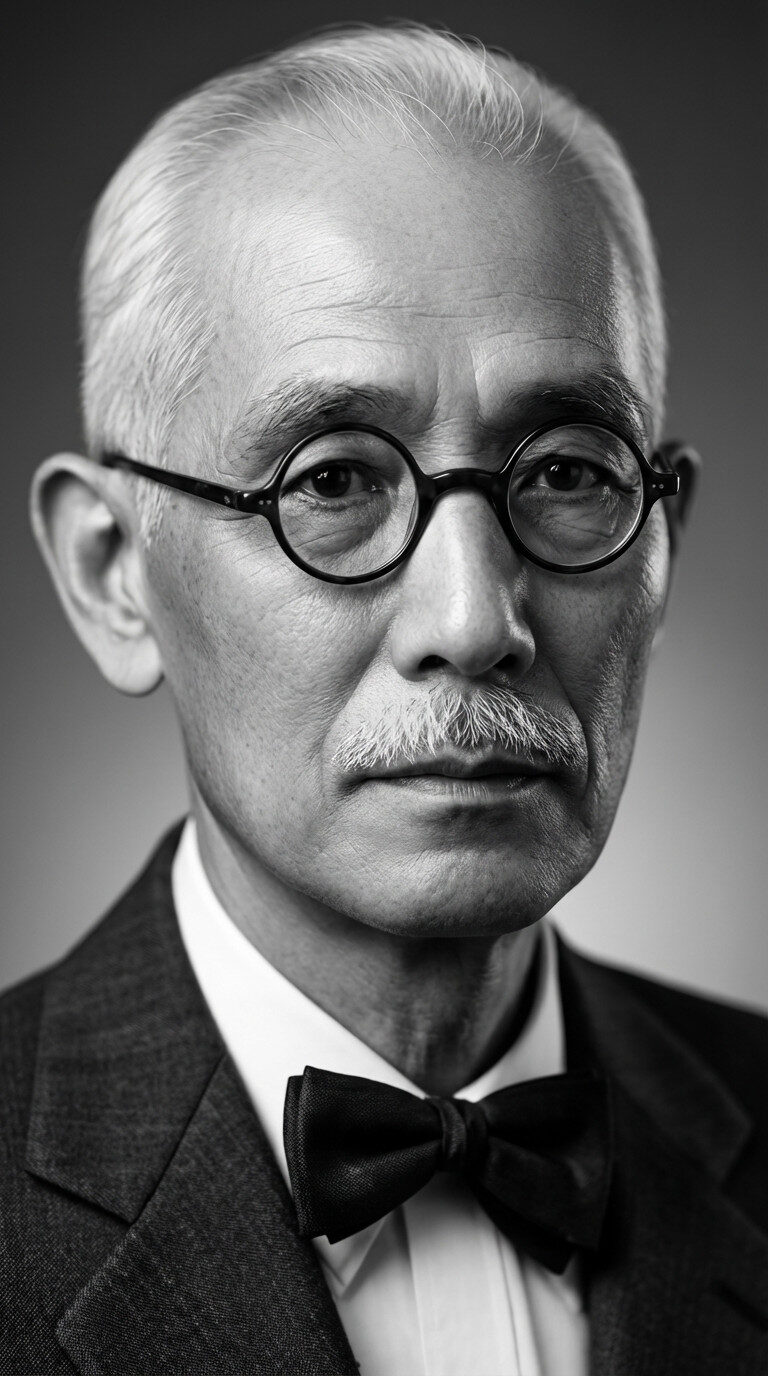
On May 11, 1945, father Kokichi Betsui died at the age of 70 in Honolulu. Mother Yei lived until the age of 79, dying on January 28, 1960. They were buried at Nuuanu Memorial Park in Honolulu.
Right: Kokichi Betsui about 1930
On June 12, 1945, the University of Hawaii paid tribute to its 60 former students who were killed in the war, when a moment of silence was observed during the commencement exercises at 4:30 p.m. in the outdoor theater on campus. At the time, there were 1,204 members of the faculty and student body on active military service.
On April 21, 1946, the former VVV men held a memorial service for their seven members who were killed in action during the war. The ceremony was held at 3:00 p.m. at the Church of the Crossroads. Services were held for Daniel Betsui, Grover Nakaji, Howard Urabe, Akio Nishikawa, Robert Murata, Jenhatsu Chinen, and Hiroichi Tomita, all former UH students. The Reverend Mineo Katagiri of Nuuanu Congregational Church, presided. Hung Wai Ching, former secretary of the UH YMCA, was the speaker. The service included the presentation of specially printed and framed certificates for Gold Star Mothers. All former VVV members, friends, and the ASUH (Associated Students of UH) were invited.
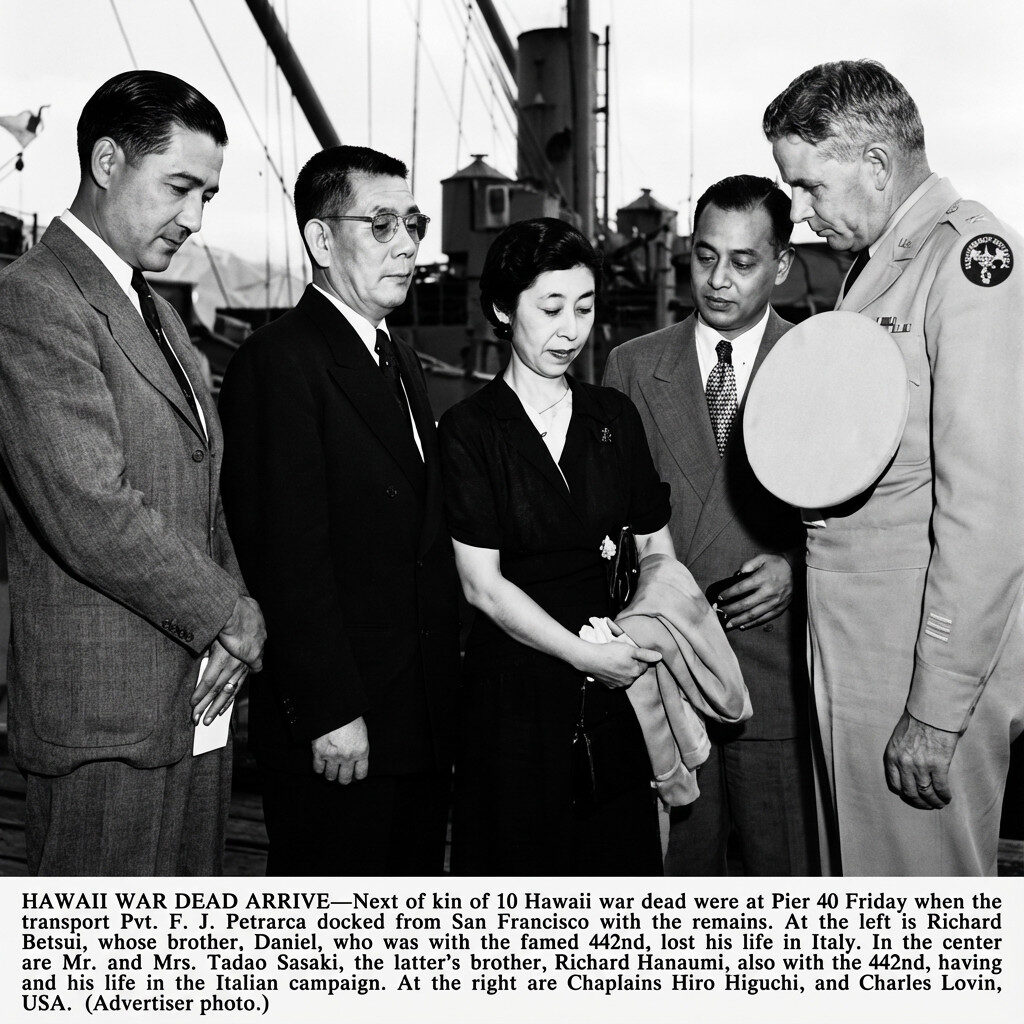
Above: Richard Betsui on the left, meeting the ship carrying his brother’s remains
In 1947, the US began to close most of its overseas wartime military cemeteries. Families were given the option of having their loved one reburied in one of the few remaining cemeteries overseas or returned home. The Betsui family chose to have Daniel returned to Hawaii. He arrived on January 20, 1950, aboard the USAT Private F.J. Petrarca at Pier 40 in Honolulu Harbor along with the remains of nine other soldiers. A brief welcome ceremony was held at the dock, conducted by Chaplains Major C.E. Lovin of the U.S. Army, Major John E. Hayes of the U.S. Air Force, and Lieutenant Junior Grade J.E. Zoller of the U.S. Navy. Afterwards, the flag-draped caskets were taken to the Army mausoleum at Schofield Barracks to await funeral arrangements.
On February 3, 1950, the remains of Sgt. Betsui arrived by Army ship at Port Allen, Kauai – along with the remains of three other servicemen. A short memorial was held at the dock. The Betsui family held a Memorial Service for their son the following evening at 7:00 p.m. at the Hanapepe Christian Church. His ashes were later returned to Oahu for burial.
Sgt. Daniel D. Betsui was buried at the National Memorial Cemetery of the Pacific at Punchbowl in Section Q, Site 1244, on April 4, 1950.
At the annual VVV Memorial Service on May 26, 1957, held at the Church of the Crossroads, the congregation sang one of Daniel Betsui’s compositions, The Men of the VVV.
Postscript. On May 14, 2012, the 70th anniversary of the formation of the Varsity Victory Volunteers, the University of Hawaii awarded posthumous degrees to the seven ROTC cadets, including Sergeant Daniel Betsui, who were killed during World War II while serving with the 442nd Regimental Combat Team. The diploma reads:
The Regents of The University of Hawai’i on the recommendation of the Faculty of University of Hawai’i at Mānoa have conferred upon
Daniel Den Betsui
the degree of Bachelor in Memoriam with all its privileges and obligations
Given at Honolulu, Hawai’i, this twenty-fifth day of March, two thousand twelve
Brother Richard K. Betsui served as a Captain in the 442nd and the MIS during World War II.
———-o———–
Researched and written by the Sons & Daughters of the 442nd Regimental Combat Team in 2025.