Soldier Story: Edwin H. Kokubun
Soldier Story
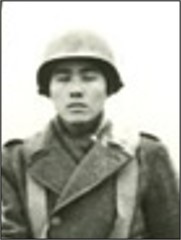
Edwin Hisashi Kokubun
Sergeant
442nd Regimental Combat Team
Antitank Company
Edwin Hisashi Kokubun was born on May 10, 1921, in Kaheka, Maui, Territory of Hawaii, the son of Tetsukichi and Isa Kokubun. His parents arrived in Hawaii on September 20, 1902, with their son on the Nippon Maru from the village of Sugita, Fukushima Prefecture, Japan.
Edwin had nine siblings: brothers Tetsu (born in Fukushima), Harry Tetsugo, Ted Tetsugi, Kenneth Yoshio, and Herbert Tetsuo; and sisters Kaneya, Miriam Otsugi, Margaret Kimiyo, and Ruth Tokie.
In 1930, the family was living in Paia, Maui, and father Tetsukichi was a foreman on the sugar plantation. By 1940, Tetsukichi had died and Edwin was living with his family in the Libby (pineapple) Cannery Camp. He was working for the cannery, as was elder brother Harry who was a machinist. Also with them were cousins Walter and Edward, and sister Miriam Aiona with her children Clarence and June.
Edwin signed his draft registration card on February 16, 1942, at Local Board No. 3 at the Paia Mill. His point of contact was his mother Isa Kokubun. They lived in Haiku where he was employed by Libby, McNeill & Libby at the Haiku (pineapple) Cannery warehouse. Edwin was 5’10” tall and weighed 155 pounds.
Kokubun enlisted in the U.S. Army on March 23, 1943. He had completed one year of high school and his occupation was given as “Semi-skilled mechanic/repairman.” He was sent with the other new soldiers to the “tent city” known as Boomtown at Schofield Barracks on Oahu.
The new soldiers were given a community farewell at Iolani Palace on March 28, 1943, prior to sailing on the S.S. Lurline on April 4 for the mainland. After arrival at Oakland, California, they were sent by train to the 442nd RCT at Camp Shelby, near Hattiesburg, Mississippi.
Private Kokubun was assigned to the 442nd’s Antitank Company. Basic training for the 442nd soldiers began on May 10 and lasted until August 23. On October 20 platoon and company training began and lasted about one month. Afterwards, training continued in the field as they all learned to coordinate and work together.
The final phase of training before maneuvers involved working in the field with the artillery. Finally, on January 28, 1944, the “D” Series maneuvers began in DeSoto National Forest in Mississippi, conducted by the 69th Infantry Division. During these maneuvers, the 442nd worked through six “problems” – playing part of the Division during the first three problems and playing the enemy during the last three. By late February, everyone was back at Camp Shelby again.
After a year of basic, unit, specialized, and combat training and field maneuvers, Kokubun left with the Combat Team by train on April 22, 1944, for Camp Patrick Henry, Virginia. They sailed from nearby Hampton Roads on May 2 in a convoy of about 100 ships that had taken two days to form. Antitank Company sailed on the Liberty Ship S.S. Thomas Nelson Paige, where they shared a hold area of four-tiered bunks with the 442nd Service Company. The Combat Team arrived at the war-torn port of Naples, Italy, on May 28.
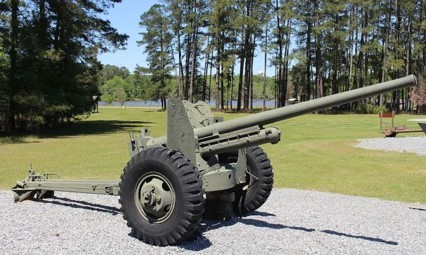
Above: 57mm antitank gun at Camp Shelby
After arriving, the Combat Team spent a week at a staging area in nearby Bagnoli before leaving on LSTs (Landing Ship Tanks) for Anzio on June 6. From the Anzio beachhead, they marched five miles inland to a bivouac area. On June 9, the 442nd was trucked through the recently liberated city of Rome to a large bivouac area near Civitavecchia, 44 miles north of Rome. There, they underwent additional training and final preparations for movement to the front lines.
On June 26, 1944, the 442nd RCT moved forward to the front lines for their first combat engagement near Suvereto – in the Rome-Arno Campaign. Each of Antitank Company’s three gun platoons was attached to one of the 442nd’s three infantry battalions. At times, however, the mountainous terrain made it impossible to use Antitank Company’s 57mm guns. When this happened, the Antitank men were used as litter bearers and ration carriers.
One success after another saw the 442nd RCT continuously pushing the Nazis north 29 miles to the Cecina River.
On July 14, Antitank Company was pulled out of the battle lines and assigned to support the invasion of southern France, known as “Operation Dragoon. They were sent to bivouac near Lido di Roma, where they bivouacked at Gallera Airfield. They first underwent physical training to harden the men for an airborne invasion. On July 28, Antitank Company moved to Marcigliana Airfield north of Rome for final glider training. British Antitank 6-pound guns were substituted for their own 57mm guns, which were not suitable for glider loading, lashing, and unloading.
On August 3-4, the entire Antitank Company completed two tactical flights and was certified as glider troops, authorized to wear the Glider Badge. On August 5, they moved to another bivouac area south of Rome at Frascati. There, they awaited further orders and were officially attached to the 517th Parachute Infantry Regiment of the First Airborne Task Force.
On August 15, 1944, they took to the air in 44 towed glider planes. The three platoons were split up to support different elements of the 517th. As they reached the coast of France, at 3,000 feet – rather than the prescribed 100 feet – the gliders were cut off from their C-47 tug planes. Many pilots discovered as they approached the ground that all was not as shown in the aerial photos during the pre-flight briefing. This caused considerable confusion during landing. The ground was covered by grape arbors constructed of stout timber and the hedgerows were much higher than anticipated. This produced rough landings with nine men injured. The general opinion of the Antitank men was that:
It was a good thing that we didn’t know what we were getting into, because if we had to do it all over again you couldn’t get us to ride those flying boxcars.
Below: One of the gliders after landing the 517th and Antitank Company in France
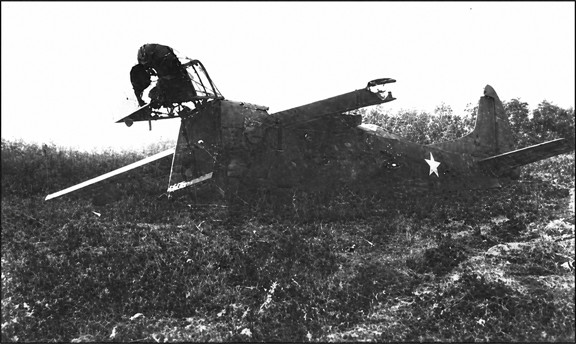
Right after landing near Les Arcs and Le Muy, crews unloaded and proceeded to the pre-arranged assembly area where they were hastily regrouped. On August 16, contact was made with the 7th Army’s 36th and 45th Divisions, that were the seaborne units of the invasion. Antitank Company’s mission was to protect the wide area of the exposed right flank of the 7th Army. All three battalions of the 517th were committed, with one Antitank Company platoon for each battalion. Antitank Company’s mission from this time on was to give anti-mechanized protection to the 517th.
By September 11, the 517th was overlooking the Maritime Alps town of Sospel, which was heavily defended by the Germans.
Antitank Company was engaged in combat until October 20 when they were relieved by the 552nd Antitank Company. They were withdrawn from the front lines and sent to a bivouac area on the coast near Nice. Two days later, they convoyed north to the Vosges Mountains.
On October 24, Antitank Company rejoined the 442nd RCT for the battles in the Rhineland-Vosges Campaign in the Vosges Mountains. They reached Bruyères on October 27 and were bivouacked next to the 442nd Service Company. Almost immediately, they were committed to action.
Due to the hilly, forested, snow-covered terrain, the use of their anti-tank guns was not feasible. Antitank Company was used as litter bearers, supply and ammunition packers, and even front-line riflemen. They suffered more casualties during their three weeks of combat in the Vosges than during the rest of their time during the war – three killed and 15 wounded.
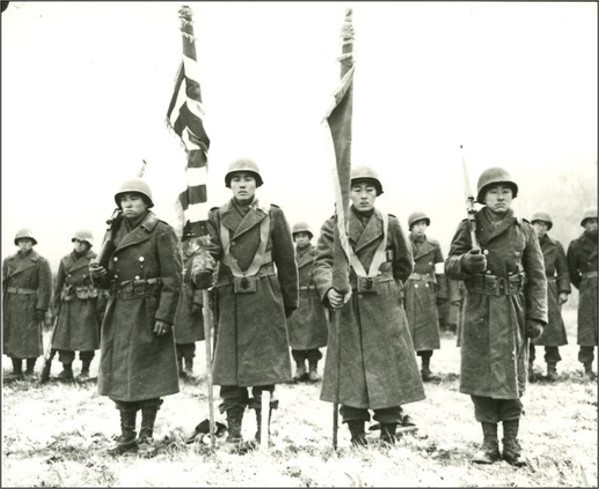
On November 12, Antitank Company was honored to serve as the Color Guard for the 442nd citation ceremony near Lépanges, five miles southwest of Bruyères. They had only just received their winter uniforms, as shown in the famous U.S. Army Signal Corps photo below.
Below: Honor Guard at 442nd Citation Ceremony near Lépanges, L-R: S/Sgt. Matsuo Kaminishi, Sgt. Edwin Kokubun, S/Sgt. Henry Yamane, and S/Sgt. Kunito Sadaoka
The following day, Antitank Company (with the exception of the kitchen crew) moved forward with 2nd Battalion and held a defensive line about 1/2 mile northwest of Langefosse until relieved by elements of the 103rd Division on November 17.
By this time, the 442nd had suffered such high casualties that it was no longer combat-effective. Thus, they were sent to the south of France for the Rhineland-Maritime Alps Campaign from November 1944 to March 1945. This was primarily a defensive campaign to guard the Franco-Italian border from incursion by the enemy in Italy. On November 19 Antitank Company was back on the road to the province that it had helped to liberate while attached to the 517th Parachute Infantry.
After a 2-day bivouac at St.-Jeannet, the Antitank’s 1st Platoon was sent to support the 100th Battalion that was in command of the high ridges above the coastal town of Menton, the last French locality before the border. Third Platoon was sent to run a mule pack train of supplies up to 3rd Battalion that was occupying positions above the battered town of Sospel. The rest of the company moved to a bivouac area near the railroad station at L’Escarène.
Due to the defensive nature of this campaign, the men were frequently given passes to enjoy the nightclubs and bars along the coast. For this reason, the Maritime Alps Campaign was nicknamed the “Champagne Campaign.”
By March 1945, the 442nd was again combat-ready and was sent back to Italy for the Po Valley Campaign. Their deployment to Italy was conducted as a closely guarded secret.
The mission of the 442nd was to conduct a surprise attack on the western end of the Gothic Line, a heavily fortified and defended line that ran across the Italian peninsula. The objective was to cause the Nazis to commit reserve forces in defense, thereby weakening their ability to withstand the subsequent main thrust of the Fifth Army to breakthrough the Gothic Line and capture Bologna.
The Combat Team (without its 522nd Field Artillery Battalion that had been sent to fight in the Central Europe Campaign in Germany) arrived at the Peninsular Base Section in Pisa on March 25. Antitank Company was issued new 57mm guns and spent time at their bivouac near the walled city of Lucca in test-firing them. However, as the steep mountains meant the use of their guns was again not feasible, when they moved to the front lines they were assigned to the infantry battalions as litter bearers. Antitank men also served in many other capacities: rations and ammunition carriers to the front lines, mine-sweeping the roads, manning roadblocks, guarding bridges, and even carrying rifles at Hill 706, Mount Pizzacuto, and Mount Uccelliera.
The 442nd was so successful in its initial surprise attack on the Germans that it continued moving north, taking one strongpoint after another. Antitank Company was responsible for blocking the roads leading into the town of Massa from the east. By April 10, the 442nd crossed the Frigido River north of Massa and pushed ahead to occupy the high ground above the town of Carrara. On April 26, the company finally was able to revert to its initial purpose. First and Third Platoons supported the 100th and 3rd Battalions, respectively, in the event of a mechanized enemy attack. Second Platoon went to support 2nd Battalion the following day.
By April 28, the 442nd was in Genoa and the fighting was nearing an end. On May 1, Antitank Company moved 55 miles north to Alessandria and the next day the Germans in Italy surrendered, a week before the rest of the German forces surrendered.
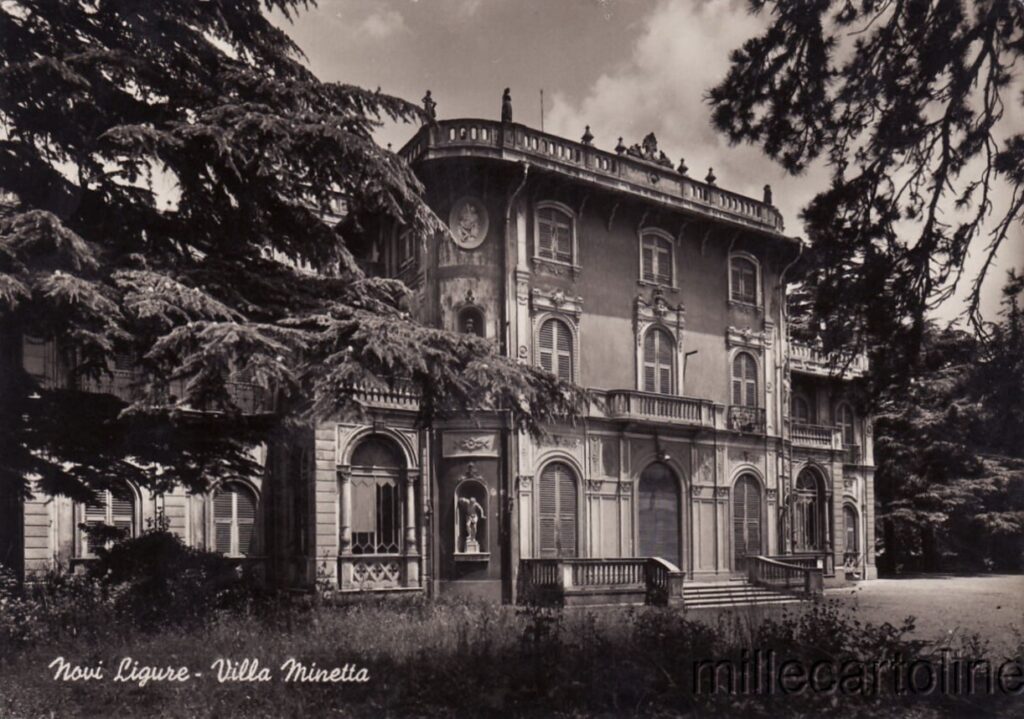
On May 4, the 442nd went into bivouac at Novi Ligure, where the entire Antitank Company occupied Villa Minetta, a large mansion owned by an Italian nobleman. On May 13, they participated in a citations review by Lieutenant General Lucian K. Truscott Jr. and Major General Edward M. Almond.
Below: Villa Minetta
The 442nd soon was sent to Ghedi Airfield near Brescia and again living in their pup tents. While most of the 442nd was assigned to process and guard thousands of German prisoners of war, Antitank Company posted guards in the internal regimental area. In addition, the Army Educational Program and intra-mural sports were instituted. Antitank Company formed a softball team that won the regimental championship.
On June 14, they were sent to Lecco at Lago di Garlate where they enjoyed the lake and the beautiful countryside. This did not last long, however, and Antitank Company was the first group to leave, on July 7. They went by truck 270 miles south to establish a bivouac at Coltano di Pisa, where the rest of the 442nd would soon follow and set up bivouac areas in the Pisa, Livorno, and Tombolo areas. Their occupation duties were to guard military installations in the area and also guard the POWs and supervise their work details.
For his military service, Edwin Hisashi Kokubun received the following awards and decorations: Bronze Star Medal with oak leaf cluster, American Campaign Medal, European-African-Middle East (EAME) Campaign Medal with one silver star and the bronze arrowhead device, World War II Victory Medal, Army of Occupation Medal, Distinguished Unit Badge, Combat Infantryman Badge, and Glider Badge. The silver star device on the EAME Campaign Medal indicated combat in five campaigns and the arrowhead device indicated participation in the glider-borne invasion of Southern France.
Kokubun was posthumously awarded the Congressional Gold Medal on October 5, 2010, along with the other veterans of the 442nd Regimental Combat Team. Conferred by the U.S. Congress, the award states: “The United States remains forever indebted to the bravery, valor, and dedication to country these men faced while fighting a two-fronted battle of discrimination at home and fascism abroad. Their commitment and sacrifice demonstrate a highly uncommon and commendable sense of patriotism and honor.”
Sgt. Kokubun was among the 833 returning war veterans who arrived on the USAT Evangeline on December 19, 1945, at Pier 24, in Honolulu Harbor’s Kapalama Basin. The men were allowed to mingle with their family and friends on the pier for about an hour. They were then taken by bus to Fort Kamehameha for processing, and instructions to return soon for discharge. He was discharged from the U.S. Army on January 3, 1946, in Honolulu.
In 1946, Edwin married Michie Muroshige (born September 1, 1921), the daughter of Gosazuchi and Tomo Muroshige of Kipahulu, Maui.
Kokubun sailed on December 21, 1946, on the S.S. Matsonia from Honolulu, arriving on December 26 at Los Angeles, California. He and his wife arrived back in Honolulu on November 5, 1947, aboard the S.S. Matsonia from San Francisco. They lived in Maui and over the years raised a family of three sons.
In 1964, Edwin and his family were living in Wailuku when his mother Isa Kokubun died at the age of 86 at Maui Memorial Hospital. She was buried in the Paia Mantokuji Mission Cemetery. Her survivors were: on Maui – Tetsu, Miriam (Mrs. Aiona), and Kimiyo (Mrs. Chozo Tanji) in Kahului and Harry in Paia; in Honolulu – Herbert and Ruth (Mrs. Hakaru Shishido); and in California – Ted and Kenneth in Los Angeles.
On October 7, 1974, it was announced in the Honolulu Star-Bulletin that Edwin Kokubun, a Maui Electric Company supervisor, was to be honored by the American Cancer Society as “Volunteer of the Year.” The award was given for his organizing the Maui Ostomy Association. At the time of the award he was serving as its President. The award was given at the Society’s annual dinner held at the Pacific Ballroom, Ilikai Hotel in Honolulu.
In November 1997, the four Antitank veterans who had been photographed in November 1944 met again. The occasion was the opening of a special 442nd RCT photo exhibit at the Fort DeRussy Army Museum in Honolulu.
Their reunion was the first time they had all met since the war, although Kaminishi, Yamane, and Sadaoka lived on Oahu and Kokubun on Maui. Edwin was interviewed by a reporter for the Honolulu Star-Advertiser and recalled how when the photo was taken he had his eyes closed and was exhausted simply standing for the ceremony:
All I was thinking was that it was cold and I wanted to get out of there. We had all fought for four days straight. It’s a blessing we are all still here. Although we all live in Hawaii, we kind of lost touch after the war, trying to get on with our lives.
Below: 1997 Antitank Honor Guard reunites in Honolulu; L-R: Matsuo Kaminishi, Edwin Kokubun, Henry Yamane, and Kunito Sadaoka, standing in the same order as in 1944
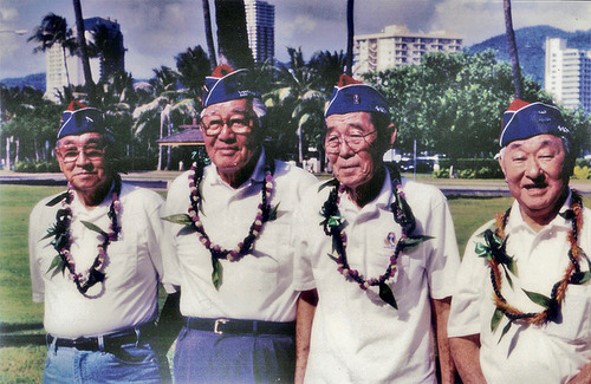
Yamane said that after that famous 1944 photo, he had collapsed, complaining of dizziness. He was taken to a hospital, treated, and released back to his company.
In the typical self-effacing way of the 442nd Veterans, Kokubun said that he had “just been following orders,” and:
I do tell my grandchildren that that photo will be on display in the Smithsonian. Maybe nobody will know my name, but it’s nice to know that it will hang there forever.
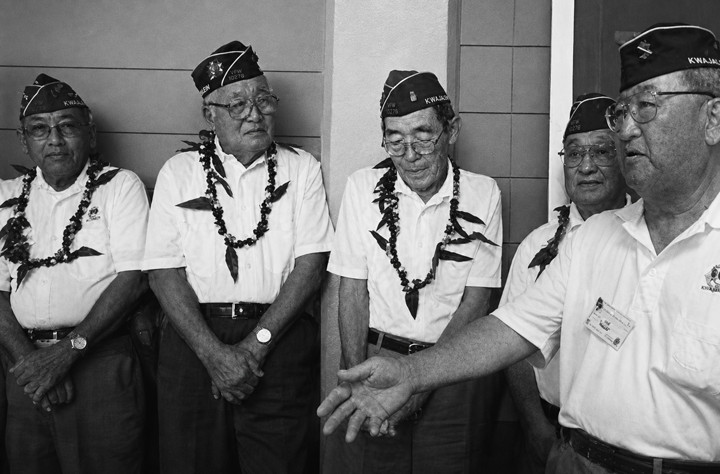
Also present at Fort DeRussy that day was Tak Senzaki, who was invited to relate to reporters the “Rescue of the Lost Battalion” while in the Vosges. This took place October 27 – 30, 1944, and is considered one of the top 10 battles of World War II.
Below: Kaminishi, Kokubun, Yamane, and Sadaoka with Tak Senzaki (I Company) at Fort DeRussy
Edwin’s wife Michie Kokubun died at the age of 79 on June 3, 2003, in Wailuku. Her funeral service was held at the Wailuku Hongwanji Mission.
At some point after her death, Edwin H. Kokubun moved to Pearl City, Oahu. He died at the age of 88 on February 23, 2010, at St. Francis Hospice West in Honolulu. He was inurned with his wife at the National Memorial Cemetery of the Pacific (Punchbowl), Court 6-A, Row 100, Site 154. Edwin and Michie were survived by three sons and three grandchildren.
Researched and written by the Sons & Daughters of the 442nd Regimental Combat Team in 2026