Soldier Story: George Katsuya Sawada
Soldier Story
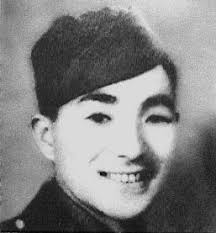
George Katsuya Sawada
Technician 4th Grade
442nd Regimental Combat Team
Medical Detachment
George Katsuya Sawada was born in Hilo, Territory of Hawaii on February 21, 1915, to Frank Shinsaku Sawada and Kabu (Watanabe) Sawada, both originally from Niigata, Japan. He was the eldest of three children followed by Fred Hiroshi and Catherine. He went to Japan in May 1918 and returned to the United States in 1925, when his family settled in Seattle, Washington. George was both an exceptional student and an outstanding swimmer. His mother unfortunately died of tuberculosis when he was thirteen, leaving him to help raise his siblings.
After graduating from Franklin High School in Seattle, Washington, George went to the University of Washington – Seattle, where he was a member of the Pi Mu Chi Premedical Honor Society. He graduated in June 1941 and entered the medical school there, but his studies were unfortunately cut short when his family was forcibly removed to the Puyallup Assembly Center in Washington. They were again relocated to Minidoka WRA concentration camp in Hunt County, Idaho. George volunteered at the Camp Hospital.
When the Army began accepting Japanese-American volunteers for the 442nd Regimental Team in March 1943, George enlisted and was sent to Camp Shelby, Mississippi for training. His prior medical training assured that he was assigned to the Regiment’s Medical Detachment. In February he traveled on furlough back to Minidoka where he married Yuriko Takahashi on Sunday, 5 February. The Minidoka Irrigator reported on the wedding and said he and his new wife departed on 9 February to return to Camp Shelby.
George Sawada departed Camp Shelby with the 442nd on on April 22, 1944, by train for Camp Patrick Henry, Virginia. On May 2, they sailed from nearby Hampton Roads in a convoy of over 100 ships bound for the Theater of War.
After a lengthy crossing, the 442nd arrived at Naples, Italy, on May 28 to join in the Rome-Arno Campaign. The Combat Team spent the next two weeks at a bivouac at Staging Area No. 4 in nearby Bagnoli.
The 442nd then left on LSTs and LCIs on June 6 and arrived at the recently liberated Anzio beachhead the next day. Finally, on June 9 they headed out in a convoy through the city of Rome, which had just been liberated on June 4, for a large bivouac near Civitavecchia, about 50 miles north. There they made final preparations to advance to the front lines.
The 442nd entered combat in the Rome to Arno Campaign on June 26, 1944, near Suvereto. They encountered some heavy fighting as they continuously pushed the Germans up the Italian peninsula. During the battle for Hill 140, George Sawada was killed on July 5, 1944, by a Nazi sniper while he was serving as a medic for the 100th Battalion.
For his service, Technician 4th Grade was awarded the Bronze Star Medal, Purple Heart Medal, American Campaign Medal, European-African-Middle Eastern Campaign Medal with one bronze star, World War II Victory Medal, and Combat Medic Badge. He was posthumously awarded the Congressional Gold Medal on October 5, 2010, along with the other veterans of the 442nd Regimental Combat Team. Conferred by the U.S. Congress, the award states: “The United States remains forever indebted to the bravery, valor, and dedication to country these men faced while fighting a 2-fronted battle of discrimination at home and fascism abroad. Their commitment and sacrifice demonstrates a highly uncommon and commendable sense of patriotism and honor.ˮ
George is buried at the Evergreen-Washelli Cemetery in Seattle.