Soldier Story: Harry Masao Nakayama
Soldier Story
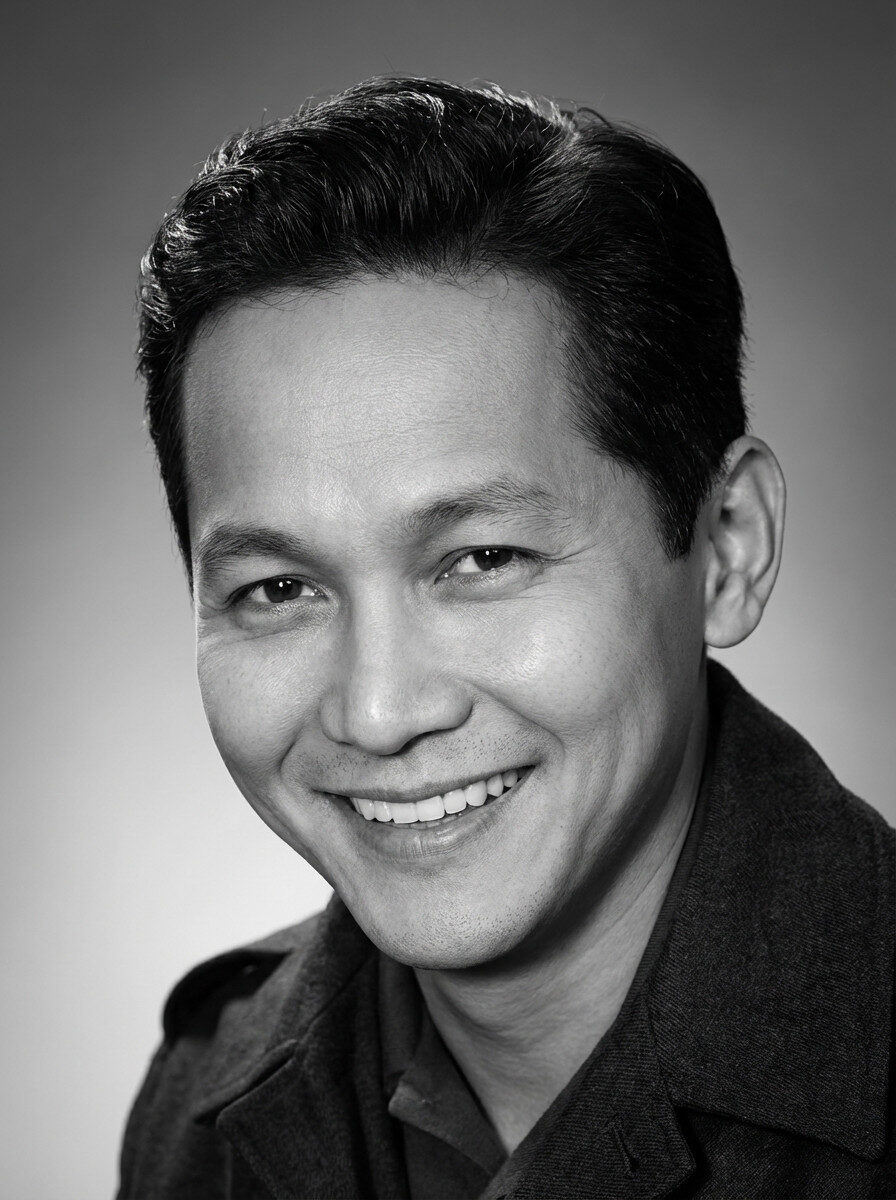
Harry Masao Nakayama
Corporal
442nd Regimental Combat Team
3rd Battalion, Headquarters Company
Harry Masao Nakayama was born in Haiku, Maui, Territory of Hawaii, on August 11, 1922, to Isaburo and Yoshi (Takenaka) Nakayama. He had seven siblings: brothers Motoye (died in 1926 at age 7) and Yoshio, sisters Hinayo, Fuyuko, and Yuriko, and step-sister Masako Takenaka from his mother’s first marriage.
Isaburo and Yoshi arrived from Japan in 1889 and 1913, respectively. Isaburo worked for a while in Kohala on Hawaii island prior to moving to Maui.
In 1920, Isaburo was working on a ranch and the family lived in Haiku. In 1930 the family was living in Makawao District at Kuiaha in Haiku. Father Isaburo worked on a sugar plantation.
By 1940, Masao was living with his sister Fuyuko and her husband Mitsugi Imamura in Kahului. Mitsugi was a truck driver for a hauling company, and Masao worked as a fountain clerk at a retail drug store. He briefly worked as a carpentry instructor at the high school.
Masao signed his draft registration card on June 30, 1942, Local Maui Board No. 2 in Paia. He lived with his family in Haiku (P.O. Box 171) and his father was his point of contact. He was employed by the Kahului Railroad Company, 450 Main Street, Kahului. He was 5’3½” tall and weighed 111½ pounds.
Harry Masao Nakayama enlisted in the U.S. Army on March 23, 1943. His civilian occupation was “Paymasters, payroll clerks, and timekeepers.” He had completed four years of high school.
He was sent along with the other volunteers to Schofield Barracks on Oahu to the “tent city” known as Boom Town. On March 28, they were given a community farewell at Iolani Palace. On April 4, they sailed on the S.S. Lurline to San Francisco. After a train trip across the US, the new soldiers of the 442nd arrived at Camp Shelby, Hattiesburg, Mississippi, for training.
Harry was assigned to the 3rd Battalion, Headquarters Company. While at Camp Shelby, on September 3, 1943, it was reported in the Hattiesburg American that he was promoted to Technician 5th Grade. After basic training, the men were given a two-week furlough before unit training began.
During their time off, Nakayama was one of many men who visited Washington DC, as reported in the Honolulu Star-Bulletin on October 4, 1943. He and Mitsugi Unemori, Kazufumi Uchiyama, and Edwin Tani were asked for their opinions on the news that the 100th Infantry Battalion (Separate) was finally in combat in Italy. As the article reported, the men all had typical reactions:
…the entire team is deeply pleased that fellow AJAs are facing the Axis on the battlefield at last…[and] welcomed the news of Hawaii men at Salerno as reassurance that the army will fulfill its promise of battle service made when the opportunity to volunteer was offered.
After over a year of basic, unit, combat, and specialty training and field maneuvers, Nakayama left Camp Shelby with the 442nd Regimental Combat Team on April 22, 1944, by train for Camp Patrick Henry, Virginia. They shipped out to the Theater of War on May 2, 1944, from nearby Hampton Roads in a convoy of over 100 ships.
On May 20, their ships passed the Strait of Gibraltar and were in the Mediterranean. The 442nd arrived at Naples, Italy, on May 28. Some men marched the 10 miles to nearby Bagnoli, some were transported from the railroad station on small inter-urban trains, and some went by trucks. Once at Staging Area No. 4, they set up bivouac and began to uncrate their supplies. Waterproofing was removed from all metal parts and weapons made ready for combat. Some soldiers received day passes to Naples and Pompeii.
On June 6, the 442nd left on LSTs and LCIs and arrived at Anzio the next morning. They debarked into the rubble of the recently liberated town and marched about five miles to their bivouac area. That night German planes raided the Anzio supply dumps and the men witnessed the aerial fireworks.
The 442nd moved out of Anzio in the late afternoon of June 9 to convoy through Rome. Many trucks became hopelessly lost in the city. The last trucks finally arrived in the middle of the night more than 24 hours late, at their large bivouac near Civitavecchia, abut fifty miles north of Rome, on June 11.
The next ten days were spent in an arduous physical conditioning program including long marches over mountainous terrain, brushing up on marksmanship and small-unit tactics. The 442nd was now part of the 34th Infantry Division and the 100th Battalion was attached to the 442nd as its 1st Battalion, which had been left at Camp Shelby as a training cadre for new soldiers.
On June 26, 1944, the 442nd RCT moved forward to the front lines for their first combat engagement. They were in heavy fighting as they liberated towns from the enemy. The most fierce battle was at Hill 140, just north of the Cecina River. After driving the enemy north to the Arno River, the Combat Team was pulled from the lines and sent to Naples for shipment to France, to fight in the Rhineland-Vosges Campaign. They arrived at Marseilles on September 29 after a two-day voyage, and bivouacked at nearby Septèmes prior to traveling over 500 miles north by truck or rail boxcars to the Vosges Mountains.
Nakayama was in combat for the next month during the bitter fighting to liberate the important rail and road junction of Bruyères, neighboring Biffontaine and Belmont, and the “Rescue of the Lost Battalion,” the 1st Battalion, 141st (Texas) Infantry that had advanced beyond the lines and was surrounded on three sides by the enemy. The weather was cold, wet, snowy, and miserable as the men fought in the heavily wooded forests still in their summer uniforms. They were subjected to living in foxholes, and incoming artillery raining down on them in “tree bursts.”
After the fierce fighting in the Vosges, the 442nd was at half strength, and was sent to the south of France. There, they could rebuild to full combat strength while participating in the Rhineland-Maritime Alps Campaign, which was mostly a defensive position guarding the French-Italian border from attack by the German Army in Italy. The 442nd was there from November 23, 1944, until March 15, 1945, when they were relieved and moved in relays to the new staging area at Marseilles. On March 20-22, the 442nd (without its 522nd Field Artillery Battalion who were sent to Germany) left France to fight in the Po Valley Campaign for the final push to defeat the Nazis in Italy. They arrived at the Peninsular Base Section in Pisa on March 25 and were assigned to Fifth Army.
The objective of the 442nd was to execute a surprise diversionary attack on the western anchor of the German Gothic Line. This elaborate system of fortifications had been attacked in the fall of 1944, but no one had yet been able to pry the Germans loose from the western end. The Gothic Line in this area was hewn out of solid rock, reinforced with concrete, and constructed to give all-around protection and observation. The Germans were dug into mountain peaks rising almost sheer from the coastal plain, save for scanty scrub growth after being stripped bare of vegetation by the Germans.
The Combat Team left their initial staging area and moved to a bivouac at San Martino, near the walled city of Lucca. Starting on April 3, the 442nd conducted a surprise attack on the Germans at Mount Folgorito. By April 6 the 2nd Battalion had gained the ridge of Mount Folgorito and was poised for an attack on Mount Carchio and Mount Belvedere to the north, the peak that looked down on the city of Massa. By noon, F Company had reduced Mount Carchio while the rest of the 2nd Battalion began working on the wide, rolling top of Mount Belvedere, which was defended by the veteran troops of the crack Machine Gun Battalion Kesselring. The enemy battered the 442nd attackers with a steady stream of mortar fire, to no avail, and were defeated.
After these battles, the 442nd moved farther north, finally taking Aulla on April 25, penetrating as far north as Torino. The 442nd’s diversionary attack was relentlessly pursued by the Combat Team, resulting in a complete breakthrough of the Gothic Line in the west. Despite orders from Hitler to fight on, the German forces in Italy surrendered on May 2, 1945, a week before the rest of the German forces in Europe surrendered.
Nakayama was with the 442nd while in occupation first at Novi Ligure, then at Ghedi Airport guarding and processing German prisoners, and next at Lecco where they enjoyed the countryside and Lake Garlate. They returned to the Livorno/Pisa/Florence area on July 12 for further POW and military installation guard duty. While there, men of the 442nd were able to participate in the information, education, sports, and recreation programs the Army set up to keep everyone fully occupied. Nakayama took advantage of this and enrolled in one of the education programs offered.
For his military service, Corporal Harry Masao Nakayama was awarded the Bronze Star Medal with oak leaf cluster, Good Conduct Medal, American Campaign Medal, European-African-Middle Eastern Campaign Medal with four bronze stars, World War II Victory Medal, Army of Occupation Medal, Distinguished Unit Badge, and Combat Infantryman Badge. He was awarded the Congressional Gold Medal on October 5, 2010, along with the other veterans of the 100th/442nd Regimental Combat Team. Conferred by the U.S. Congress, the award states: “The United States remains forever indebted to the bravery, valor, and dedication to country these men faced while fighting a two-fronted battle of discrimination at home and fascism abroad. Their commitment and sacrifice demonstrate a highly uncommon and commendable sense of patriotism and honor.:
On December 17, 1945, Nakayama was among 551 returning veterans who arrived aboard the USAT Aconcagua at Honolulu, docking at Pier 26 at 8:00 a.m. The ship was met by a large throng of family and friends who had come with lei and gifts. However, they were roped off from the pier and the soldiers were whisked away in Army trucks to Fort Kamehameha for processing. Nakayama was discharged from the U.S. Army on December 23, 1945.
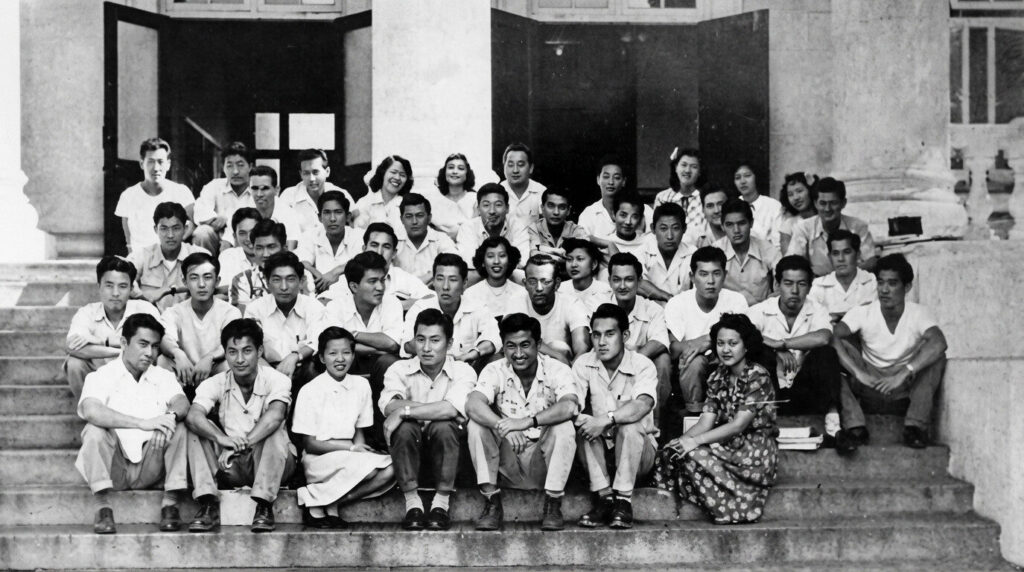
Above: Commerce Club in Ka Palapala yearbook, 1949;
Nakayama is top row, 4th from left
Harry Nakayama enrolled in the University of Hawaii (UH) on the GI Bill in 1947. He had his name officially changed from Masao Nakayama to Harry Masao Nakayama, by order of Governor Ingram M. Stainback, as published in the Honolulu Star-Bulletin on October 10, 1947.
He graduated in June 1950 from UH with a Bachelor of Arts degree.
Below: Harriet Nakayama, Leigh High School faculty, 1967
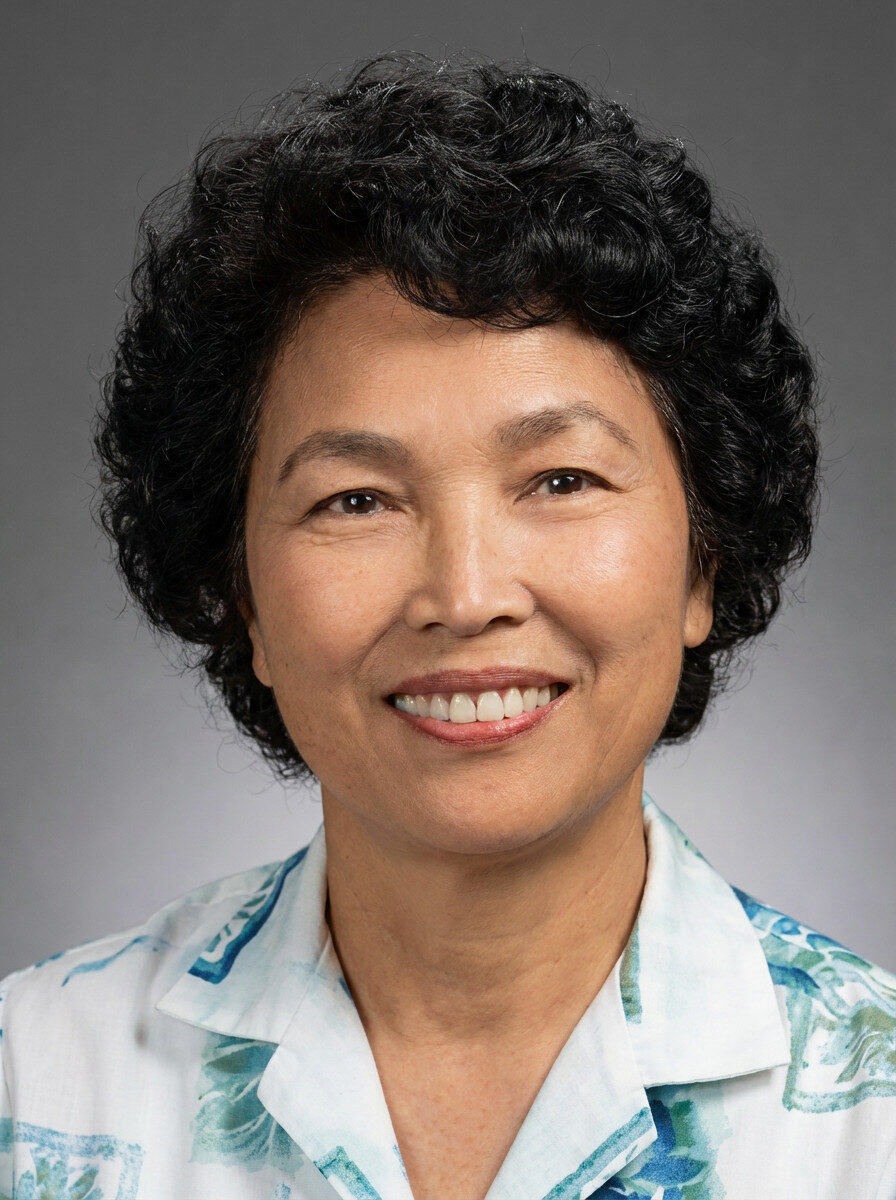
He married Harriet Tamiyo Shiramizu (born January 1, 1926). She was the daughter of Masajiro and Koma (Shimomura) Shiramizu of Puunene, Maui. They settled at 725 8th Avenue in Honolulu. Over the years, the couple raised a family of two daughters.
After seven months of participation in the 442nd Veterans Bowling League, Nakayama and his team – Island Lumber and Hardware – won the 442nd championship for 1953, as reported in the October 2 Honolulu Star-Bulletin.
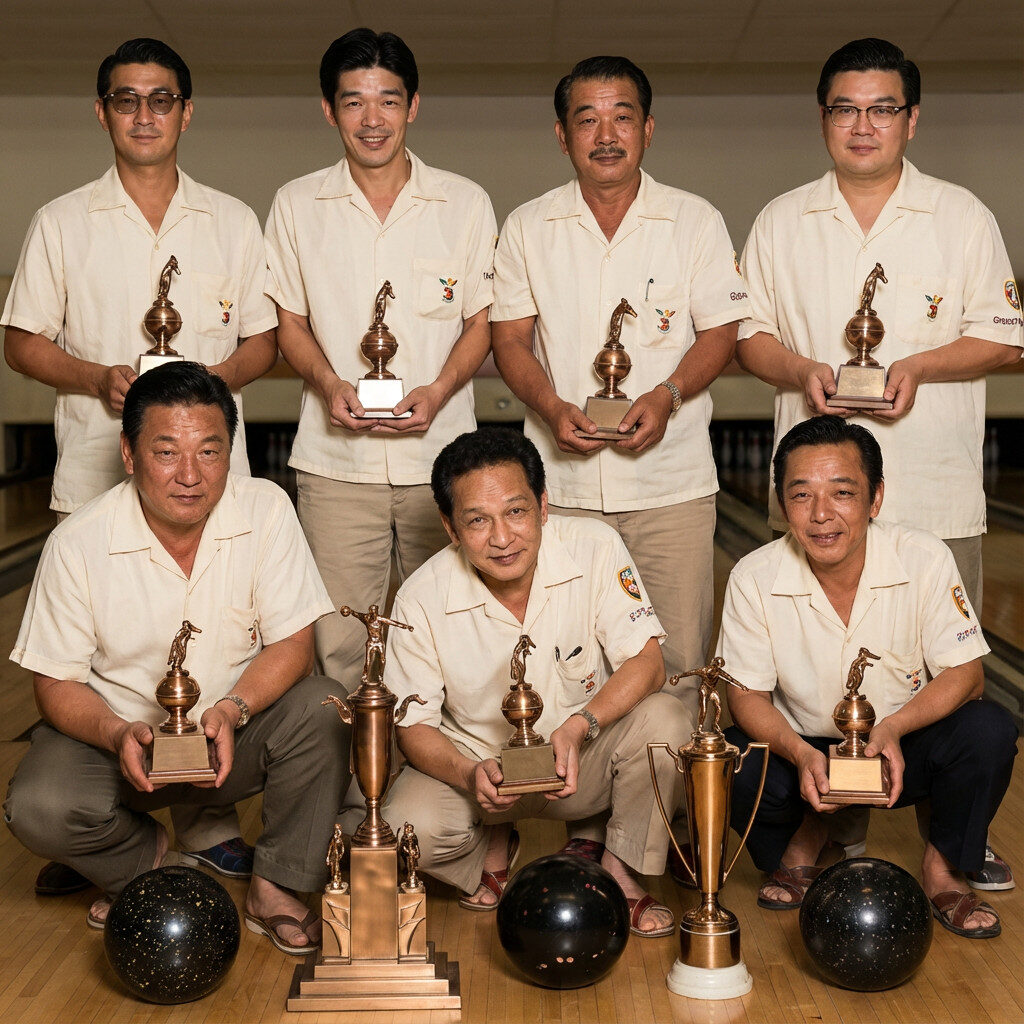
Above: Front L to R: Isamu Furuya, Harry Nakayama, Tokujo Ige. Back L to R: Shiro Morioka, Minoru Tamashiro, Yoshiro Iwamoto (captain), Yoshi Tsuetsugu
Nakayama and his family moved to California about 1957, in order for him to pursue a career in the state’s computer industry. They lived in the Del Rio neighborhood of San Bernardino. About 1964 the family moved north to San Jose, where Harry began working for Lockheed. He later worked at the Ames Research Laboratories (part of NASA) until his retirement. Harriet was employed as a librarian at Leigh High School in San Jose.
Harry’s father Isaburo Nakayama died on November 20, 1958, in Kahului. His mother Yoshi died on June 11, 1980, in Kahului.
Harry Masao Nakayama died at the age of 94 on October 27, 2016, in Los Gatos, Santa Clara County, California. He was inurned at the National Memorial Cemetery of the Pacific at Punchbowl in Court 13A, Row 100, Site 101. On his marker is inscribed: Cpl, 442 Inf Regt, Go For Broke. Survivors included his wife Harriet, two daughters, three grandchildren, sisters Masako (Mrs. Hiyayoshi Takahashi), Nancy Fukuyo (Mrs. Mitsuji Imamura), and Yuriko (Mrs. Naoki Misawa). His brother Yoshio and sister Hinayo (Mrs. Hisayuki Inouye) predeceased him. Harry’s obituary noted that “he was a quiet and modest man who will be remembered for his dry wit and sense of humor.” As of this writing, Harriet Nakayama is living in California and has celebrated her 100th birthday.
Researched and written by the Sons & Daughters of the 442nd Regimental Combat Team in 2025, with assistance by his daughter, who is a member of the Sons & Daughters.