Soldier Story: Henry Kiyoshi Hori
Soldier Story

Henry Kiyoshi Hori
Private First Class
442nd Regimental Combat Team
2nd Battalion
Headquarters Company/G Company
Henry Kiyoshi Hori was born on September 7, 1920, in Honolulu, Oahu, Territory of Hawaii. He was the eldest of six children born to Kaihei and Kiwa (Kawata) Hori. His siblings were Isamu Sami, John Mitsuo, Dorothy Kimiko, Dolores Asae, and Mary Mitsuko.
Kaihei emigrated from the village of Yamamuro, Kita District, Kumamoto Prefecture, Japan, arriving in Honolulu aboard the Korea Maru on December 11, 1905. Kiwa arrived on the Korea Maru on October 5, 1919. Kaihei initially worked as a day laborer. He worked for Otsuki Contractors, 1321 10th Avenue in Honolulu.
Kiyoshi, as Henry was then known, attended Liliuokalani Intermediate School. On June 4, 1939, he graduated from McKinley High School.
Henry registered for the draft on February 14, 1942, at Local Board No. 2, 3563 Waialae Avenue, Honolulu. He was working for the Provisional General Hospital #2, St. Louis College, in the receiving office. He was living with his family and their home was located at the corner of Waialae Avenue and Oili Road. His point of contact was his mother, Kiwa; he was 5’6” tall and weighed 118 pounds.
On March 24, 1943, Henry enlisted in the U.S. Army. He was a carpenter’s apprentice, and had graduated from high school. He was sent to the “tent city” known as Boom Town at Schofield Barracks, with the other 442nd volunteers.
On March 28, the new soldiers were given a community farewell at Iolani Palace. On April 4, they sailed on the S.S. Lurline to Oakland, California. About this time, Henry had filed an application to have his name officially changed from Kiyoshi Hori to Henry Kiyoshi Hori. The petition was approved by Governor Ingram M. Stainback on April 12, 1943.
After a train trip across the US, the new soldiers of the 442nd arrived at Camp Shelby, Mississippi, for training. Pvt. Hori was assigned to the 2nd Battalion, Headquarters Company. At some point during his service, Pvt. Hori was reassigned to G Company.
Following a year of basic, unit, combat, and specialized training and field maneuvers, Henry left Camp Shelby with the Combat Team on April 22, 1944, for Camp Patrick Henry, Virginia. They shipped out to Europe on May 2, 1944, from nearby Hampton Roads in a convoy of over 100 ships.
Once they arrived in the Mediterranean, the USAT Elbridge Gerry, which carried all of 2nd Battalion except Company E, left the convoy and headed for port in Oran, Algeria, arriving on May 21. They were there for two weeks, offloading cargo and then guarding Army vehicles and supplies.
Meanwhile, the rest of the 442nd had arrived at Naples, Italy, on May 28. After time in bivouac at nearby Bagnoli, they left for Anzio, and finally arrived at a large bivouac near Civitavecchia, abut fifty miles north of Rome, on June 11.
Second Battalion left Oran on a British ship, HMT Samaria, on June 5 and arrived at Naples on June 9. They went to the bivouac area in nearly Bagnoli. While there, some of the men were issued day passes to visit Rome or Pompeii. They finally left Naples by LSTs on July 15 and went directly to Civitavecchia, arriving on June 17.
Hori and the 442nd entered battle in the Rome-Arno Campaign near Suvereto north of Civitavecchia on June 26 – with the objective of capturing the seaport city of Livorno 50 miles north. Over the next 15 days, the 442nd steadily pushed the Germans north along the western side of the Italian peninsula. The towns they captured, liberated, or – in the case of unopposed entry – were the first to enter, were: Suvereto and Belvedere on June 26, Sassetta on June 27, Molino a Ventoabbto on July 3, and Hill 140 in the vicinity of Castellina on July 9.
The Combat Team saw especially fierce fighting just north of the Cecina River at Hill 140 beginning on July 3. Captured Germans from the 36th SS Regiment reported that they had been ordered to “hold until the defenses at Pisa were completed.”
After driving the enemy north to the Arno River, the Combat Team was pulled from the front lines on September 6 and sent to Naples for shipment to France to fight in the Rhineland-Vosges Campaign. They arrived at Marseilles on September 29 after a two-day voyage, and bivouacked at nearby Septèmes prior to traveling over 500 miles north by truck or rail boxcars to the Vosges Mountains.
It was reported in the Honolulu Star-Bulletin on October 4, 1944, that Private Henry K. Hori of 1177 Oili Road was among the Hawaii soldiers who were recently wounded in the Mediterranean Area. The date, location, and nature of his wound were not found in our research; however, it was during the Rome-Arno Campaign.
After arriving at Charmont-devant-Bruyères in the Vosges on October 11, the 442nd began their initial mission of liberating the important road and rail junction of Bruyères on October 15. After accomplishing this on the 18th, they were given a short rest only to be ordered to join in the fight to rescue the 1st Battalion of the 141st (Texas) Infantry Regiment. Ordered to advance beyond the lines and surrounded by the enemy, the 141st was trapped. The 141st and other units had been unable to free the Texas men, so the 442nd was called in. The “Rescue of the Lost Battalion,” as it was later called, ended in victory for the 442nd, but at great loss of life.
Following the Vosges, Hori went with the 442nd for fighting in the Rhineland-Maritime Alps Campaign in southern France. They were in the area of Nice, Menton, and Sospel beginning on November 21. This was mostly a defensive position to guard against German incursion into France across the border with Italy.
While there, the men often had short passes to spend time in Nice relaxing or sightseeing. For this reason, the men nicknamed this period the “Champagne Campaign.”
On March 15, 1945, the 442nd was relieved and moved in relays to the new staging area at Marseilles. On March 20-22, the Combat Team (without its 522nd Field Artillery Battalion who were sent to Germany) left France to fight in the Po Valley Campaign for the final push to defeat the Nazis in Italy. They arrived at the Peninsular Base Section in Pisa on March 25 and were assigned to Fifth Army. The 442nd fought in the Po Valley Campaign in what was initially intended to be a diversionary attack up the west coast while the main thrust of the Allies in Italy was farther east.
The 442nd relentlessly pursued the enemy in their diversionary attack, resulting in a complete breakthrough of the Gothic Line in the west. Despite orders from Hitler to fight on, the German forces in Italy surrendered on May 2, 1945, a week before the rest of the German forces in Europe surrendered.
During the Po Valley Campaign, Pfc. Hori was wounded in April when he was hit by artillery fragments in his shoulder. The exact date and location were not found in our research.
After returning to his unit from the hospital, Hori remained in Italy for occupation duties – initially, processing and guarding German POWs at Ghedi Airfield, then the move to Lecco where they enjoyed Lake Garlate and the beautiful countryside, and finally to the Livorno/Pisa/Florence area for more guarding of POWs and military installations.
Henry Hori returned home on December 19, 1945, on the USAT Evangeline. He was among the 567 war veterans on the ship that docked at Pier 24 in Honolulu. After they disembarked, friends and family were allowed to visit with the men for one hour on the dock. Then the soldiers were sent on Army trucks to the Oahu Personnel Center at Fort Kamehameha for processing prior to their discharge at a later date.
Hori was discharged from the U.S. Army on December 29, 1945.
For his military service, Private First Class Henry Kiyoshi Hori was awarded the Bronze Star Medal with oak leaf cluster, Purple Heart Medal with oak leaf cluster, Good Conduct Medal, American Campaign Medal, European-African-Middle Eastern Campaign Medal with four bronze stars, World War II Victory Medal, Army of Occupation Medal, Distinguished Unit Badge, and Combat Infantryman Badge. He was posthumously awarded the Congressional Gold Medal on October 5, 2010, along with the other veterans of the 442nd Regimental Combat Team. Conferred by the U.S. Congress, the award states: “The United States remains forever indebted to the bravery, valor, and dedication to country these men faced while fighting a two-fronted battle of discrimination at home and fascism abroad. Their commitment and sacrifice demonstrate a highly uncommon and commendable sense of patriotism and honor.”
After the war, Henry worked at Hickam Air Force Base as a carpenter. He married Maizie Hisae Nagai on August 19, 1950. She was born on April 15, 1922, in Mountain View, Hawaii island, to Mr. and Mrs. Kajiro Nagai. The couple raised a family of two daughters. He was a member of the 442nd Veterans Club.
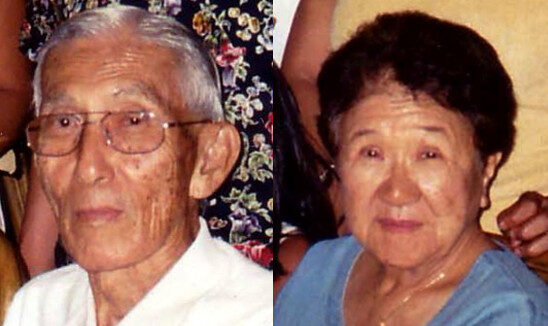
Above: Henry and Maizie Hori in later years
Henry K. Hori died at the age of 89 on October 27, 2009. He was predeceased by his wife Maizie, who had passed away on June 28, 2008. Survivors included his two daughters, three grandchildren, brother John Hori, and sisters Mrs. Dorothy Imamura, Mrs. Dolores Kaiwi, and Mrs. Mary Shimomura.
Henry and Maizie were inurned together at the National Memorial Cemetery of the Pacific at Punchbowl, C11-0, Row 100, Plot 123. On their plaque is inscribed “Together Forever.”
Researched and written by the Sons & Daughters of the 442nd Regimental Combat Team in 2022. Updated in 2026 with assistance by his daughter who is a member.