Soldier Story: Hidetoshi Tokusato
Soldier Story
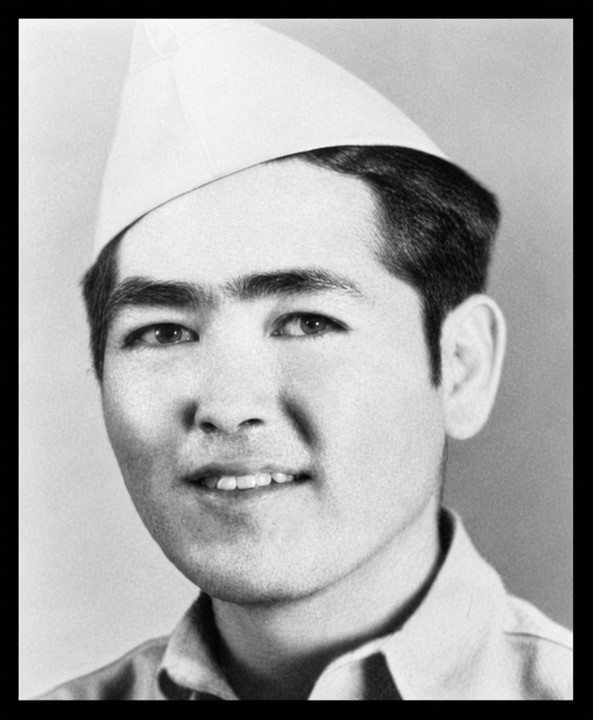
Hidetoshi Tokusato
Private First Class
442nd Regimental Combat Team
3rd Battalion, L Company
Hidetoshi Tokusato was born on November 10, 1914, at Camp 6, Waiakea Homesteads, south Hilo, Hawaii island, Territory of Hawaii. Camp 6 was housing for workers at the Waiakea (Sugar) Plantation. His parents were Saburo and Uto (Kitomura or Kiyuna) Tokusato.
Hide was the second child and second son of five sons and two daughters: sons Seiro, Paul Masaichi, Yoshio, and Seijin; and daughters Shizuko and Kimie.
Saburo arrived in 1906 from Okinawa Prefecture, Japan. He first lived in Kurtis Camp on 11-Mile Road outside of Hilo. He had married Uto in Japan in 1903. She arrived from Okinawa in 1912, probably from Kitatami, Nakagami District. Saburo died in 1925.
In 1930, mother Uto and her six younger children lived with her eldest son Seiro and his wife Hatsuko. Seiro and Hide were working on the sugar plantation – they lived in Camp #6.
In 1940, widowed mother Uto was living at Camp #6 on Waiakea Road. Her sons Hide and Masaichi were working on the sugar plantation.
On October 26, 1940, Hide signed his World War II draft registration card at Local Board No. 2, Room 7, Professional Building in Hilo. He was living with his family in House #13, Camp 6; his point of contact was his mother, Uto; and he was 5’7” tall and weighed 157 pounds. He was employed by Waiakea Mill Company at Waiakea Homesteads, Hilo.
On February 23, 1942, Hidetoshi enlisted in the U.S. Army. He was one of the 1,432 nisei soldiers of the Hawaiian Provisional Battalion who were sent on June 5, 1942, from Honolulu to Oakland, California on the USAT Maui, a former Matson ship. On arrival they were re-named the 100th Infantry Battalion (Separate) and were sent on special trains to Camp McCoy, Wisconsin for combat infantry training.
On January 6, 1943, the 100th was transferred to Camp Shelby, Mississippi, for additional training, including a few months at Camp Claiborne, Louisiana, for war games and field exercises. On July 16, they returned to Camp Shelby, and met the newly arrived soldiers from the recently organized 442nd Regimental Combat Team. Four days later, on July 20, the 100th Battalion received its colors and motto, Remember Pearl Harbor, the motto they had requested.
The 100th left Camp Shelby on August 11 for to Camp Kilmer, New Jersey, for processing to the Theater of War and shipping out on a transport ship for the Mediterranean on August 21. However, Hidetoshi was not among these 100th Infantry Battalion troops; he was unable to go (research did not reveal the reason) – and he remained at Camp Shelby where he was reassigned to Company L, 3rd Battalion, 442nd Regimental Combat Team.
From August 1943 to April 1944, Hide stayed with the 442nd in training at Camp Shelby until the Combat Team left on April 22 for Camp Patrick Henry, Virginia. They left from nearby Hampton Roads in a large convoy of over 100 troop ships on May 2, and arrived at Naples, Italy, on May 28.
The 442nd entered combat near Suvereto on June 26, 1944. In the next few days, they saw action at Belvedere, Sassetta, and Castagnetto. On July 1, they crossed the Cecina River in their efforts to push the Germans north along the Italian Peninsula. On July 4 the 2nd and 3rd Battalions (which included Hidetoshi’s Company L) encountered heavy fighting and made a very slow advance against Hill 140 and the ridge that ran west from it to the coastal plain – it was in this action that Hidetoshi was mortally wounded.
He was admitted to a field hospital behind the lines in southern Tuscany, near Grossetto, with a primary leg wound from the blast effects of an artillery shell received in battle. He died the same day; his length of service was 2 years and 9, 10, or 11 months. He was one of seven men from his company to be killed this day.
About July 6, Hidetoshi was buried in the U.S. Military Cemetery in Follonica, Grossetto Province, southern Tuscany, in Section C, Row 41, Plot 380. The cemetery had been opened by the 46th Quartermaster Graves Registration Company only a week earlier to handle the large number of deaths as the Allies pushed north.
For his wartime service, Pfc. Hidetoshi Tokusato was awarded the following: Bronze Star Medal; Purple Heart Medal; Good Conduct Medal; American Campaign Medal; European-African-Middle Eastern Campaign Medal with one oak leaf cluster, World War II Victory Medal, Distinguished Unit Badge, and Combat Infantryman Badge. He was posthumously awarded the Congressional Gold Medal on October 5, 2010, along with the other veterans of the 442nd Regimental Combat Team. Conferred by the U.S. Congress, the award states: “The United States remains forever indebted to the bravery, valor, and dedication to country these men faced while fighting a two-fronted battle of discrimination at home and fascism abroad. Their commitment and sacrifice demonstrate a highly uncommon and commendable sense of patriotism and honor.”
His survivors included his mother, brothers, and sisters Shizuko Maeda (Mrs. Sadamitsu Maeda), and Kimie.
On August 9, 1944, the Tokusato family printed a Card of Thanks in the Hilo Tribune–Herald for all the assistance, floral offerings, money, and gifts they received during their bereavement following the death of Hidetoshi in Italy. They especially thanked Chaplain Lovely of Waiakea Mill Plantation, Waiakea-uka Young Peoples’ Club, the A.J.A. Morale Committee, and the American Legion.
It was reported in the Hilo Tribune-Herald on September 6 that Hidetoshi was among six Hawaii island soldiers killed in action in Italy.
On January 21, 1945, Hidetoshi was posthumously awarded the Purple Heart Medal with other soldiers killed in action, at a ceremony in the Army USO Playhouse on Mamo Street in Hilo; his mother Uto accepted the medal.
The Waiakea-uka Athletic Club dedicated a large stone memorial on May 3, 1946, to the five soldiers of the Waiakea-uka Camp who lost their lives in Europe. The memorial was placed in the small camp cemetery on the outskirts of Hilo. The soldiers memorialized were: Kazuo Goya, Nobuo John Takayama, Yoshito Jack Takayama, Hidetoshi Tokusato, and Yoshio Jacob Yoshimura.
Below: Two views of the 1946 Waiakea-uka memorial
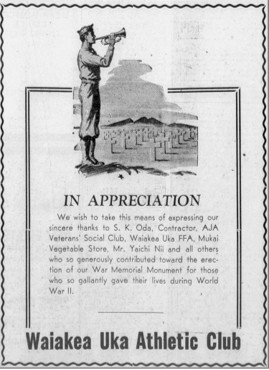
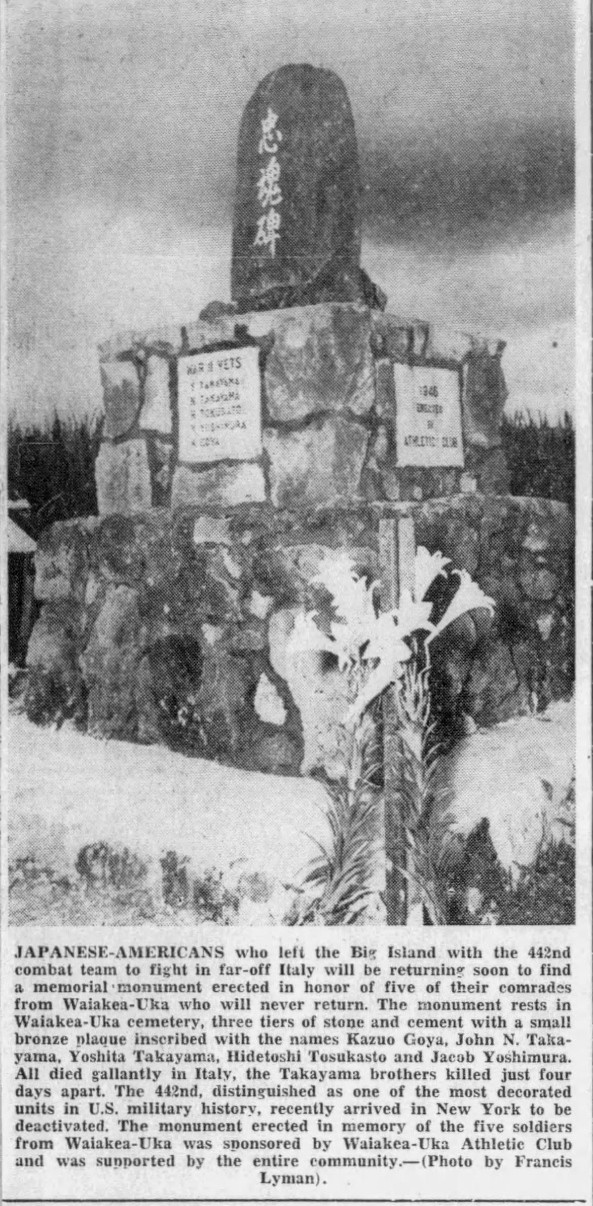
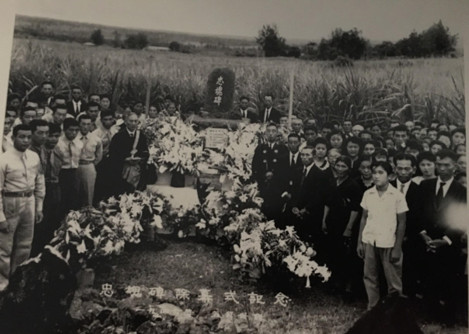
In 1948 as most of the overseas U.S. military cemeteries were being closed, families were given the choice of having their loved one’s remains returned to the U.S. or reburied at one of the remaining in-country cemeteries. The Tokusato family asked for Hide’s body to be returned home. On July 11, 1949, the body of Hidetoshi was one of 34 war dead to arrive in Honolulu on the Army transport ship USAT Captain Arlo L. Olson.
The flag-draped casket containing the remains of Hidetoshi arrived in Hilo on LST 487 from Honolulu on August 30. The following day, his funeral was held at the Church of the Holy Cross; his niece Betty played the organ at the service
On August 31, a tombstone application for a veteran’s flat granite marker was filed by his elder brother Seiro Tokusato, to be shipped to 92 Ponahawai Street, Hilo, for the grave of Hidetoshi Tokusato. The application stated that the burial location would be the East Hawaii Veterans Cemetery No. 1 in Hilo. His first unit appears on his tombstone, rather than the one in which he served while in combat in Italy.
His brother Pfc. Paul Masaichi Tokusato served in the 442nd RCT, 2nd Battalion, F Company.
Researched and written by the Sons & Daughters of the 442nd Regimental Combat Team in 2020. Updated in 2026.