Soldier Story: Hiroichi Tomita
Soldier Story
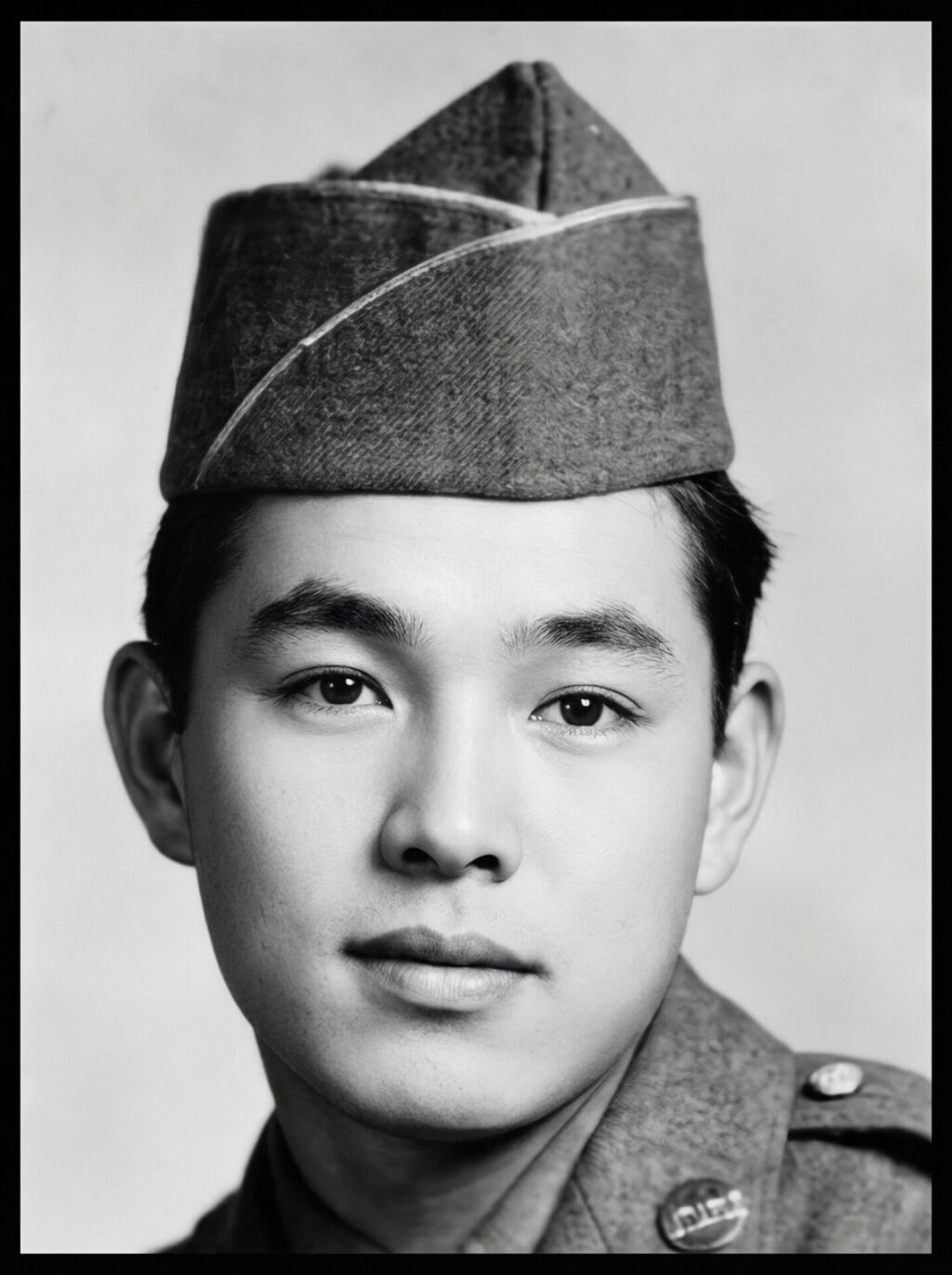
Hiroichi Tomita
Private First Class
442nd Regimental Combat Team
2nd Battalion, F Company
Hiroichi Tomita was born on May 2, 1923, in Wailuku, Maui, Territory of Hawaii. He was the second-eldest son of Taichi and Shizue (Kozai) Tomita. His siblings were: brothers Tetsuo Richard, Mikio Michael, Shoichi Herbert, and Kenneth; and sisters Fumiko Jeanette, Chiyoko, Michiko Mildred, and Yaeko Lillian.
Father Taichi Tomita emigrated from the village of Rokugo, Kumamoto Prefecture, Japan, on the Tenyo Maru, arriving in Honolulu on October 4, 1915. Mother Shizue was born in Wailuku, the daughter of Uzo and Tsuji Kozai. Uzo and Tsuji each arrived from Japan in 1891. In 1910, they were living in Wailuku and had two children, but only Shizue was at home. They were both truck farmers.
In 1920, Taichi and Shizue were living in Wailuku and had no children. Taichi was a waiter at a hotel. By 1930, they had eight children and Taichi was a hotel cook. In 1940, they were living in Wailuku and Taichi was the chief cook at a hotel.
Hiroichi attended Wailuku Elementary School and graduated from Baldwin High School in 1941. He then moved to Honolulu when he enrolled at the University of Hawaii (UH) in the fall of 1941. It was mandatory that all males at UH belong to the Reserve Officers Training Corps (ROTC) for their first two years.
On December 7, 1941, immediately after Pearl Harbor was attacked by Japan, Hiroichi and all UH ROTC cadets were told to report for duty, armed with a Springfield rifle and five bullets each, and sent out to engage Japanese paratroopers who were thought to have landed. After searching for 6 or 7 hours, they received official orders converting them into the Hawaii Territorial Guard (HTG). Their mission was to protect vital installations on the island from the feared impending invasion by the Imperial Japanese Army.
Six weeks later, on January 19, 1942, Hiroichi and the other Japanese American cadets were discharged from the HTG as they had been classified 4C – “enemy aliens” – and were ineligible to serve in the military due to suspicion of their potential loyalty to Japan. Next came the long and courageous battle to prove that Americans of Japanese ancestry were just as loyal as those of other ancestral origins.
At UH, classes were already suspended. The former UH cadets petitioned Military Governor Lieutenant General Delos C. Emmons to be allowed to serve in any way possible. On February 25, 1942, their petition was accepted by Emmons. Hiroichi and the other expelled cadets were assigned to a 169-man auxiliary unit called the Varsity Victory Volunteers (VVV). They were stationed at Schofield Barracks and helped with various construction projects at military installations around Oahu. Their steady and reliable performance played a significant role in assuaging the doubts of the Army leaders and President Franklin D. Roosevelt.
For the next 11 months – from February 25, 1942, to January 28, 1943 – the VVV worked for the U.S. Army Corps of Engineers, 34th Construction Engineer Regiment, stationed at Schofield Barracks on Oahu.
On June 30, 1942, Hiroichi Tomita signed his draft registration card, Maui Local Board No. 2, Bank of Hawaii Building in Wailuku. His point of contact was Toshiaki Hamamoto of Wailuku. Tomita was employed by the Corps of Engineers Auxiliary, 34th Engineers, at Schofield Barracks. He was 5’4” tall and weighed 120 pounds.
After the announcement that the Army was forming a Japanese American Combat Team in early 1943, the VVV was disbanded so that its members could volunteer.
Hiroichi Tomita enlisted in the U.S. Army on March 24, 1943. He was sent to the “tent city” nicknamed Boomtown at Schofield Barracks. On March 28, he was at the community farewell ceremony at Iolani Palace given by the community for the new soldiers of the 442nd RCT. The men left on April 4 on the S.S. Lurline. After arriving at Oakland, California, they were sent by train to Camp Shelby, Mississippi.
At Camp Shelby, Private Tomita was assigned to 2nd Battalion, F Company. After nearly a year of basic and specialized training and field maneuvers, the 442nd left for Camp Patrick Henry, Virginia, on April 22, 1944. On May 2, the 442nd sailed from nearby Hampton Roads in a convoy of 100 ships enroute to the Theater of Operations. All of the 2nd Battalion, except for E Company, was aboard the USAT Elbridge Gerry.
After entering the Mediterranean, the USAT Elbridge Gerry was diverted to the port of Oran, Algeria, in North Africa to offload cargo, arriving on May 21.
Meanwhile, the rest of the 442nd continued on to Italy, arriving at Naples on May 28. From Naples, the men of the 442nd marched to the train station and were taken to Staging Area No. 4 at nearby Bagnoli.
On June 6, the 442nd left Naples on LSTs for Anzio, leaving E Company behind in Bagnoli to await the arrival of the rest of 2nd Battalion from Oran. From Anzio, the 442nd went by truck convoy through Rome and arrived at a large bivouac 50 northwest of Rome near Civitavecchia.
The 2nd Battalion left Oran on the British ship HMT Samaria on June 5 and arrived at Naples on June 9. They went to the bivouac area in nearby Bagnoli, where they met up with E Company. While there, some of the men were issued day passes to visit Rome or Pompeii. The entire 2nd Battalion finally left Naples by LSTs on July 15 and went directly to Civitavecchia, bypassing Anzio. They arrived at the large Civitavecchia bivouac on June 17, where they met up with the rest of the 442nd.
Tomita and the 442nd entered combat in the Rome-Arno Campaign near Suvereto north of Rome on June 26 – with their objective of capturing the seaport city of Livorno 50 miles north. Over the next 15 days, the 442nd steadily pushed the Germans north along the western side of the Italian peninsula. The towns they captured, liberated, or – in the case of unopposed entry – were the first to enter, were: Suvereto and Belvedere on June 26, Sassetta on June 27, and Molino a Ventoabbto on July 3.
The Combat Team saw especially fierce fighting just north of the Cecina River at Hill 140 in the vicinity of Castellina beginning on July 3. Captured Germans from the 36th SS Regiment reported that they had been ordered to “hold until the defenses at Pisa were completed.” On July 9 in the vicinity of Casale, they faced determined resistance with the enemy using their terrain to full advantage. A map taken from a dead German indicated that they had every hill, house, and terrain feature zeroed in from prepared gun positions, with azimuth readings, ranges, and fields of fire elaborately developed. This knowledge was possible because of the Germans’ long occupation of the ground they were defending.
After the bitter fighting to secure Hill 140, the 2nd Battalion moved to the next hill, Hill 132, which proved equally difficult to capture. It was estimated that the Germans threw 18,000 artillery rounds at the two hills. As F Company dug into foxholes on the reverse slope, the enemy launched counterattack barrages. They spent July 11 and 12 there, in the vicinity of “the pink house.”
F Company’s Sergeant Wataru Kohashi later recalled:
Company F had advanced to Hill 132 after Hill 140. Pfc. Hiroichi Tomita, the platoon runner, announced that he was going back to Battalion Headquarters and asked if we wanted water. The boys gave him about a dozen canteens to bring back filled with water…The next morning [July 12], [at] the red house which was the Battalion Aid Station…I noticed canteens all over the ground behind the house. I asked, what happened here? They said that two F Co. boys got killed and showed me the bodies of H. Tomita and communications Sgt. Kiyoshi Iguchi, who had accompanied Tomita. There was nothing for me to do but to pick up the canteens and take them back to the boys on the line.
Pfc. Hiroichi Tomita was killed either late on July 11 or in the early morning hours of July 12, which is the official death date. That same morning, 2nd Battalion attacked and took the ridge at Mo dei Rotini with F Company on the left, G Company on the right, and E Company in reserve. They held the ridge and moved on to Pastina.
Pfc. Hiroichi Tomita was buried in the American Military Cemetery at Follonica, about 47 miles south. His grave was in Section E, Row 49, Site 585.
For his military service, Pfc. Hiroichi Tomita was awarded the: Bronze Star Medal, Purple Heart Medal, Good Conduct Medal, American Campaign Medal, European-African-Middle Eastern Campaign Medal with one bronze star, World War II Victory Medal, and Combat Infantryman Badge. He was posthumously awarded the Congressional Gold Medal on October 5, 2010, along with the other veterans of the 442nd Regimental Combat Team. Conferred by the U.S. Congress, the award states: “The United States remains forever indebted to the bravery, valor, and dedication to country these men faced while fighting a two-fronted battle of discrimination at home and fascism abroad. Their commitment and sacrifice demonstrate a highly uncommon and commendable sense of patriotism and honor.”
After their son’s death, Tomita’s family wrote to Pfc. Masatoshi Hokama, their neighbor before the war, and asked him to take a photo of his grave.
Finally, in 1945 during the occupation of Italy, Hokama was in a position to fulfill the Tomita family’s wishes. He showed their letter to his commanding officer, Captain Joseph Hill, and asked permission to visit the cemetery. “This is a beautiful letter,” Capt. Hill told him, “Hiroichi Tomita was my favorite runner.” He loaned Hokama his personal jeep so he could drive to the cemetery, which was 50 miles away.
Hokama asked five F Company men to accompany him to Follonica. They located Tomita’s grave and solemnly posed by it, while one of them took their photo. Hokama sent the photo to the Tomita family right away. This iconic photo appears on the cover of The Men of Company F, their unit history, written by Ron Oba and published in Honolulu in three editions: 1992, 1998, and 2005.
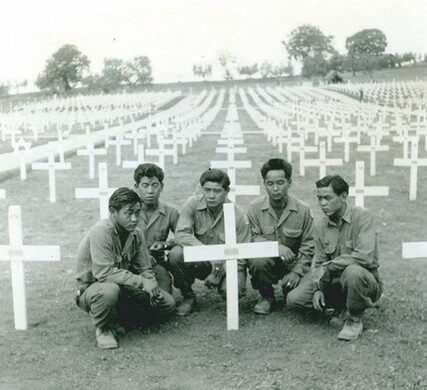
Above: At Follonica Cemetery; left to right – Sadao Okuhara, Mamoru Hiranaka, Yoshio Yamamoto, Masatoshi Hokama, and Katsuji Nakamura; photo by Tajiro Uranaka
On June 12, 1945, the University of Hawaii paid tribute to its 60 former students who were killed in the war, when a moment of silence was observed during the commencement exercises at 4:30 p.m. in the outdoor theater on campus. At the time, there were 1,204 members of the faculty and student body on active military service.
On April 21, 1946, the former VVV men held a memorial service for their seven members who were killed in action during the war. The ceremony was held at 3:00 p.m. at the Church of the Crossroads. Services were held for Daniel Betsui, Jenhatsu Chinen, Robert Murata, Grover Nagaji, Akio Nishikawa, Hiroichi Tomita, and Howard Urabe, all former UH students. The Reverend Mineo Katagiri of Nuuanu Congregational Church, presided. Hung Wai Ching, former secretary of the UH YMCA, was the speaker. The service included the presentation of specially printed and framed certificates for Gold Star Mothers. All former VVV members, friends, and the ASUH (Associated Students of UH) were invited.
In 1947, the US began to close most of its wartime overseas cemeteries. They gave the families the choice of having their loved one reburied in one of the few cemeteries that would remain or being returned home. The Tomita family chose to have their son’s remains return to Hawaii.
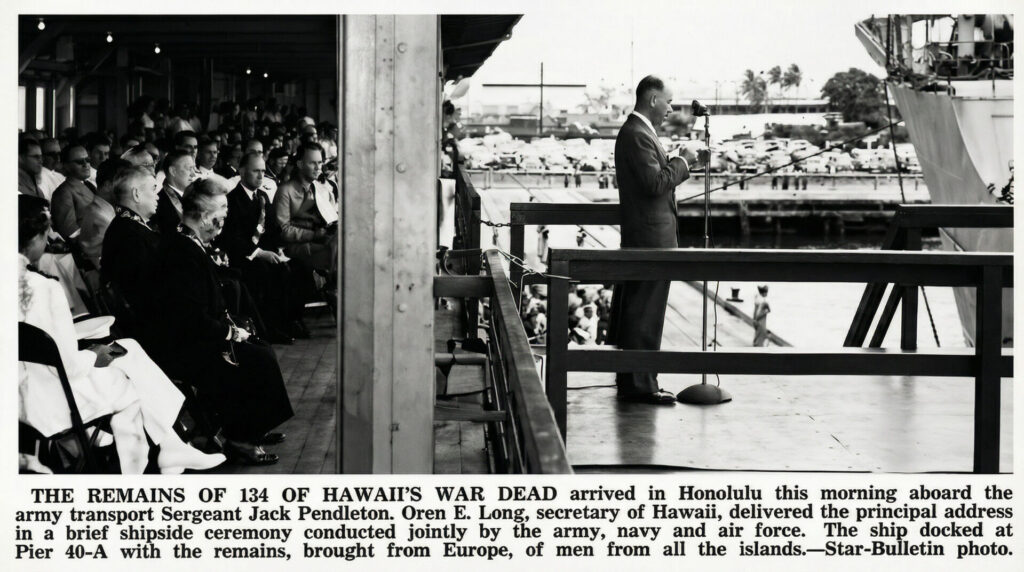
Above: Memorial Service at Pier 40-A, April 21, 1949
As a result, the remains of Hiromichi Tomita were returned to Hawaii in the fourth large contingent of war dead to arrive. Tomita’s casket was among those of 133 other men that arrived at Honolulu Harbor on the USAT Sergeant Jack J. Pendleton on April 21, 1949. At the brief dockside ceremony, prayers were offered by Army Chaplains Edwin L. Kirtley and Hiro Higuchi, Navy Chaplain J.E. Johnson, and Bishop Kodo Fujitani of Nishi Hongwanji Mission. The 264th Army Band played Aloha Oe and two hymns for the several hundred family and friends in attendance. The flag-draped caskets were held at the Army Mausoleum at Schofield Barracks pending funeral arrangements.
On August 5, 1949, at 3:00 p.m., Tomita was buried in the National Memorial Cemetery of the Pacific at Punchbowl, Section D, Site 157.
Postscript. In 2012, the 70th anniversary of the formation of the Varsity Victory Volunteers, the University of Hawaii awarded posthumous degrees to the seven ROTC cadets, including Pfc. Hiroichi Tomita, who were killed during World War II while serving with the 442nd Regimental Combat Team. The diploma reads:
The Regents of The University of Hawai’i on the recommendation of the Faculty of University of Hawai’i at Mānoa have conferred upon
Hiroichi Tomita
the degree of Bachelor in Memoriam with all its privileges and obligations
Given at Honolulu, Hawai’i, this twenty-fifth day of March, two thousand twelve
Hiroichi’s brother Corporal Richard Tetsuo Tomita served in A Battery, 522nd Field Artillery Battalion, 442nd Regimental Combat Team, and is buried next to him.
Researched and written by the Sons & Daughters of the 442nd Regimental Combat Team in 2026.