Soldier Story: Isaac F. Akinaka
Soldier Story
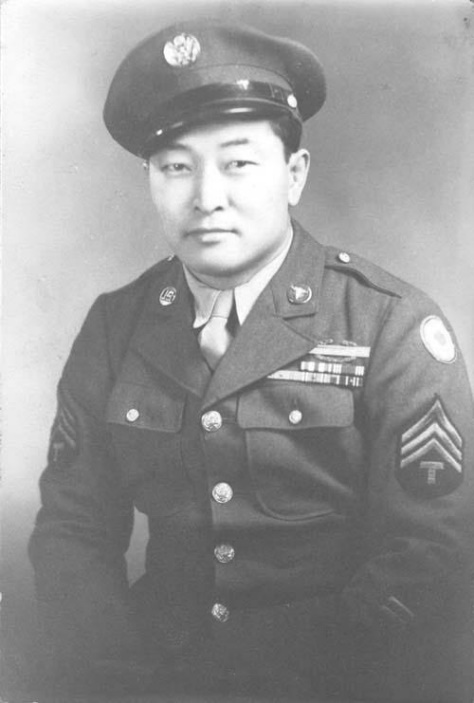
Isaac Fukuo Akinaka
Technician Fourth Grade
100th Infantry Battalion (Separate), Medical Company
Isaac Fukuo Akinaka was born on May 15, 1911, in the Kaimuki section of Honolulu, Territory of Hawaii, the son of Kenjiro and Fusa (Akagi) Akinaka. His siblings were: brothers Takao and Kenzo; and sisters Beatrice Masaye, Tomaye, and Jesse Yaeko. Kenjiro emigrated from Hiroshima Prefecture, Japan, in 1896. Fusa emigrated from the village of Nagato, Jinseki District, Hiroshima Prefecture, on the Korea Maru, arriving in Honolulu on February 4, 1908.
Father Kenjiro started as a field hand on a pineapple plantation on Maui. He later moved to Honolulu where in 1920, the family lived in Honolulu near Hobron Avenue in Kaimuki. Kenjiro was employed as a stonemason, and he later became a cement contractor.
In 1930, the family lived at 3260 Olu Street in Kaimuki. After graduating from McKinley High School, Isaac worked as an electrician’s helper at Hawaiian Pineapple Company for a few years. Parents Kenjiro and Fusa died in 1932 and 1933, respectively.
He registered for the draft on October 26, 1940, at Local Board No. 3, National Guard Armory, Honolulu. He listed his sister Masaye as his point of contact, and they lived in the family home on Olu Street. Isaac was working for the Alexander Young Building Company in Honolulu. He was 5’5” tall and weighed 135 pounds.
After high school, Isaac performed a mission in the Pacific area as a member of the Church of Jesus Christ of Latter Day Saints (LDS). He was encouraged to keep a journal and became a prolific writer.
Isaac enlisted in the 298th Infantry Regiment on December 9, 1940. He was sent to the “tent city” known as Boom Town at Schofield Barracks for training. He wrote in his diary a few months later, after he was in the 298th, the following:
Friday, March 21, 1941 – One thing very noticeable to us trainees from Reception Center is the lack of military discipline in the 298th for we had very strict training by Regular men in “Boom Town.” Here, the officers and men seem more like one big family with its usual squabbles of minor nature.
He also commented in his diary on March 29 about meeting another Morman soldier who was quiet and soft-spoken, “indeed an exception amongst Army men whose every other word is usually loud and profane.”
At the time, his civilian occupation was listed as “Locomotive fireman” and he had completed four years of high school. His enlistment was due to end on December 8, 1941. As Pearl Harbor had been attacked on December 7, he reenlisted on December 8.
In late May 1942, the 298th Japanese American soldiers were transferred to a separate unit called the Hawaii Provisional Battalion, and on June 5 they were transported on the USAT Maui, arriving on June 12 at Oakland, California. Upon arrival, the battalion was designated the 100th Infantry Battalion (Separate). They were sent by train to Camp McCoy, Wisconsin, for basic training. On January 6, 1943, they were sent for further training at Camp Shelby, Mississippi. While there, they went on field maneuvers to Camp Claiborne, Louisiana.
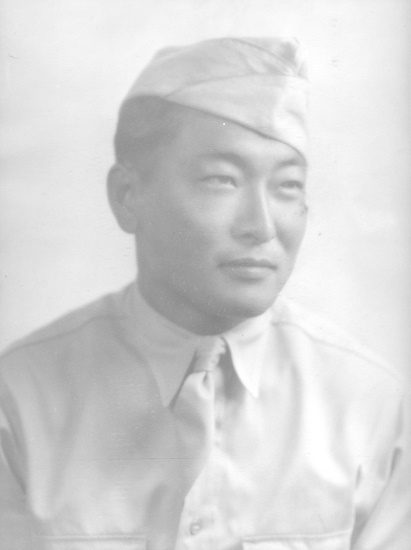
The 100th (Separate) departed Camp Shelby on August 11, 1943, and traveled by train to Camp Kilmer, New Jersey. On August 21, they were sent by train from Camp Kilmer to Brooklyn, New York, ferried to Staten Island, and boarded the S.S. James Parker – a recently converted banana and tourist ship. They sailed in a convoy the next day at dusk to the Mediterranean Theater. Akinaka was on the ship and listed in Headquarters Company, Communication Platoon.
Initially landing in Oran, Algeria, on September 2, the 100th Battalion (Separate) was assigned to the 34th (Red Bull) Division.
On September 19, 1943, the 100th boarded the attack transport Frederick Funston and arrived offshore of Salerno Beach, Italy, at 8:00 a.m. on September 22. They entered combat in the Naples-Foggia Campaign.
Although Akinaka was in the Communication Platoon, so many men were wounded or killed in the early days of combat that he volunteered to become a Medic. He was in battle as the 100th fought its way inland and northward toward Rome.
He was awarded a Bronze Star Medal for his actions on November 29, 1943. The citation reads in part:
Tec/4 Isaac F. Akinaka (then Private First Class), Medical Department… For heroic achievement in action….in the vicinity of Castilnuovo, Italy.
A couple of months later, Tec/4 Akinaka received a Silver Star Medal for his actions near Cassino on February 8, 1944. The citation reads:
The President of the United States of America, authorized by Act of Congress, July 9, 1918, takes pleasure in presenting the Silver Star to Technician Fourth Grade [then Technician Fifth Grade] Isaac F. Akinaka, for conspicuous gallantry and intrepidity in action against the enemy while serving as a Medical Aidman with the Medical Detachment, 100th Infantry Battalion (Separate), attached to the 34th Infantry Division, on 8 February 1944, in the vicinity of Cassino, Italy. The company to which Technician Fourth Grade Akinaka was attached was attacking under cover of a smoke screen. The wind suddenly changed direction, exposing the attacking company to the full view of the enemy, and immediately terrific machine gun and artillery fire was directed upon them. Technician Fourth Grade Akinaka unhesitatingly left his defiladed position, went forward, and moving swiftly from one wounded man to another during the fire fight, administered first-aid to the several wounded. Finding two of his comrades in a particularly exposed position, Technician Fourth Grade Akinaka carried them from the field of battle. Although exploding shells showered him with dirt and rocks and any movement brought intense enemy machine pistol and machine gun fire upon him, he did not stop until he had cared for all the wounded. Technician Fourth Grade Akinaka’s courage and unstinting devotion to duty in saving the lives of several of his comrades reflects credit upon himself and is in keeping with the high traditions of the military service.
The 100th (Separate) was sent to the large bivouac at Civitavecchia to meet up with the 442nd RCT in June 1944. They entered battle together on June 26 near Suvereto in the Rome-Arno Campaign. However, Isaac returned to the US shortly after the 100th had arrived at Civitavecchia. He was granted a short leave to visit Salt Lake City, Utah, then he went to Madigan General Hospital in Fort Lewis, Washington. From there Akinaka was sent to Fitzsimmons General Hospital in Denver, Colorado, where he received three months of medical training in early 1945.
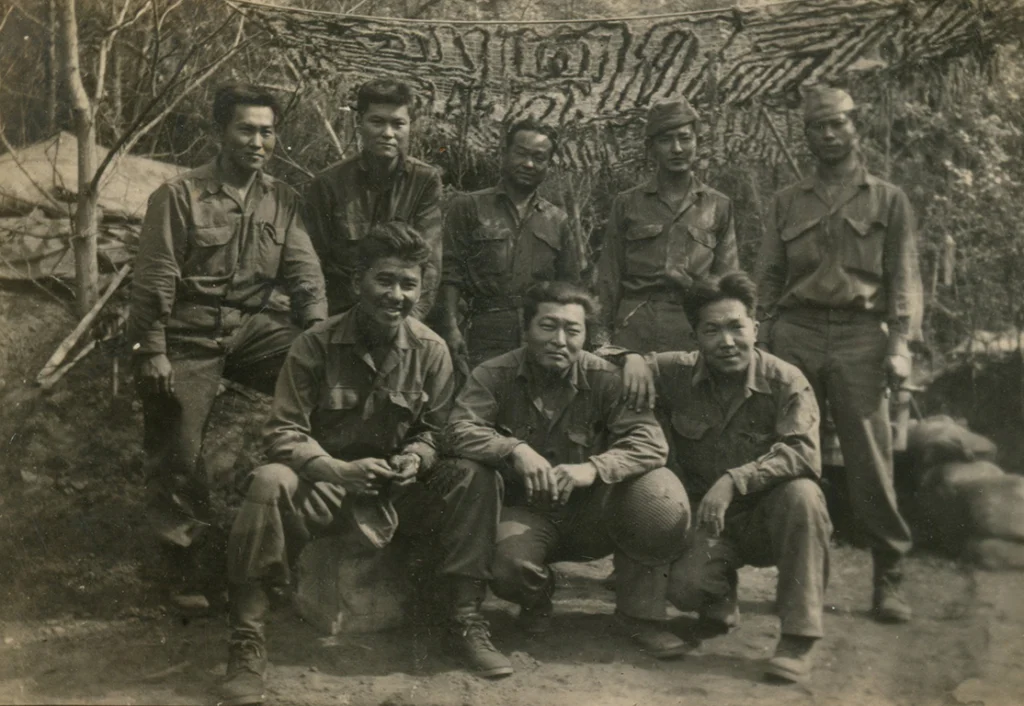
Above – Headquarters gang in Civitavecchia, Italy. First row (l-r): Albert Oki, Isaac Akinaka, Edward Saito. Second row (l-r): Akiyoshi Kuriyama, Hidenobu Hiyane, James Oki, David Suzuki
Isaac returned to Salt Lake City and married Gwen Yaiko Yamaki on April 17, 1945, at the Salt Lake Temple. They were devout members of the LDS Church. She was born on April 19, 1918, in Woodrow, Utah, to Rokusaburo and Ishi (Mesaku) Yamaki. The couple returned to Fort Lewis, where Akinaka was ward master of the prisoner-of-war psychiatric ward. He was discharged from the Army on August 31, 1945, at Fort Lewis.
For his military service, Technician Fourth Grade Isaac Fukuo Akinaka was awarded the Silver Star Medal, Bronze Star Medal with oak leaf cluster, Purple Heart Medal, Good Conduct Medal, American Defense Medal, American Campaign Medal, Asiatic-Pacific Campaign Medal, European-African-Middle Eastern Campaign Medal with one bronze star, World War II Victory Medal, Combat Infantryman Badge, and Combat Medic Badge. He was posthumously awarded the Congressional Gold Medal on October 5, 2010, along with the other veterans of the 100th Infantry Battalion (Separate). This is the highest Congressional Civilian Medal. The award states: “The United States remains forever indebted to the bravery, valor, and dedication to country these men faced while fighting a 2-fronted battle of discrimination at home and fascism abroad. Their commitment and sacrifice demonstrates a highly uncommon and commendable sense of patriotism and honor.”
After the war, Isaac and Gwen returned to Hawaii for several years before moving to California. While in Honolulu in 1950, they lived with their two eldest sons at 3254 Olu Street, next door to his siblings who lived at 3260. Once back in California, the couple lived in San Luis Obispo and were temple workers for five years at the Los Angeles Mormon Temple. Isaac was an ordained priest in the LDS church. He worked at the California Department of Corrections as a prison guard for 17 years and for the Federal Prison System for two years, before retiring in 1975. In the early 1980s, the couple completed a two-year church mission in Japan. Over the years, they raised a family of three sons.
Isaac Fukuo Akinaka died on June 25, 1984, in Houston, Texas. His memorial service was held on July 9, at 12:00 p.m. at the LDS temple in San Luis Obispo. He was buried at the National Memorial Cemetery of the Pacific at Punchbowl in Honolulu, Section E, Grave 133-A. Survivors included his wife and three sons, brother Kenzo, sisters Beatrice Akinaka and Mrs. Jesse Akinaka Hakoda, and five grandchildren. Gwen Akinaka died on October 10, 2001, and was buried with her husband.
Photos courtesy of 100th Infantry Battalion website: 100thbattalion.org
Please click here for a more in-depth look at Akinaka’s life story.
Researched and written by the Sons & Daughters of the 442nd Regimental Combat Team in 2021; updated in 2026