Soldier Story: Isaac Isamu Ikehara
Soldier Story
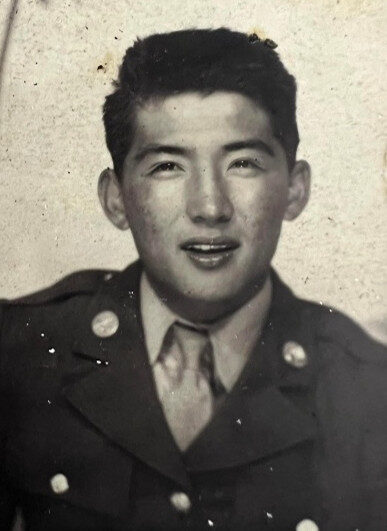
Isaac Isamu Ikehara
Staff Sergeant
442nd Regimental Combat Team
3rd Battalion, K Company
Isaac Isamu Ikehara was born on April 21, 1924, in Waipahu, Oahu, Territory of Hawaii. He was the fourth child of Seikichi and Kanako (Miyashiro) Ikehara. His siblings were: brothers Clark Kiyoshi, Thomas Tadashi, Sidney Satoshi, and Robert Akira, and sister Lillian Setsuko.
Father Seikichi emigrated from Kumito District, Okinawa Prefecture, Japan, in 1907 and settled in Waipahu. He was born on October 5, 1887. In 1910, he was working as a chauffeur for an express wagon service and the only boarder in the home of Kame and Nabe Arakaki who worked on the sugar plantation. Kanako Miyashiro, born May 7, 1897, arrived from Okinawa in 1915 and married Seikichi on February 8, 1918, at the Waipahu Methodist Church.
In 1930, the Ikehara family lived in Waipahu at the rear of Government Road. Seikichi worked as a chauffeur for a taxi cab business and Kanako worked on the sugar plantation. By 1940, they had moved into Honolulu and lived at 406 Ohe Lane. Seikichi was a janitor in a hotel and Kanako was a dressmaker in a dress shop.
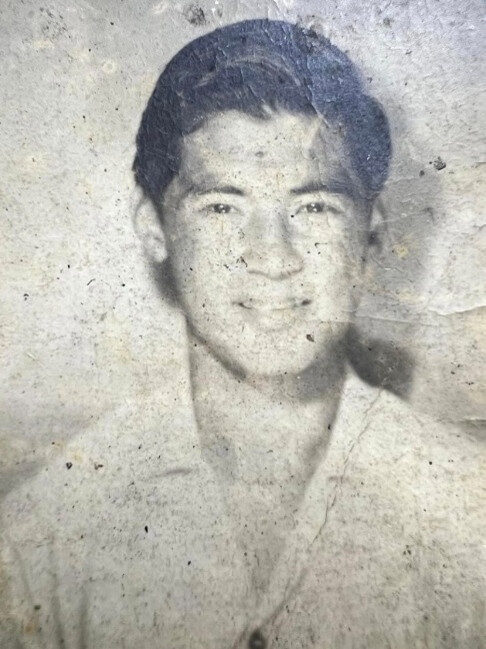
Right: Isaac Ikehara, circa 1940
In 1942, Isaac was among the first group of student blood donors at McKinley High School in its new campaign to donate to the Honolulu Blood Plasma Bank. The students were escorted to Queen’s Hospital on March 10 to kick off the program. He graduated from McKinley a few months later on June 7 at 5:00 p.m. in the senior core building courtyard. There were 1,030 graduates in his class.
Isaac signed his draft registration card at the age of 18 on June 30, 1942, Local Board No. 5, located in Room 24 at the Royal School on Punchbowl Street. His point of contact was his mother and he lived with his family at 406 Ohe Street. He was employed by Hawaiian Pineapple Company in Iwilei, was 5’3” tall, and weighed 125 pounds.
Ike, as Ikehara came to be known, enlisted in the U.S. Army on March 25, 1943, in Honolulu. He was listed as having completed four years of high school and his civilian occupation was “Semiskilled warehousing, storekeeping, handling, loading/unloading, and related occupations.”
He was sent to the “tent city” known as Boom Town at Schofield Barracks along with the other volunteers. On March 28 they were given an aloha farewell ceremony at Iolani Palace. The new soldiers sailed on April 4 on the S.S. Lurline for Oakland, California.
After arrival, the soldiers were sent by train to the 442nd at Camp Shelby, Mississippi. Ike was assigned to 3rd Battalion, K Company. Basic training lasted from May 10 to August 23. On September 22 it was announced in the Honolulu Star-Bulletin that of the 297 Hawaii men in the 442nd RCT 257 of them were recently promoted. Ike was promoted from Private First Class to Corporal. While at Shelby, Ike was on Company K’s basketball team.
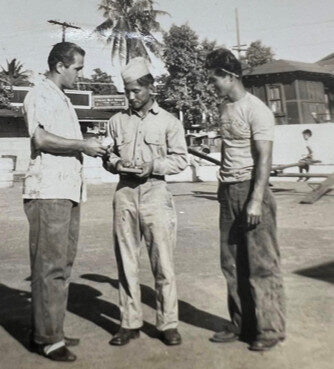
Below: New soldier Ikehara (center) and his brother Aki (right), Mother Waldron Park in Kakaako, 1943
After a year of basic, combat, and specialized training and field maneuvers, the 442nd left Camp Shelby on April 22, 1944. They travelled by train to Camp Patrick Henry, Virginia. On May 2, they sailed from nearby Hampton Roads in a convoy of about 100 ships, arriving at Naples, Italy, on May 28.
After over a week in bivouac at nearby Bagnoli, the 442nd was sent by LSTs on June 6 to Anzio, arriving the next day. They marched five miles to their bivouac. That night they witnessed the aerial fireworks as the enemy raided the supply dumps at Anzio. Long red tracer streaks criss-crossed the sky, punctuated by the quick flashes of flak bursts as the Allied gunners followed the flight of the German planes.
On June 9, the Combat Team left Anzio and were trucked through the recently liberated city of Rome to a large bivouac near Civitavecchia, about 50 miles north. There, they prepared for movement to the front lines in the Rome-Arno Campaign.
Ikehara entered combat with the 442nd near Suvereto north of Rome on June 26 – with their objective of capturing the seaport city of Livorno 50 miles farther north.
Over the next 15 days, the 442nd steadily pushed the Germans north along the western side of the Italian peninsula. On July 1, the 442nd’s 100th and 2nd Battalions had crossed the Cecina River, easily fordable at that time of year. The 3rd Battalion remained in reserve on the south side of the river. Resistance, while not heavy, was stiffening, indicating that the enemy would make some sort of a stand on the high ground just north of the Cecina River. On July 3, enemy artillery fire became increasingly heavy.
By mid-day on July 4, K Company had crossed the river and relieved the 100th Battalion at Hill 140. The relief, carried out in daylight, brought on a storm of enemy self-propelled and artillery fire, causing heavy casualties in both battalions. Third Battalion sustained a 5-hour artillery barrage. It gained very little ground but managed to improve its position somewhat.
Furious firefights ensued all through the day on July 5. Enemy resistance was skillful and determined. All along the front the Germans held more doggedly than at any time since the breakthrough at Cassino and Anzio in the earlier Naples-Foggia Campaign, which had been experienced by the 100th Battalion (Separate). The battle for Hill 140 was later nicknamed “Little Cassino.” The enemy prisoners being captured said that they had been “ordered to hold until the defenses at Pisa were completed.”
On July 7, 3rd Battalion had been working its way up the western slopes of Hill 140, in reality a long ridge that ran west from the summit of the hill to the sea. The Germans were well dug in. K Company took the brunt of the attack, and their advance was measured in yards. On July 7, the last German resistance was battered into submission and the assault companies were able to push on more rapidly.
It was later reported in the Honolulu newspapers that Ikehara was among those wounded in the Rome-Arno Campaign. Our research did not reveal the date, place, or nature and severity of his wound; however, he did recover and return to duty. Ikehara later received a Bronze Star Medal. The citation noted that it was presented for his:
…valorous conduct near Hill 140…he rallied and reorganized his men within 50 yards of a superior concentration of enemy forces and led them in a ferocious counterattack which routed the Germans.
After pushing the enemy north to the Arno River, the Combat Team was withdrawn from the battle lines and sent south to Naples. They left for France on September 27. Once they arrived at Marseilles, they were in a bivouac area in nearby Septèmes until October 9, when they were transported north by truck convoy or rail boxcars to fight in the Rhineland-Vosges Campaign.
They arrived in the assembly area at Charmois-devant-Bruyères at midnight on October 13. At 2:00 p.m. the next day, the 442nd began moving into position to attack the important rail and road center of Bruyères the following morning. After several days of intense fighting, the enemy had been cleared from the town and its surrounding hills. On October 23, the 442nd was ordered to take the next town, Biffontaine. Finally, on October 24, they were taken off the front lines and put in reserve in nearby Belmont for a rest after eight days of heavy fighting, many casualties, little to no sleep, and harsh weather conditions. The weather was cold, wet, snowy, and miserable, as the men fought in the heavily wooded forests still in their summer uniforms. They were subjected to living in foxholes, and incoming artillery raining down on them in “tree bursts.”
On the afternoon of October 26, the Regiment was ordered to the front lines again – this time to aid in the rescue of the “Lost Battalion,” the 1st Battalion of the 141st (Texas) Infantry. This battalion had advanced ahead of the lines and was surrounded by the enemy. Attempts by the 141st to free it had been unsuccessful, so the 442nd was assigned the mission.
The 442nd’s 3rd Battalion moved out at 4:00 a.m. on October 27. The men were forced to march in column, with each man holding on to the pack of the man in front of him, as they could not see each other in the darkness. By 2:00 p.m. they were in line with the other two infantry battalions of the 442nd. The attack moved slowly and encountered heavy resistance from enemy infantry and incessant mortar concentrations. At 3:30 p.m. Ikehara’s K Company was counterattacked by a tank and a half-track, followed by enemy infantry. The fighting was severe. After one 442nd soldier took out the tank with his bazooka, the enemy infantrymen pulled back in the early twilight. The 3rd Battalion made no attempt to follow up due to the pitch darkness.
All units resumed the attack on the morning of October 28, with resistance as fierce as ever. Third Battalion encountered a series of manned roadblocks in its advance up the hill, and K Company was stopped by enemy fire from several machine guns, riflemen, and grenadiers.
After several days of severe fighting, on October 30, the Lost Battalion was finally rescued. The 442nd continued on fighting through the first week of November.
After the fierce fighting in the Vosges, the 442nd was at half-strength due to heavy casualties and was sent to the south of France. There, they could rebuild to full combat strength while participating in the Rhineland-Maritime Alps Campaign, which was mostly a defensive position guarding the French-Italian border from attack by the German Army in Italy. The 442nd was there from November 23, 1944.
Ikehara and his 3rd Battalion were initially stationed high up in the mountains in L’Escarène and Sospel. They alternated with 2nd Battalion between these two towns and holding positions on the line at Peira Cava. With other companies of 3rd Battalion they hosted a Christmas party in L’Escarène for children from St. Joseph’s Orphanage. However, in late December through early January due to the enemy’s maneuvers elsewhere, 3rd Battalion moved from being a mobile reserve and took up positions along a regimental reserve line between the 100th and 2nd Battalions. This was done to counter any potential German offensive in the area.
While in the south of France, the men were often given day passes to Nice to enjoy the nightlife and the military rest centers that opened up. For this reason, they nicknamed this period the Champagne Campaign.
This nice interlude ended when the 442nd was relieved from their posts on March 15 and moved in relays to the new staging area at Marseilles. On March 20-22, the 442nd (without its 522nd Field Artillery Battalion that was sent to fight in Germany) left France to fight in the Po Valley Campaign for the final push to defeat the Nazis in Italy. They arrived at the Peninsular Base Section in Pisa on March 25 and were assigned to Fifth Army.
The objective of the 442nd was to execute a surprise diversionary attack on the western anchor of the German Gothic Line. This elaborate system of fortifications had been attacked in the fall of 1944, but no one had yet been able to pry the Germans loose from the western end. The Gothic Line in this area was hewn out of solid rock, reinforced with concrete, and constructed to give all-around protection and observation. The Germans were dug into mountain peaks rising almost sheer from the coastal plain, bare of vegetation save for scanty scrub growth.
The Combat Team left their initial staging area and moved to a bivouac at San Martino, near the walled city of Lucca. Starting on April 3, the 442nd conducted a surprise attack on the Germans at Mount Folgorito. One success after another saw the 442nd continuously moving farther north, finally taking Aulla on April 25, and penetrating as far north as Torino.
Highlights of S/Sergeant Ikehara’s experience with 3rd Battalion and Company K included their 5-hour climb up Mt. Folgorito in full battle gear and under observation and mortar fire by the enemy, and their crossing of the Frigido River on April 9. On April 11, Co. K bypassed Carrara and pushed north into the mountains, taking Sorgnano and Gragnano without opposition. On April 21, 3rd Battalion attacked Mt. Nebbione, and the next day waged an all-day firefight on Tendola that went into the night.
The Combat Team had never taken a step back and had achieved one success after another. On April 28, 3rd Battalion had alternately marched and been conveyed by vehicles to the outskirts of Genoa, which they quickly garrisoned.
The 442nd had relentlessly pursued what was supposed to be a diversionary attack and it had resulted in a complete breakthrough of the Gothic Line in the west. Despite orders from Hitler to fight on, the German forces in Italy surrendered on May 2, 1945, a week before the rest of the German forces in Europe surrendered.
S/Sgt. Ikehara was with the 442nd while in occupation. Their first move was to regroup the Combat Team at Novi Ligure where they were in bivouac until May 16. On that date, they were sent to Ghedi Airfield near Brescia to search, process, and guard the thousands of German prisoners of war. They were relieved of that duty on June 14 and moved to Lecco where they enjoyed nearby Lake Garlate and the beautiful countryside. On July 7-10 they moved again, to the Livorno/Pisa/Florence area for further guard duty.
Soldiers were returned to the US according to a “point system.” Points were accrued according to such criteria as length of time in theater, wounds received, dependents back home, etc. Our research did not reveal the exact date of Ikehara’s arrival back in Hawaii. However, it was likely shortly before he was discharged. Records show that S/Sgt. Ikehara was discharged from the U.S. Army in Honolulu on November 16, 1945.
For his World War II service, Staff Sergeant Isaac Isamu Ikehara was awarded the following decorations: Bronze Star Medal with oak leaf cluster, Purple Heart Medal, Good Conduct Medal, American Defense Medal, European-African-Middle Eastern Campaign Medal with four bronze stars, World War II Victory Medal, Army of Occupation Medal, Distinguished Unit Badge, and Combat Infantryman Badge. He was posthumously awarded the Congressional Gold Medal on October 5, 2010, along with the other veterans of the 442nd Regimental Combat Team. Conferred by the U.S. Congress, the award states: “The United States remains forever indebted to the bravery, valor, and dedication to country these men faced while fighting a two-fronted battle of discrimination at home and fascism abroad. Their commitment and sacrifice demonstrate a highly uncommon and commendable sense of patriotism and honor.”
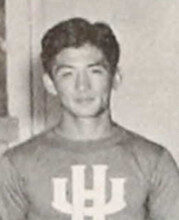
After returning to Hawaii, Isaac enrolled at the University of Hawaii (UH), where he was on the boxing team.
Right: Ikehara was a flyweight on the UH boxing team, 1948
He joined the 442nd Veterans Club and was a very active member of the K Company Chapter. He served as Club President in 1947.
On January 27, 1948, the 442nd and 100th Veterans Clubs hosted a luau for General Mark W. Clark, under whom they had served in the Fifth Army in Italy. Held at Fort DeRussy’s Maluhia Recreation Center, Lt. General John E. Hall, commander of Army forces in the Pacific, and Governor Ingram M. Stainback were among the 800 attendees. Ikehara presented Clark with a chamois-skin scroll signed by every veteran in attendance. Clark noted in his remarks that given his high regard for the 442nd’s fighting abilities he had personally appealed to Army Chief of Staff General George C. Marshall for them to return to him in Italy in 1945 for the final push against the Gothic Line.
Ike graduated from UH with a Bachelor’s degree in Marine Zoology in 1950. He married Betty Tomiye Shimizu later that year. Betty was born in Honolulu on February 8, 1925, to Mr. and Mrs. Shigeji Shimizu. Over the years the couple raised a family of two sons.
Below: Ikehara was 442nd Club President when General Mark W. Clark visited in early 1948
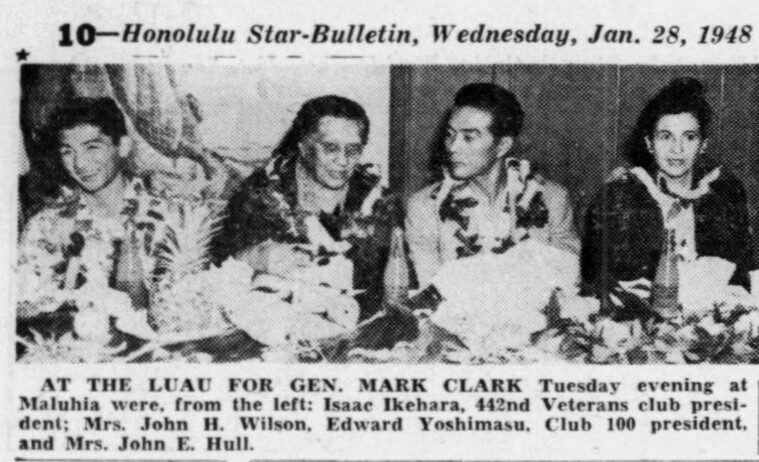
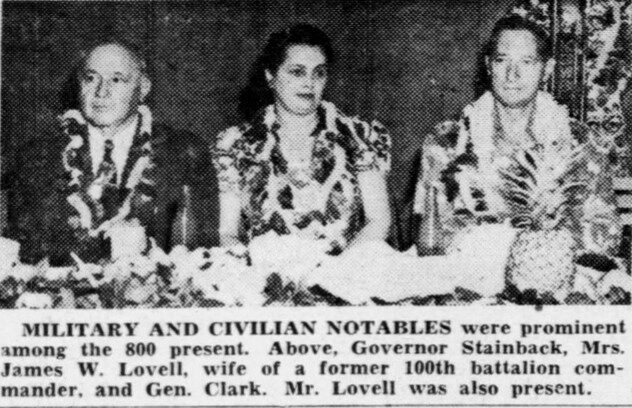
After finishing college, Ike worked as a fisheries research biologist for the U.S. Fish and Wildlife Service until 1955, when he moved to the Hawaii Fish and Game unit as an aquatic biologist.
In 1962, Ikehara and his family moved to Guam. He first worked for the Department of Agriculture, Fish and Wildlife Division, serving as Division Chief from February 1966 to March 1972. In addition, during 1965-1966 he was Guam’s Acting Director of Agriculture. In 1972 he was named Chairman of the Guam Water Pollution Control Commission, after having served on the Commission since 1967. In the 1970s, he served on Guam’s Environmental Protection Agency (EPA) Board and was appointed at the Federal level to a 2-year term on the Western Pacific Fishery Management Council. While living in Guam, Ike was active in the Hui O Hawaii Club and the Hawaiian Golf Club. He was listed as a service, fish, and wildlife consultant in the December 1978 Guam Business Directory, residing in the town of Tamuning. His wife Betty retired from RCA Global Communications in Guam.
In 1964 Ike took his family to Italy. His son remembers that they drove from Rome to Monaco in a Volkswagen beetle, stopping off in Florence, Pisa, Livorno, and Genoa, which he assumed at the time were the places that K Company had been. His father “even spoke some ‘pidgin Italian’ during that visit.”
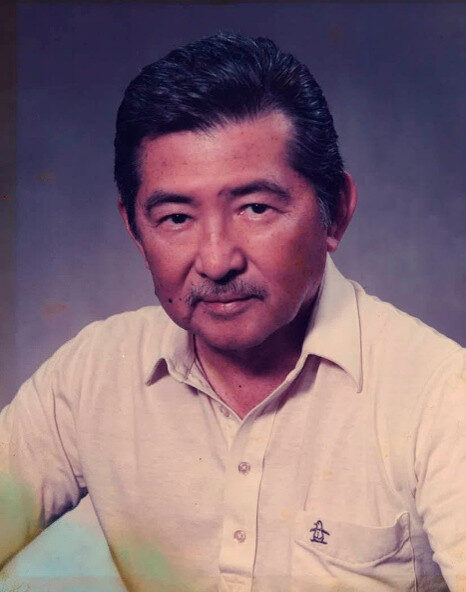
Left: Ike in the 1980s
Ike’s father Seikichi died on October 15, 1970, in Honolulu at the age of 83. His mother Kanako died on November 12, 1991. She was the retired owner of Ike’s Walk-In and a member of the Kalihi Union Church.
After retiring from government work, Isaac and Betty continued to live in Guam, returning to Hawaii shortly before he died on August 20, 1994, at the age of 70. He was survived by his wife, two sons, brothers Clark and Thomas Ikehara, sister Lillian Gillis (Mrs. John Q.), and six grandchildren. His memorial service was held at 12:00 p.m. at Hosoi Mortuary on August 27. Ikehara was buried at the Hawaii State Veterans Cemetery in Kaneohe, Section 49, Site 5. Betty Ikehara died in Mililani, Oahu, on February 5, 2000, at the age of 75 and was buried with her husband.
Researched and written by the Sons and Daughters of the 442nd Regimental Combat Team in 2026, with assistance by his son.