Soldier Story: Iwao Morita
Soldier Story
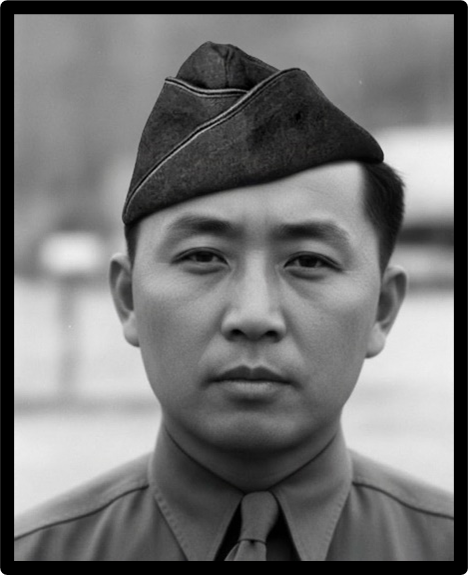
Iwao Morita
Private First Class
100th Infantry Battalion (Separate)
F Company
Iwao Morita was born on August 1, 1908, in Hanamaulu, Kauai, Territory of Hawaii. He was the second son of Tosaku and Taka (Inouye) Morita. His siblings were: brothers Isami, Masatoshi, Toshiaki, Matao, Tozo, Kiyoshi, Makoto, and Satoshi; and sisters Midori, Kayoko, and Harumi.
Father Tosaku and Taka emigrated from Japan in 1902. They arrived from Fukuoka Prefecture on the S.S. Korea on November 12 at the ages of 22 and 19, respectively.
In 1910, the family was living in Hanamaulu on the Lihue (Sugar) Plantation. Iwao attended Hanamaulu School.
In 1920, the family was living on Plantation Road in Hanamaulu. Father Tosaku was a plantation laborer.
In 1930, father Tosaku and Iwao were mechanics at the sugar mill and Masatoshi was a blacksmith on the plantation.
In the spring of 1940, Iwao – age 32 and unmarried – was still with the family. He worked from home as an automobile mechanic, and father Tosaku was a machinist and Masatoshi a truck driver on the sugar plantation. Brother Toshiaki worked as an automobile mechanic at a repair shop.
Iwao signed his draft registration card on October 24, 1940, Local Board No. 2 in Lihue. His father was his point of contact and their address was P.O. Box 124 in Hanamaulu. He was unemployed at the time. Morita was 5’3” tall and weighed 130 pounds. On November 27, 1940, it was reported in the Honolulu Star-Bulletin that Iwao was among the Kauai volunteers for the draft.
On December 1, the volunteers began to undergo physical examinations. It was reported that the men on the east side of Kauai, including Hanamaulu, were so eager to enter the service that they waived any claim of exemption.
Iwao Morita was inducted into the U.S. Army on December 10, 1940, at Lihue, Kauai. He was sent by inter-island steamer with the other new soldiers for the 299th Infantry Regiment, Hawaii National Guard (which had been federalized on October 15) to Schofield Barracks on Oahu. There was a festive sendoff for the 71 Kauai men as they left Pier 2 in Nawiliwili Harbor for Oahu. They were in the first draft of Kauai men.
After arrival in Honolulu, the new soldiers were sent to Boom Town, the tent city for trainees at Schofield Barracks. On March 14, 1941, it was announced that their training was completed and the soldiers assigned to their unit. Iwao was assigned to Company C, Schofield Barracks Reception Center.
On May 28, 1942, Army Chief of Staff General George C. Marshall established the Hawaii Provisional Infantry Battalion composed of the 298th and 299th Hawaii National Guard and other units.
Morita, as part of the Hawaii Provisional Infantry Battalion, sailed on the U.S.S. Maui on June 5, 1942, for the mainland. Upon arrival at Oakland, California, on June 12 the unit was activated and designated as the 100th Infantry Battalion (Separate). The term “Separate” meant that they were not assigned to a larger unit. They were then sent by train to Wisconsin for basic training at Camp McCoy. The 100th was authorized to be an “oversized” battalion, as an infantry battalion normally has four companies and the 100th had two extra rifle companies, that is, Company E and Company F.
At Camp McCoy, Morita was assigned to F Company, 1st Platoon. After six months of training, on January 6, 1943, the 100th was sent to Camp Shelby, Mississippi, for combat training and maneuvers. Lieutenant General Lesley J. McNair, chief of Army Ground Forces, took an interest in the 100th, possibly as he had been stationed in Hawaii in 1921. He issued orders for them to undergo extensive training in rifle squads, tactics, and leadership. In April, the 100th was sent on field maneuvers to Camp Claiborne, Louisiana. Their training was observed by Lt. Gen. McNair, who determined then that they would be deploying overseas in one to two months. On June 16, the unit returned to Camp Shelby.
On August 11, the 100th left Camp Shelby by train for Camp Kilmer, New Jersey. They were then sent to Staten Island, New York, where they sailed on the S.S. James Parker on August 21 for the Mediterranean. On the ship manifest at Camp Kilmer, Morita’s name was crossed off, but then approved for shipment as initialed by commander Lieutenant Colonel Farrant L. Turner. This is an indication that Morita may have been ill while awaiting the ship, but had recovered in time to be cleared for embarkation.
After entering the Mediterranean, the 100th arrived at Oran, Algeria, on September 2, 1943.
In Oran, Lt. Col. Turner was initially given the option of having his men serve as guards for rail lines and supply depots. He pressed for combat duty as he knew his men were ready and eager to fight. As a result, they were assigned to the 133rd Infantry Regiment, 34th (“Red Bull”) Division. After receiving training in German tactics and land mines, they left Oran on September 19 with the 34th Infantry as its “1st Battalion” on the S.S. Frederick Funston.
The 100th went ashore at Salerno, about 35 miles south of Naples, Italy, with the other two battalions of the 133rd on September 22. The two extra companies – Company E and Company F – were assigned to remain at Salerno on guard duty in the beach area: Company E at an ammo dump and Company D at a temporary airstrip that had been leveled off for use by P-40 fighter aircraft. The other companies marched off of the dunes onto hot, dusty roads. A 6-mile hike brought them to a bivouac area.
Capture of the hills in this area was crucial in clearing the way to Monte Cassino, an integral point in Germany’s Gustav Line, a string of heavily defended fortifications.
While Companies E and F were still in Salerno, the 100th had proceeded south and then north, pushing the Nazis back, through Montecorvino, Montemarano, Castelvetere, Chiusano, Montefalcione, and Benevento. On October 4, the 34th Division went into assembly areas off the front lines. The 133rd Regiment, including the 100th Battalion, camped about 10 miles southwest of Benevento near San Martino. Since Salerno, they had lost three men killed, 23 wounded, and 13 injured in accidents. On October 7, they were trucked north to bivouac at Montesarchio, where they spent eight days before moving on to Bagnoli. It was in Bagnoli that Companies E and F were trucked up from Salerno and finally rejoined the outfit.
During this period, General Charles W. Ryder, 34th Division commander, gave his 100th troops a token of his esteem – the Red Bull shoulder patch to wear on the sleeve of their uniform.
The 100th made its first crossing of the Volturno River on October 18. The next day at midnight, they waded across the Volturno again. Next came the attack on San Angelo d’Alife where the 100th suffered more casualties. On October 24, Lt. Col. Turner ordered Companies E and F to relieve Companies A and C – meaning that the two extra companies were in active combat at this time.
After San Angelo and its commanding heights had been secured, the 100th had lost 21 killed and 67 wounded. The 133rd, including the 100th, was in divisional reserve near San Angelo from October 25 to 31. On November 1 they were back on the move and facing their third crossing of the Volturno River, which at this point was no great obstacle at a depth seldom over two feet on level ground. After this crossing, the advance was into bald and rugged mountains where the Germans had set up a strong defense line including heavily mined areas. The attack was up mountain sides, with trails that jeeps could not negotiate.
In the attack on November 5, Companies E and F were in the lead. Pfc. Iwao Morita died of wounds received on this day just north of the Volturno River at Santa Maria Oliveto east of Pozzilli. He was buried at the U.S. Military Cemetery at Telese about 50 miles south.
For his military service in World War II, Private First Class Iwao Morita was awarded the: Bronze Star Medal, Purple Heart Medal, American Defense Campaign Medal, American Campaign Medal, Asiatic-Pacific Campaign Medal, European-African-Middle Eastern Campaign Medal with one bronze service star, World War II Victory Medal, and Combat Infantryman Badge. He was posthumously awarded the Congressional Gold Medal on October 5, 2010, along with the other veterans of the 100th Infantry Battalion (Separate). Conferred by the U.S. Congress, the award states: “The United States remains forever indebted to the bravery, valor, and dedication to country these men faced while fighting a two-fronted battle of discrimination at home and fascism abroad. Their commitment and sacrifice demonstrate a highly uncommon and commendable sense of patriotism and honor.”
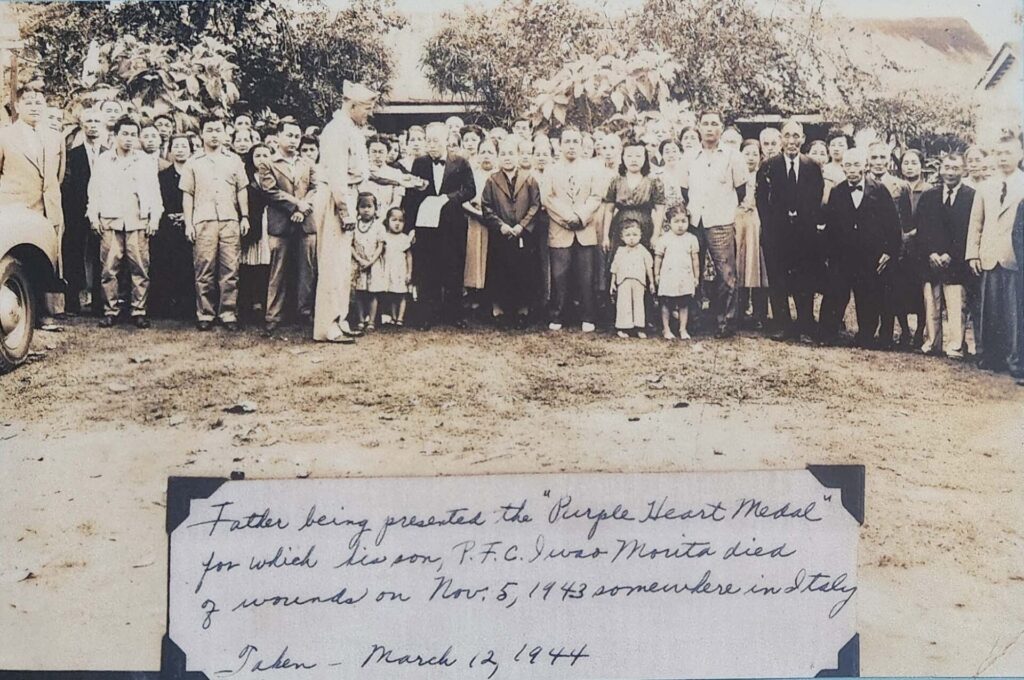
In 1947, the US began a program of closing most of the overseas wartime military cemeteries. Families were notified that they had the option of having their loved one reinterred in one of the few remaining cemeteries overseas or returned home. The Morita family chose to have Iwao brought home.
Private Iwao Morita’s remains arrived on December 24, 1948, at Pearl Harbor’s Pier M-3 aboard the USAT Sinnet with the remains of 121 other of Hawaii’s fallen soldiers. More than 700 families and friends were there to meet the ship as it docked while the 264th Army Band was playing Aloha Oe. A brief memorial service was held at the pier, conducted by USARPAC chaplain Edwin L. Kirtley. After a moment of silence and a prayer by Army chaplain Eugene L.A. Fisher, the Secretary of Hawaii, Oren E. Long, eulogized the men: “We are proud to have had such sons. These men stood the test of action and added a new chapter of American heroism to our history.” Navy chaplain Wendell Wheeler gave the benediction. The flag-draped caskets were taken to Schofield Barracks where they were stored in the Army Mausoleum pending funeral arrangements by the families.
Iwao Morita’s remains were later shipped to Kauai, arriving at Port Allen. He was buried at the Kauai Veterans Cemetery. His father Tosaku Morita applied for his U.S. Government gravestone on February 7, 1949. Morita was the first of his family to die. His survivors included his parents, eight brothers, and three sisters. His sisters later married: Harumi became Mrs. Susumu Yoshikami and Kayoko became Mrs. Fred K. Izuka.
On the tombstone application form signed by his father on February 7, 1949, Morita’s unit was shown as Company F. In pencil, Company D was written in below this. According to the record as written in the 1954 book, Ambassadors in Arms, by Thomas D. Murphy, on November 13, over a week after Morita’s death, some men from Companies E and F were transferred to the other companies to fill the gaps caused by casualties. And a month later, on December 15, the few men left in Companies E and F were assigned to C Company of the 100th.
The name of Iwao Morita appears with the names of 58 other Kauai soldiers killed in World War II on the Toba Memorial Tablets. The tablets, just discovered in August 2025, are located on the second floor of the Memorial Tower adjacent to the Waimea Shingon main temple. The tower was built by Kauai Gold Star families after World War II.
His brothers Masatoshi Morita served in the 100th Infantry Battalion (Separate), E Company, and Ronald Kiyoshi Morita served in the 442nd Regimental Combat Team, 2nd Battalion, E Company.
Researched and written by the Sons & Daughters of the 442nd Regimental Combat Team in 2025, for his niece and her husband who are members.