Soldier Story: James Satoshi Kawashima
Soldier Story
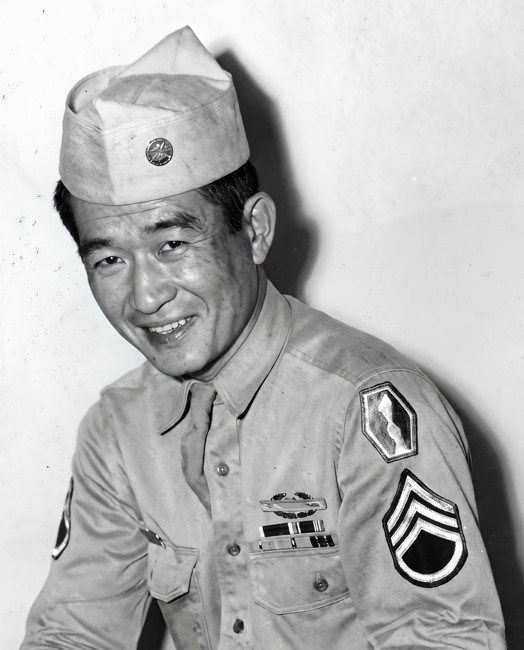
James Satoshi Kawashima
Staff Sergeant
442nd Regimental Combat Team
100th Infantry Battalion, C Company
James Satoshi Kawashima was born on September 19, 1918, at 2859 Manoa Road, Honolulu, Territory of Hawaii. He was the eldest of three sons of Sakichi and Masaki (Nishimura) Kawashima. His brothers were Oscar Kiyoshi and David Wataru.
Father Sakichi, born on March 9, 1892, in the village of Kasahara, Fukuoka Prefecture, Japan, emigrated to Hawaii in 1907. In 1910, he was single and living at Camp No. 10 in Puunene, Maui, where he worked on the sugar plantation. He lived with Tanizo Matsuda and Mosaburo Isuahara, two other plantation workers.
Mother Masaki Nishimura was born on October 10, 1900, in Honolulu to Rokuro and Tatsuye Nishimura who arrived from Niigata Prefecture, Japan, in 1899. She and Sakichi Kawashima were married on July 7, 1917, at 1325 Piikoi Street by the Reverend Frank S. Scudder, a Congregational minister.
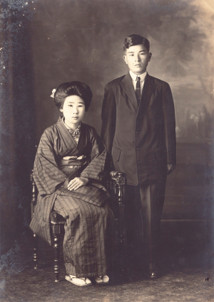
Right: Sakichi and Masaki Kawashima
In 1917, when Sakichi signed his World War I draft card on July 31, he and Masaki lived at 2213 Manoa Road where he was a yardboy for Dr. Blodgett. In 1920, they were working for the Cooke family at 2859 Manoa Road. He was a garden worker and she was a maid. In the 1930 Federal Census, Sakichi’s wife is erroneously and confusingly identified as “Shizuku” – there is no record of Sakichi having any other wife than Masaki. [Note: The name perhaps was confused with another Kualii house servant named Shizuko Kawabata.]
Jimmy, as James Kawashima was known, was raised at Kualii, the historic, 30-acre Manoa Valley property that was home to the family of Charles Montague Cooke Jr. and his wife Lila Lefferts Cooke. His father was employed in various positions, and eventually he was the family chauffeur, while his mother was house maid to the Cooke family. Among the entire staff, his parents held the highest positions. When Jimmy became old enough, he worked for the head gardener.
On October 26, 1940, Kawashima signed his draft registration card at Local Board No. 4, 1083 South Beretania Street. His point of contact was his mother. He was employed by C.M. Cooke Jr., and lived with his family at his place of employment at 2859 Manoa Road. He had a scar above his left eyebrow, was 5’6” tall, and weighed 125 pounds.
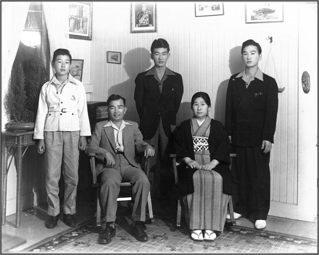
Left: David, Sakichi, James, Masaki, Oscar Kawashima, c. 1940
On March 25, 1941, James Kawashima enlisted in the U.S. Army. His residence was the Cooke address on Manoa Road, he was listed as “Gardener/groundskeeper,” and he had attended McKinley High School.
On June 21, 1941, Jimmy was among the 146 Selective Service men of the 298th Infantry of the Hawaii National Guard who had just completed 13 weeks of intensive training on Oahu. He was assigned to 1st Battalion, Company G of the 298th stationed at National Guard Woods, their new home at Schofield Barracks.
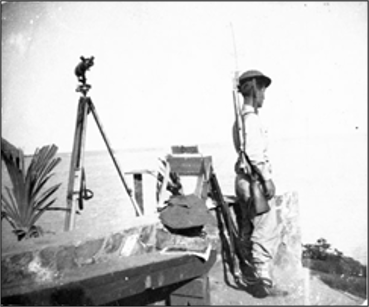
Right: Kawashima standing guard at Wailea Point near Waimanalo on Oahu, late 1941
In 1942 Kawashima was among the 1,432 officers and men who sailed on June 5 on the S.S. Maui and arrived in San Francisco on June 12. They were designated the 100th Infantry Battalion (Separate) and Jimmy was a Corporal in 1st Platoon, Company B. They trained at Camp McCoy, Wisconsin, and then on January 6, 1943, were transferred to Camp Shelby, Mississippi, for more training, with field maneuvers at Camp Claiborne, Louisiana.
The 100th (Separate) departed Camp Shelby on August 11, 1943, and traveled by train to Camp Kilmer, New Jersey. On August 21, they were sent by train to Brooklyn, New York, ferried to Staten Island, and boarded the S.S. James Parker. They sailed in a convoy the next day at dusk to the Mediterranean Theater. Corporal Kawashima was on the ship and listed in B Company, 1st Platoon.
Initially landing in Oran, Algeria, on September 2, the 100th Battalion (Separate) was assigned to guard supply trains traveling from Casablanca to Tunisia. Wanting frontline duties for his men, the 100th’s commander Colonel Farrant Turner rejected this, and the 100th was subsequently assigned to the 34th Infantry (“Red Bull”) Division as its “2nd” Battalion. On September 22, they sailed from Oran on the USAT Frederick Funston and landed on the beach at Salerno, Italy, as part of the 133rd Infantry Regiment, 34th Infantry Division.
The 100th entered the combat zone the next day, September 23, 1943. Kawashima was there for all of the 100th’s action in the Naples-Foggia Campaign: Benevento, three Volturno River crossings, Alife, Rapido River, Pozzilli, and Monte Cassino. In November, Corporal Kawashima was wounded in his left arm by shrapnel from a land mine explosion. The exact date was not found in our research; however, it was in the vicinity of Pozzilli and Venafro. He was in the hospital for about a month and then returned to duty in December.
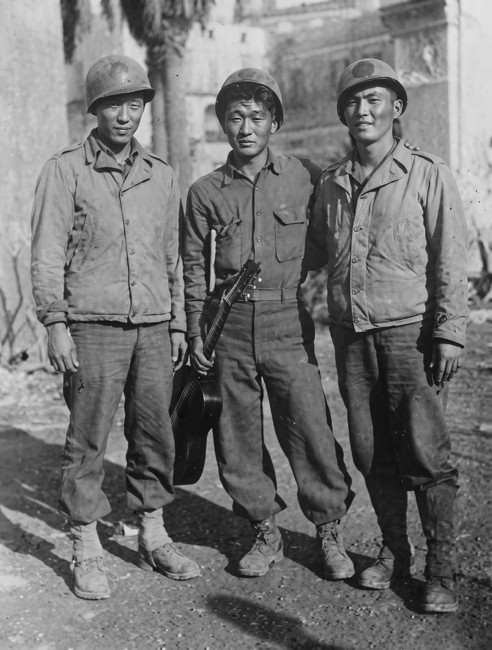
Left: Kawashima (center) with buddies, 1943
The 442nd Regimental Combat Team arrived in Italy from Camp Shelby on May 28, 1944. They met up with the 100th Infantry Battalion (Separate) at a large bivouac near Civitavecchia, north of Rome. The 100th (Separate) was assigned to the 442nd on June 11.
On June 26, the 442nd and the 100th entered combat together near Suvereto in the Rome-Arno Campaign. Their mission was to push the Nazis north to Pisa.
On August 10, the 100th Infantry Battalion (Separate) was designated the 100th Battalion, 442nd Regimental Combat Team. They were in effect the Combat Team’s “1st Battalion,” which had been depleted while at Camp Shelby by sending replacement troops to the 100th (Separate) in Italy. They were permitted to keep their “100th” designation to honor their outstanding training and combat record.
By September, the 442nd had pushed the enemy north to the Arno River and was assigned to the west of Florence. By this time, the Supreme Allied Command had decided that the 442nd would be sent to the Seventh Army to engage in the battles to liberate France. They were transported to the port of Piombino on September 10 and left the same day on Liberty ships for Naples, arriving the next day. While there, they were bivouacked in an area of olive groves and the men were given day-passes to Pompeii and Naples.
On September 27, the 442nd sailed on the troop transport ships U.S.S. Samuel Chase, U.S.S. Joseph T. Dickman, U.S.S. Henrico, and U.S.S. Thurston to the southern coast of France.
Upon arrival on September 30, the men moved ten miles by train to a staging area in the vicinity of Septèmes. On October 8, they left by trucks and traveled north up the Rhône Valley, arriving at Charmant-devant-Bruyères on October 11. They were attached to the 36th Division, 7th Army.
The fierce fighting in the Rhineland-Vosges Campaign was made worse by the weather – it was unrelentingly cold, rainy, snowy, and miserable for the men, who were still in their summer uniforms.
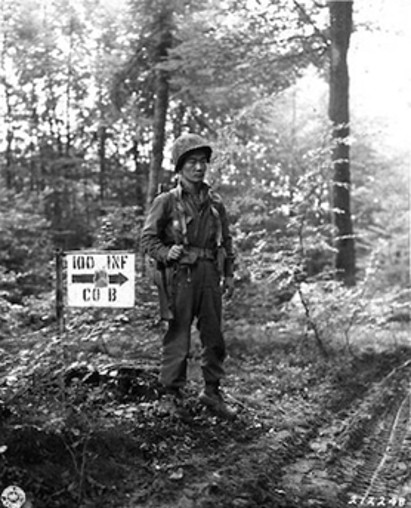
Right: 1st Platoon Leader S/Sgt. Kawashima near B Co. command post in the heavily forested and muddy Vosges Mountains, October 1944. He had removed his S/Sgt. stripes to avoid being a target.
The 100th Battalion fought in the battle to liberate the important rail and road junction of Bruyères. The Combat Team jumped off at 8:00 a.m. on October 15, with Kawashima’s B Company assigned to take Hill “A,” one of the four hills surrounding the town. By 10:00 a.m. they were in a heavy firefight with strong enemy forces. Hill A was finally taken on October 18. Bruyères was liberated later that day. The fighting to clear the enemy from the hills around the town, however, continued for several more days.
On October 24, the 100th was in reserve in the nearby village of Belmont. Kawashima suffered a twisted ankle and was kept in a field hospital there when the 442nd was ordered to rescue the 1st Battalion of the 141st (“Texas”) Infantry that had advanced beyond its support and was surrounded by the enemy. This was the famous battle that became known as the “Rescue of the Lost Battalion.” Fortunately for S/Sgt. Kawashima, he was unable to join in.
After the Rescue of the Lost Battalion, the 442nd fought for several more days. Finally, by November 9, almost all elements of the Combat Team had been relieved and moved back to rest areas. The enemy line was shattered, and the 442nd was no longer combat-ready due to such high casualties. They were sent to the south of France where they could rebuild to full combat strength while participating in the Rhineland-Maritime Alps Campaign. This was mostly a defensive position guarding the French-Italian border from attack by the German Army in Italy. The 442nd was there from November 23, 1944.
Throughout their time in southern France, the men were often given day passes to Nice where they could enjoy the nightlife and the Army Rest Centers that had opened up. For this reason, their sojourn there was nicknamed the “Champagne Campaign.”
On March 15, 1945, they were relieved and moved in relays to the new staging area at Marseilles. On March 20-22, the 442nd (without its 522nd Field Artillery Battalion who were sent to fight in Germany) left France to fight in the Po Valley Campaign for the final push to defeat the Nazis in Italy. They arrived at the Peninsular Base Section in Pisa on March 25 and were assigned to Fifth Army.
The objective of the 442nd was to execute a surprise diversionary attack on the western anchor of the German Gothic Line. This elaborate system of fortifications had been attacked in the fall of 1944, but no one had yet been able to pry the Germans loose from the western end. The Gothic Line in this area was hewn out of solid rock, reinforced with concrete, and constructed to give all-around protection and observation. The Germans were dug into mountain peaks rising almost sheer from the coastal plain, bare of vegetation save for scanty scrub growth.
The 442nd successfully pushed the Germans from their start-off point at Mt. Folgorito and Mt. Carchio, while on April 4 the 100th took the hill mass designated “Florida.” They then moved on to the “Georgia” peak, which had been attacked over a five-month period but had never been taken. It took the Combat Team exactly 32 minutes to accomplish the mission. Over the coming days, the Combat Team moved north, taking from the enemy: the peaks of “Ohio” and Mt. Belvedere; the towns of Altagnana, Pariana, and Massa; crossing of the Frigido River, an 8-hour march by the 100th over a mountain trail to take Colonnata; Carrara; Mt. Pizzacuto; Gragnana and Fosdinovo; and Mt. Nebbione – the last dominant terrain before the vital road center of Aulla.
S/Sgt. Kawashima was awarded an individual Bronze Star Medal for “heroic achievement in action” on April 21, 1945, near Aulla. The town fell to the 442nd on April 25.
The Germans surrendered in Italy on May 2, 1945. The Combat Team’s first move was to regroup all units at Novi Ligure where they were in bivouac until May 16. On that date, they were sent to Ghedi Airfield near the town of Brescia to search, process, and guard the thousands of German prisoners of war. For those not on duty, a schedule of garrison training was begun. One-day passes to Milan and rest-center passes to Alassio, Venice, and the 442nd’s rest center at San Pellegrino were instituted.
Men were sent back to the US according to a “point system.” Due to his length of service (37 months overseas) and his having been wounded, Kawashima had accumulated enough points to return home from the war in June.
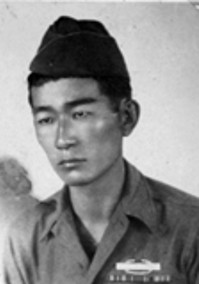
On June 28, he landed in Florida at the Miami Army-Air Force Field, and was then sent to Camp Beale, north of Sacramento, California, before arriving back in Honolulu shortly thereafter on furlough.
Right: S/Sgt. Kawashima at the end of five long campaigns
S/Sgt. James Satoshi Kawashima was awarded the following decorations for his wartime service: Bronze Star Medal with one oak leaf cluster, Purple Heart Medal, Good Conduct Medal, American Defense Medal (Pre-Pearl Harbor Medal), American Campaign Medal, European-African-Middle Eastern Ribbon with one silver star, World War II Victory Medal, Army of Occupation Medal, Distinguished Unit Badge with two oak leaf clusters, and Combat Infantryman Badge. The silver star device on the European-African-Middle Eastern Ribbon indicated his participation in five military campaigns. He was posthumously awarded the Congressional Gold Medal on October 5, 2010, along with the other veterans of the 442nd Regimental Combat Team. Conferred by the U.S. Congress, the award states: “The United States remains forever indebted to the bravery, valor, and dedication to country these men faced while fighting a two-fronted battle of discrimination at home and fascism abroad. Their commitment and sacrifice demonstrate a highly uncommon and commendable sense of patriotism and honor.”
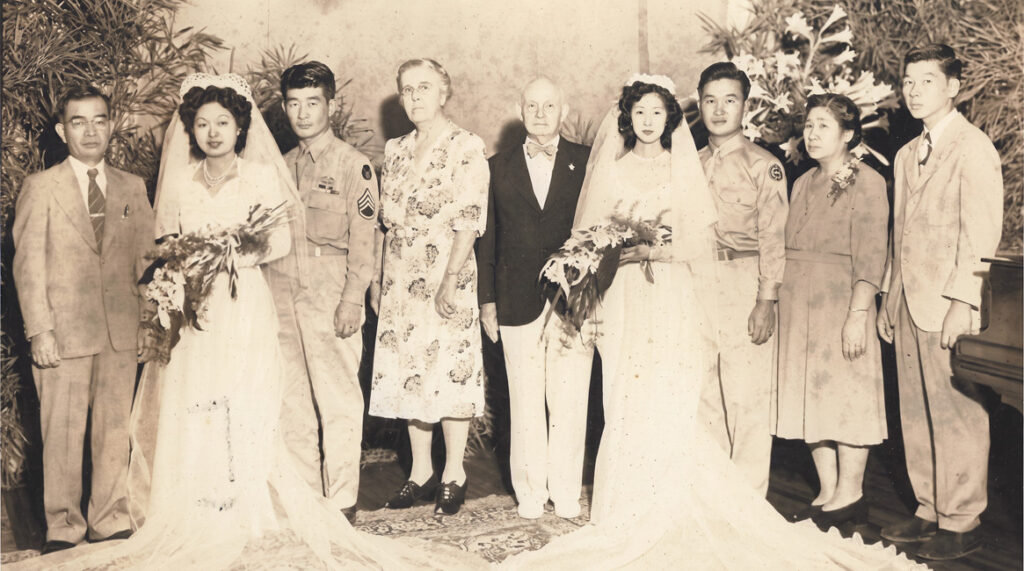
Less than a month later, Kawashima applied for a marriage license with Shizue Irene Araki of Manoa Valley on July 18, 1945. Shizue (born August 3, 1922) was the daughter of Sunao and Sachi Araki of 3839 East Manoa Road. The couple was married in a double ceremony with his brother, Pfc. Oscar Kiyoshi Kawashima and his bride, Alice Kunie Nakahama, in the large living room of the Kualii mansion. The wedding reception at Seaside Gardens on Ala Moana Boulevard served also as his homecoming from the war. The couple honeymooned at the Cooke home on Maui and lived on the Kualii estate afterwards.
Below: L-R – Father Sakichi; Shizue; James; Lila & Monte Cook; Alice; Oscar; David at the double wedding at Kualii
James Kawashima was discharged from the U.S. Army at the Separation Center in Honolulu on September 1, 1945.
A decade later James and Shizue were still employed as groundsman and maid, respectively, at the Cooke estate and they were living on the property.
Later, James was employed as a groundskeeper by the Parks and Recreation Department of the City and County of Honolulu and they lived on One Street in Manoa Valley. Over the years he was active in the 100th Infantry Battalion Veterans Club, called Club 100. He also played in Club 100’s baseball and bowling leagues. Jimmy and his brother Oscar earned their Black Belts in 1947 at the Anuenue o Manoa Judo Club.
Mother Masaki Kawashima died on March 24, 1965, at St. Francis Hospital in Honolulu. At some point afterwards, Jimmy’s father Sakichi Kawashima moved back to Maui. He died there in Kula at the age of 90 on March 30, 1982. He was inurned at Moiliili Cemetery with his wife Masaki.
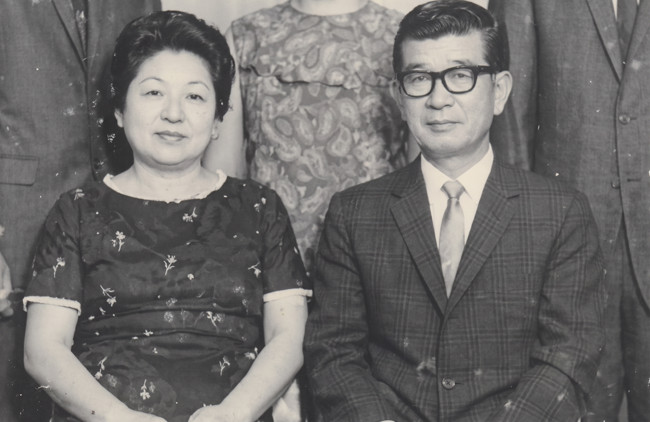
Right: Shizue & James in the 1960s
Shizue Kawashima died on December 11, 1998. She was inurned at the National Memorial Cemetery of the Pacific at Punchbowl. Section Ct8-E, Row 500, Site 519.
James Satoshi Kawashima died on April 26, 2005. A memorial service was held on May 29 at 6:00 p.m. at Hosoi Garden Mortuary. Survivors included two sons, three daughters, eleven grandchildren, two great-grandchildren, and his brother David. He was inurned next to his wife in Section Ct8-E, Row 500, Site 519 at the National Memorial Cemetery of the Pacific at Punchbowl. Their joint plaque bears the inscription “Loving Parents.”
Photos courtesy of Manoa Heritage Center and 100thbattalion.org. Visit the 100th website to read a story written in 1986 about the famous photograph taken of Kawashima in the Vosges.
His brother Oscar served from June 21, 1944, to March 7, 1946, in the 1399th Engineer Construction Battalion on Oahu and was buried in the National Memorial Cemetery of the Pacific at Punchbowl.
Researched and written by the Sons & Daughters of the 442nd Regimental Combat Team in 2021; updated in 2026.