Soldier Story: John Takehisa Matsudaira
Soldier Story
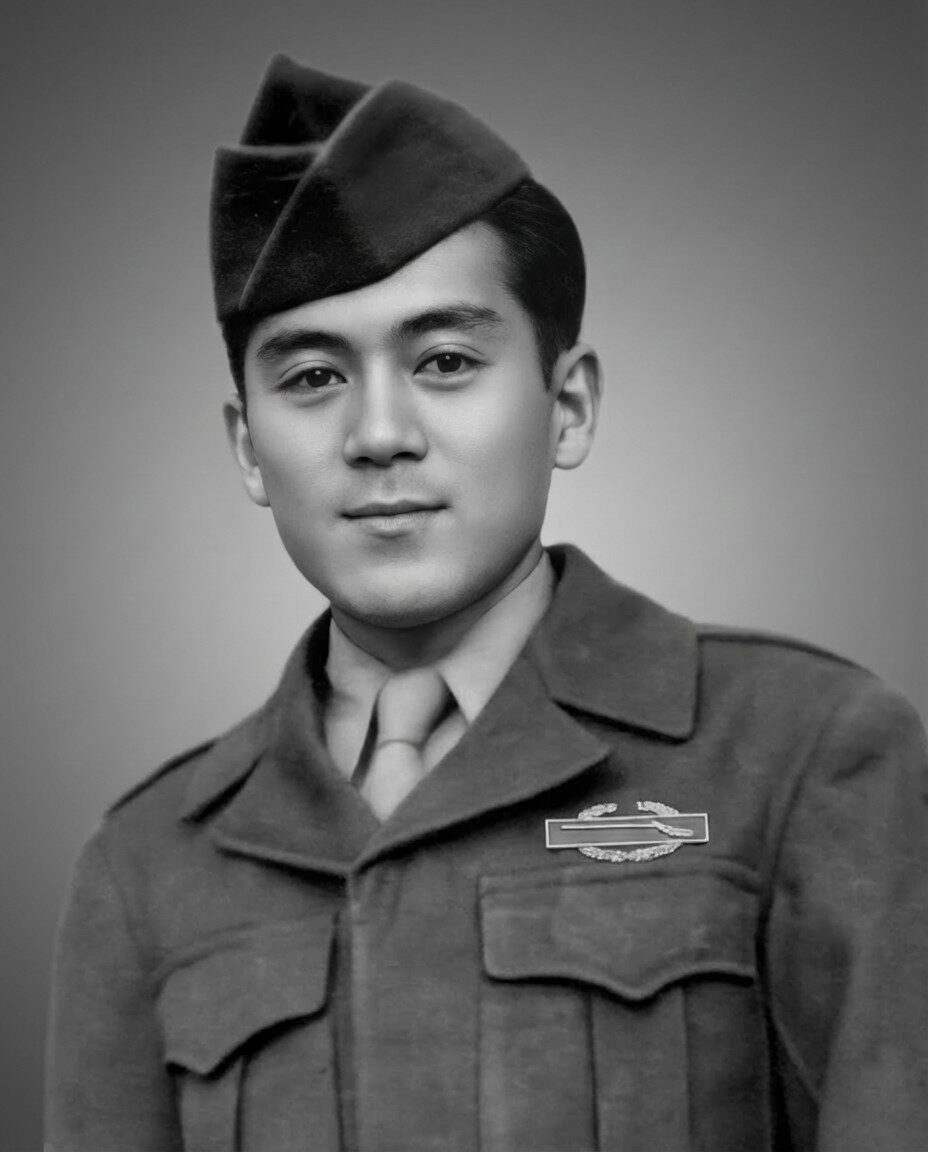
John Takehisa Matsudaira
Private First Class
442nd Regimental Combat Team
3rd Battalion, K Company
[This Soldier Story begins with the reminiscences written by John Takehisa Matsudaira.]
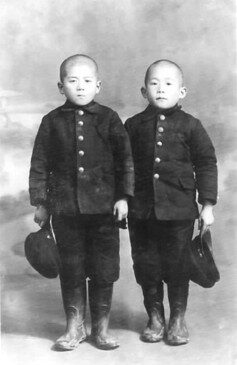
I was born in Seattle, Washington, on November 26, 1922, at the Alps Hotel in the International District. When I was six my mother [took] me and my brother to Kanazawa, Japan, where she left us with our grandparents. We finished grade school in 1935 and returned to Seattle.
Right: Schoolboys John and Michael Matsudaira, 1935, Japan
I went to the Maryknoll School and spent two years at O’Dea High School until the war started. After Pearl Harbor the family was moved to the Minidoka Relocation Center in Idaho where I worked as a swamper on a food delivery truck. The rest of my camp days were spent at the laundry room with the guys around Block 7 in discussions, debates, etc.
When I turned 21, I wanted to volunteer for the MIS [Military Intelligence Service], but was told instead to volunteer for the 442nd and then ask for a transfer at Camp Shelby. The transfer never went through.
I remember part of the [ship] convoy. On the way to Italy we stopped overnight at Augusta, Sicily. Mt. Etna was erupting. When we landed at Naples, Mt. Vesuvius was also erupting. The town of Naples was in ruins from the bombardment. We bivouacked at [Bagnoli].
Then we went to Anzio. German reconnaissance planes [came that] night and there was a display of anti-aircraft fire, like the 4th of July. We ended up north of Rome at Civitavecchia where we received more training.
[After we entered combat,] I witnessed my first casualty due to machine gun fire from across the hill. I narrowly missed getting hit.
Early morning of July 10, 1944, the whole company was resting behind Hill 140 when there was an airburst. I was the only one who was wounded and remember being carried out by Sgt. Iwamoto, Dick Naito, James Takeda, but do not know the fourth person. I was hit in the abdomen by shrapnel. I thought I had a stomach ache.
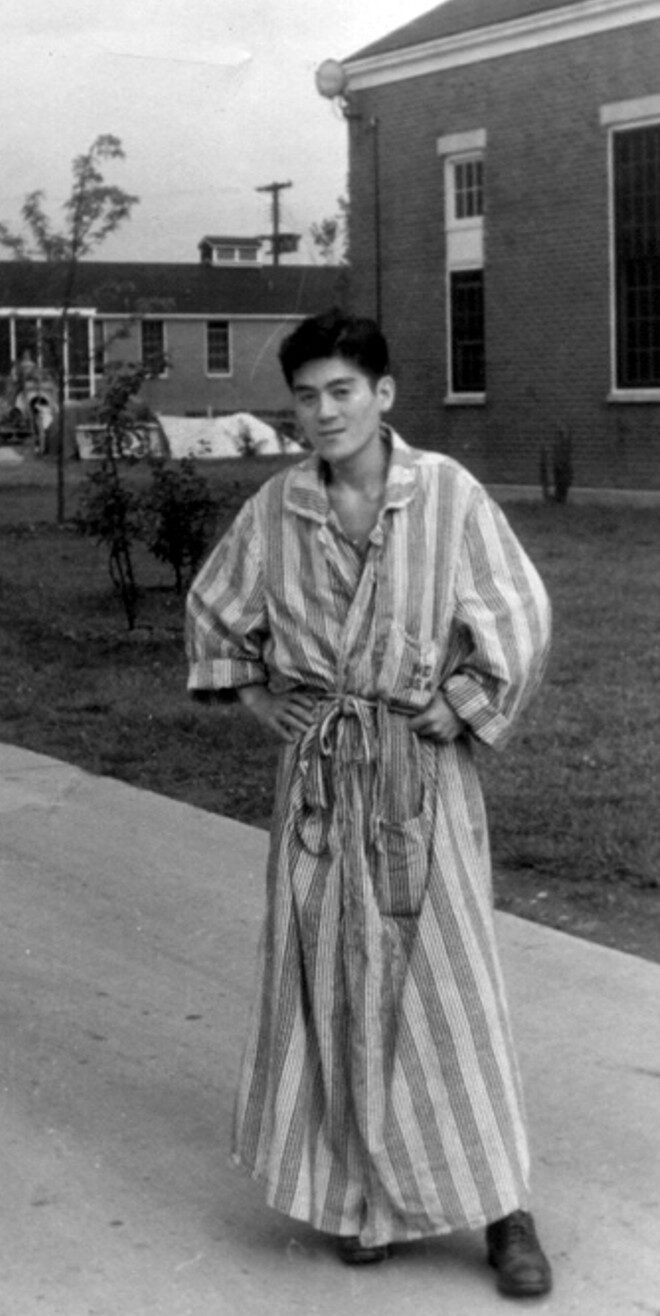
It was an injury that kept me in the hospital for three years. The priest delivered last rites twice. I survived thanks to penicillin and was discharged from Madigan General Hospital in 1947.
Left: Matsudaira at Madigan Hospital, 1947
After my discharge I went to the Burnley Art School in Seattle for three years. I worked at Boeing as a draftsman and retired after 32 years. In my off hours I was an artist, working in watercolors and oil acrylic. My work has been exhibited in galleries in Seattle. I haven’t painted for many years due to a wrist ailment.
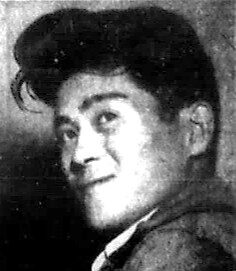
Below: Matsudaira after the war
[Following is the Soldier Story researched and written by the Sons & Daughters of the 442nd RCT.]
John Takehisa Matsudaira was born on November 26, 1922, in Seattle, Washington. He was the eldest child of Tokuhisa Thomas and Hotoru Theresa (Umeda) Matsudaira. His siblings were Michael Yoshihisa, Francis (“Tebo”)Teruhisa, James Iwao, Pauline Tsuyuko, Theophane Satoshi, Martin Mitsuyuki, Joseph Yukio, Yuriko Mary Elizabeth (died 1949 at age 7), Ida Shizuko, Vincent Akira, Theresa, and Stephen.
Parents Tokuhisa and Hotoru emigrated from Kanazawa, Ishikawa Prefecture, Japan. Hotoru was born in the district of Nomi. Tokuhisa was born in the city of Kanazawa and he arrived in Seattle in May 1909 at the age of 17. Tokuhisa returned to Kanazawa to marry Hotoru on May 21, 1921. They arrived in Seattle on July 22, 1921.
When John was six years old about 1928, his mother Theresa took his brother Michael and him to Japan. She returned to Seattle and the boys remained with their grandparents, Mr. and Mrs. Kumakichi Matsudaira, at 1-30 Kamiomi-machi, Kanazawa. As a schoolboy, John participated in a citywide art project and won first place for his drawing. The following year, Theresa converted to Catholicism.
John and brother Michael remained in Japan to finish grade school in 1935. They arrived back in Seattle on the Hiye Maru at the ages of 13 and 11, respectively. The ship sailed from Kobe and stopped at Yokohama before crossing the Pacific. It arrived at Vancouver, British Columbia, Canada, on November 23, 1935, and the boys stayed aboard, soon docking in Seattle where their father met them. The family was living at 306 Maynard Avenue. The boys were then enrolled at Maryknoll School.
In 1940, the family was living at 522 16th Avenue, in a house that they owned. Father Tom worked as a foreman at Kodiak Fisheries Company. John entered O’Dea High School in 1940.
On April 26, 1942, 51-year-old father Tokuhisa Thomas Matsudaira signed his draft registration card at Local Board No. 7, 305 Harrison Street in Seattle. It was noted on the card that his left eye was missing and he wore an eye patch. His point of contact was Father Tedesa at Maryknoll School.
The family was evacuated in May 1942 to the Puyallup WCCA Assembly Center. Shortly afterwards, John Matsudaira signed his draft registration card on June 30, Local Board No. 7, Seattle City. He was living with his family in Unit D-4-86 at the Assembly Center, which was euphemistically called “Camp Harmony.” John was 5’2” tall and weighed 110 pounds.
From there they were incarcerated at Minidoka WRA Internment Camp in Hunt County, Idaho – most of the family entered on August 18 and 22, 1942. Mother Theresa entered with newborn daughter Ida, born at Puyallup, on September 5, 1942. John was released on June 11, 1943, in order to enlist in the Armed Forces. Michael was released on November 21, 1943, for employment in Detroit, Michigan. The rest of the family, including Vincent who was born at Minidoka on July 16, 1944, was released to Seattle on March 13, 1945.
John Matsudaira enlisted in the U.S. Army on June 12, 1943, at Fort Douglas, near Salt Lake City, Utah. He was sent to the 442nd Regimental Combat Team at Camp Shelby, Mississippi, where he was assigned to 3rd Battalion, K Company.
In February 1944, John returned on furlough to Minidoka to visit his family.
After a year of basic, combat, and specialized training and field maneuvers, the 442nd left Camp Shelby on April 22, 1944. They travelled by train to Camp Patrick Henry, Virginia. On May 2, they sailed from nearby Hampton Roads in a convoy of about 100 ships, arriving at Naples, Italy, on May 28.
After over a week in bivouac at nearby Bagnoli, the 442nd was sent by LSTs on June 6 to Anzio, arriving the next day. They marched five miles to their bivouac. That night they witnessed the aerial fireworks as the enemy raided the supply dumps at Anzio. Long red tracer streaks criss-crossed the sky, punctuated by the quick flashes of flak bursts as the Allied gunners followed the flight of the German planes.
On June 9, the Combat Team left Anzio and were trucked through the recently liberated city of Rome to a large bivouac at Civitavecchia, about 50 miles north. There, they prepared for movement to the front lines in the Rome-Arno Campaign.
Matsudaira entered combat with the 442nd near Suvereto north of Rome on June 26 – with their objective of capturing the seaport city of Livorno 50 miles farther north.
Over the next 15 days, the 442nd steadily pushed the Germans north along the western side of the Italian peninsula. The towns they captured, liberated, or – in the case of unopposed entry – were the first to enter, were: Suvereto and Belvedere on June 26, Sassetta on June 27, Molino a Ventoabbto on July 3, and Hill 140 in the vicinity of Castellina on July 9.
On July 1, the 442nd’s 100th and 2nd Battalions had crossed the Cecina River, easily fordable at that time of year. The 3rd Battalion remained in reserve on the south side of the river. Resistance, while not heavy, was stiffening, indicating that the enemy would make some sort of a stand on the high ground just north of the Cecina River. On July 3, enemy artillery fire became increasingly heavy.
By mid-day on July 4, K Company had crossed the river and relieved the 100th Battalion at Hill 140. The relief, carried out in daylight, brought on a storm of enemy self-propelled and artillery fire, causing heavy casualties in both battalions. Third Battalion sustained a five-hour artillery barrage. It gained very little ground but managed to improve its position somewhat.
Furious firefights ensued all through the day on July 5. Enemy resistance was skillful and determined. All along the front the Germans held more doggedly than at any time since the breakthrough at Cassino and Anzio in the earlier Naples-Foggia Campaign, which had been experienced by the 100th Battalion (Separate). The battle for Hill 140 was later nicknamed “Little Cassino.” The enemy prisoners being captured said that they had been “ordered to hold until the defenses at Pisa were completed.”
On July 7, 3rd Battalion had been working its way up the western slopes of Hill 140, in reality a long ridge that ran west from the summit of the hill to the sea. The Germans were well dug in. K Company took the brunt of the attack, and their advance was measured in yards. On July 7, the last German resistance was battered into submission and the assault companies were able to push on more rapidly. Third Battalion was then ordered to cut the road from the town of Castellina west to Rosignano Marittimo.
On July 8, 3rd Battalion and the rest of the regiment moved on to take the road from the town of Pomaja toward the sea. On the night of July 9, 3rd Battalion was relieved by 2nd Battalion and was in reserve.
In the early morning of July 10, 1944, K Company was resting behind Hill 140 when there was an airburst. Matsudaira was wounded in the abdomen. Four comrades carried him to the plasma tent at the aid station. He was soon evacuated to a field hospital.
Below: Pfc. Matsudaira’s 1953 oil painting, entitled Foxhole. It depicts him in his coffin-like foxhole near Hill 140 and represents the cathartic rebirth from his near-death experience. Donated to the Smithsonian Museum of American Art in 2023.
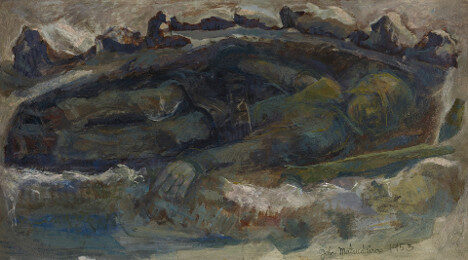
The severity of Matsudaira’s abdominal wound required a long convalescence. He was returned to the States in November 1944 for treatment at Vaughn General Hospital in Hines, Illinois.
In March 1945, John was able to visit his family at Minidoka prior to their return to Seattle. He was subsequently sent to the Army’s Madigan General Hospital at Fort Lewis, Washington, and spent another two years in medical treatment.
Below: Front row: left to right: Martin; Pauline, Mrs. Theresa Matsudaira, Vincent (baby), Elizabeth, Mr. Thomas Matsudaira, Ida, Joseph. Second row: left to right: James, Francis, Michael, Father Clement, John, Theophane
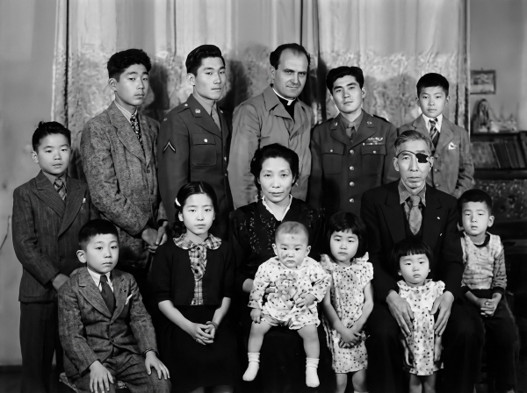
Pfc. John T. Matsudaira was discharged from the U.S Army on February 11, 1947, at Madigan General Hospital.
For his World War II service, Pfc. John T. Matsudaira was awarded the following decorations: Purple Heart Medal, Bronze Star Medal, Good Conduct Medal, American Defense Medal, European-African-Middle Eastern Campaign Medal with one bronze star, World War II Victory Medal, and Combat Infantryman Badge. He was posthumously awarded the Congressional Gold Medal on October 5, 2010, along with the other veterans of the 442nd Regimental Combat Team. Conferred by the U.S. Congress, the award states: “The United States remains forever indebted to the bravery, valor, and dedication to country these men faced while fighting a two-fronted battle of discrimination at home and fascism abroad. Their commitment and sacrifice demonstrate a highly uncommon and commendable sense of patriotism and honor.”
After his discharge from the Army, Matsudaira returned home to Seattle, about 50 miles north of Fort Lewis. He enrolled in the Burnley School of Art and Design when it first opened in 1947, and studied there for the next three years. He also studied at the Broadway-Edison Tech School, where vocational training was offered to returning veterans.
In 1950, John was living with his large family in their home at 522 16th Avenue. Father Tom was working as a fur cleaner for a fur dealer business.
While at Minidoka, John had met Lillian Aiko Inouye (born June 8, 1925), the daughter of Tsunoshi and Yayoi (Iseka) Inouye. They married on September 8, 1951, at Our Lady Queen of Martyrs Church in Seattle. Over the years, they raised three sons and one daughter.
John managed to carry on his love of painting and his friendships with other Japanese American artists in Seattle despite a lack of free time given his personal and professional obligations.
John’s mother Hotoru Theresa Matsudaira was named “Catholic Mother of the Year” in 1951, by the National Catholic Conference on Family Life. She became a U.S. citizen on November 12, 1954, in Seattle at the U.S. District Court for the Western District of Washington, Certificate No. 7219718. Her daughter-in-law Lillian was one of the witnesses to her citizenship petition.
The 442nd was an important part of John and Lillian’s lives, as they religiously attended the reunions where John visited with his Company K buddies. They also enjoyed spending time with their grandchildren. He worked as a draftsman for the Boeing Corporation for 30 years prior to retiring.
Below: 442nd Veterans 60th Anniversary Reunion, 2003; K Company. Seated: Tosh and Toshi Okamoto, Lil and John Matsudaira; Standing: Seichi and Sally Sakaida, Lily and Fred Shiosaki, Dr. Henry Shibata, Mino Takashima
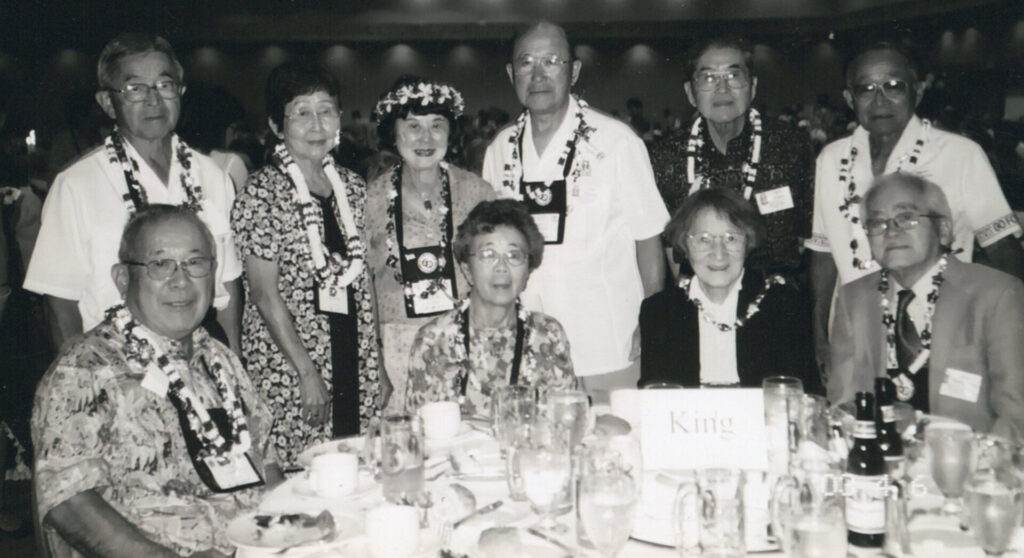
John T. Matsudaira died on January 30, 2007, in Seattle. He was survived by his wife, four children, and eight grandchildren. Following his memorial service at St. Paul’s Catholic Church, Matsudaira was buried on February 3 at Holyrood Cemetery in the Shoreline area of Seattle. His tombstone is inscribed with the words, “Purple Heart.” His wife Lillian died on May 5, 2019, and was buried next to her husband.
Postscript. The Matsudaira family attended the 442nd Veterans Reunion in Honolulu, Hawaii, in 2007, after his death earlier that year. During dinner with Munetatsu “Moon” Saito, they learned that he was next to John at the time of his wounding and was the fourth man who carried him to the aid station.
John’s art gained much recognition after his death, beginning with a retrospective exhibit, “Against the Moon: The Art of John Matsudaira,” at the Cascadia Art Museum in Edmonds, Washington, in 2016.
In an article about him and the “Northwest School” of artists, he had responded to a question by the author about his wartime experiences. Matsudaira’s short reply sums up well the attitude of many veterans of the 442nd and their reluctance to talk about the war to their families. He said: “It’s hard to explain to anyone who wasn’t there.”
For his interview by the Densho Oral History Project, go to www.densho.org.
Brother Michael served in the Military Intelligence Service at Fort Snelling,MN and in the U.S. Army Far East Command at the end of the war.
Researched and written by the Sons and Daughters of the 442nd Regimental Combat Team in 2026, with assistance by the Matsudaira family.