Soldier Story: John Yoshiyuki Udaka
Soldier Story
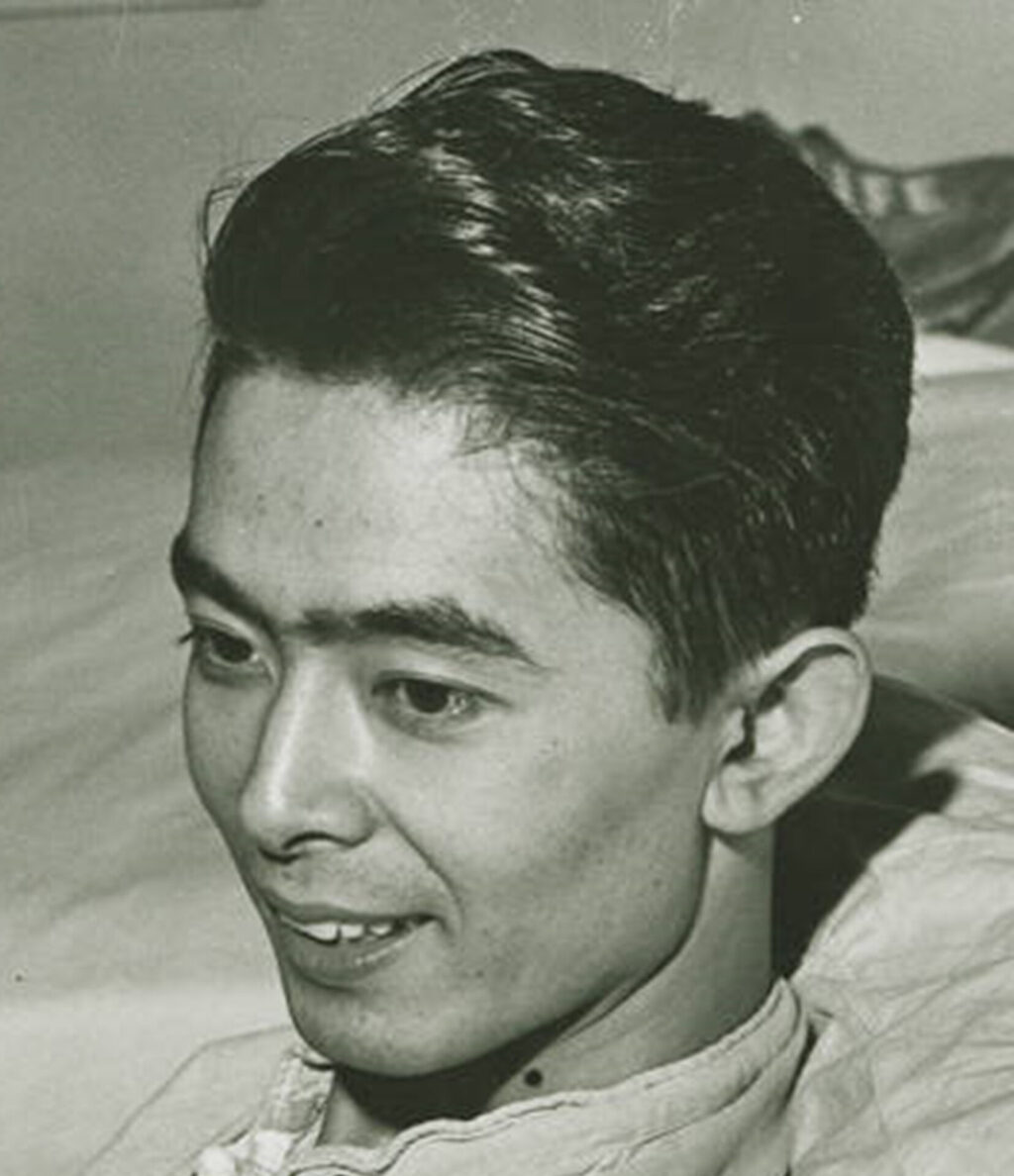
John Yoshiyuki Udaka
Staff Sergeant
442nd Regimental Combat Team
3rd Battalion, L Company
John Yoshiyuki Udaka was born on October 17, 1919, in Portland, Oregon, to Yukichi and Taki (Izuta) Udaka. His younger siblings were: brother Takuo, and sisters Yutako and Eiko. The firstborn child had died by 1919.
Yukichi Udaka (born in 1890) emigrated to the US, arriving in Honolulu, Territory of Hawaii, from the village of Toyama, Asa District, Hiroshima Prefecture, Japan, on April 30, 1906, on the S.S. Doric at the age of 16. Taki was born in 1896 in the village of Hira, Asa District. She married Yukichi about 1916 and emigrated to the US in 1918.
In 1917, when Yukichi registered for the World War I draft, he was living in Jennings, Montana, and working for the Great Northern Railway Company. He was married and had one child (the child who died by 1919).
In 1920, the couple lived at 27 North 4th Street in Portland with their infant son, Yoshiyuki. Yukichi owned and operated a bathhouse and laundry at the property.
When he was a small child, Yukichi and Taki took Yoshiyuki to Japan to see his grandparents. They returned to the US with him on the Iyo Maru, arriving on October 15, 1922, when Yoshiyuki was three years old. Listed as their US contact was their Portland neighbor, Mr. R. Hashimoto of 24 North 4th Street.
By 1930, the family had moved to Nashville, Tennessee, where Yukichi was a poultryman and started a chick sexing business. When his grandfather died in Japan, Yoshiyuki was taken again to Japan with his parents, so that his father could assume leadership of the family. While he was in Japan, Yoshiyuki followed in his father’s footsteps, and studied the science of chick sexing under Dr. Kiyoshi Masui of Tokyo University, who had developed the process in 1927.
At the age of 18, on May 18, 1938, Yoshiyuki returned to the US, arriving at Seattle, Washington, on the Hiye Maru. He was a student, and his nearest family was his father Yukichi Udaka in Toyama village. His US point of contact was a former Portland neighbor, Mr. Masuoka Baiichi of 24 North 4th Street.
John Yoshiyuki moved to Birmingham, Alabama, where he planned to establish a chick sexing business. He also traveled back and forth to Nashville, Tennessee, where he was living when he was listed in the National Draft Order held in Washington DC in October 1940 with nine other local men categorized as “Order 1298 – [local] Serial Number 2003.”
John signed his World War II draft registration card on July 1, 1941, Local Board No. 5, in Nashville. He was living at 3132 Long Boulevard where his employer W.D. Tapp also resided. He worked in a chicken hatchery located at 309 2nd Avenue North. His point of contact was Mr. Tomio Yuki of 3725 Dalton Avenue in Los Angeles, California. John was 5’7” tall and weighed 115 pounds. It was noted on his card that he wore glasses.
John was living in a Nashville boarding house when Pearl Harbor was attacked on December 7, 1941. He later recalled that not long after the attack, the FBI knocked on his door and placed him under house arrest. In a newspaper article his landlady described how he reacted to the bombing. He could no longer play golf, his favorite hobby, and he “just sat in his room with a saddened expression on his face.” She recalled that he had gone to Japan with his parents but returned to the US. He was employed at Yesterlaid Hatchery.
John made a quick trip back to Birmingham about this time. On his return, he was driving a 1942 model coupe when he was involved in a two-car collision on January 4, 1942. His car was demolished and he suffered a severe laceration.
Later in January 1942, John was called up by the Draft Board for his Army physical exam. His status was Class 1-A – Available for general military service when found acceptable to land or naval forces. On February 20 his status was changed to Class 1-C – Member of land or naval forces of United States.
He said that he would make no effort to be deferred and would be ready for service if and when he was called:
I am going to be a US soldier and fight for my country. When he learned that he passed the physical, he exclaimed, I’m in the Army now! I’ve passed!
John Y. Udaka enlisted in the U.S. Army on January 29, 1942, at Fort Oglethorpe, Georgia. He had completed grammar school and his civilian occupation was listed as “Technical agricultural occupations.” He was sent to Fort McClellan, Georgia, for basic training. Where he was stationed afterwards and in 1943 to early 1944 was not found in our research.
After Udaka underwent combat training, he was assigned to the 442nd RCT and sent to Camp Shelby, Mississippi. At Camp Shelby, he was outfitted and briefed on what was going on with the 442nd overseas, before he was sent to the Theater of War in 1944 in a group of replacements for the 442nd Regimental Combat Team. The group arrived in the Vosges Mountains just as the Combat Team was preparing to move to the south of France for the Rhineland-Maritime Alps Campaign. John Udaka was assigned to 3rd Battalion, L Company.
After devastating casualties in the Vosges Campaign in October 1944, the 442nd was below combat strength and had been ordered to the Maritime Alps where they could recover their troop numbers. Just prior to their departure from the Vosges, the large group of 382 replacements, including John Y. Udaka, arrived on November 18 and were transported south at the same time as the rest of the Combat Team.
The mission of the 442nd in southern France was to protect the right flank of the Sixth Army Group and guard against a possible enemy breakthrough down the southern coast of France. This was mostly a defensive position and the men were able to obtain passes to enjoy the nightlife in Nice. For this reason, this campaign was nicknamed the “Champagne Campaign.”
Udaka later recalled that he had the chance to see only one USO show, but he made up for lost time by seeing that one three times. As he said:
Sure was good. Only wish I’d had the chance to see a few more. But we were kept kind of busy.
After nearly five months in the area of Nice on the Mediterranean coast and Sospel in the Maritime Alps, the 442nd was sent to Italy to fight in the Po Valley Campaign. Their mission in Italy was to conduct a diversionary attack on the western end of the Germans’ Gothic Line in the final push to drive them out of Italy, before the full force of the Allied attack took place east near Bologna. The 442nd attack area contained an elaborate system of fortifications, hewn out of solid rock and reinforced with concrete. They were built to give all-around protection to the Germans – and they were dug into mountain peaks rising almost sheer from the coastal plain, giving the enemy unlimited observation of the coast.
The 442nd left France on March 20-22, 1945, for Pisa, Italy. From the staging area there, the regiment left on March 28 to a bivouac area at San Martino, near Lucca. After several months of not engaging in heavy combat, including the replacements who had not been in combat, all units utilized their available hours for training, including practicing small-unit problems with their squads and platoons far into the night.
Third Battalion moved into its assembly area the night of April 3 in the mountain town of Azzano. The climb to Azzano took five hours and the men were in full battle gear. The next day, the men slept. L Company took off downhill from Azzano at 10:00 p.m. on April 4. They reached the valley floor and began the 8-hour climb through the night to the saddle between the 3,000’ Mount Carchio and the 2,800’ Mount Folgorito, from where the attack was to be launched. By 6:00 a.m. on April 5 the attack was in full swing. L Company went along the saddle toward Mount Folgorito. The enemy’s gun positions were seized almost without a struggle due to the total surprise of the attack. The ridgeline was secure by 7:30 a.m. As L Company drove from the saddle up to the peak of Mount Folgorito it was counterattacked by the observation post at the peak. They called in protective fire from field artillery positions as L Company stormed the summit.
After the successful attack on Mt. Folgorito, the 442nd continued in the mountains successfully pushing the Germans north.
S/Sgt. Udaka was serving as an assistant squad leader. He later recalled:
It was rough, hilly country. We’d no sooner fight our way over one hill when we’d face another one.
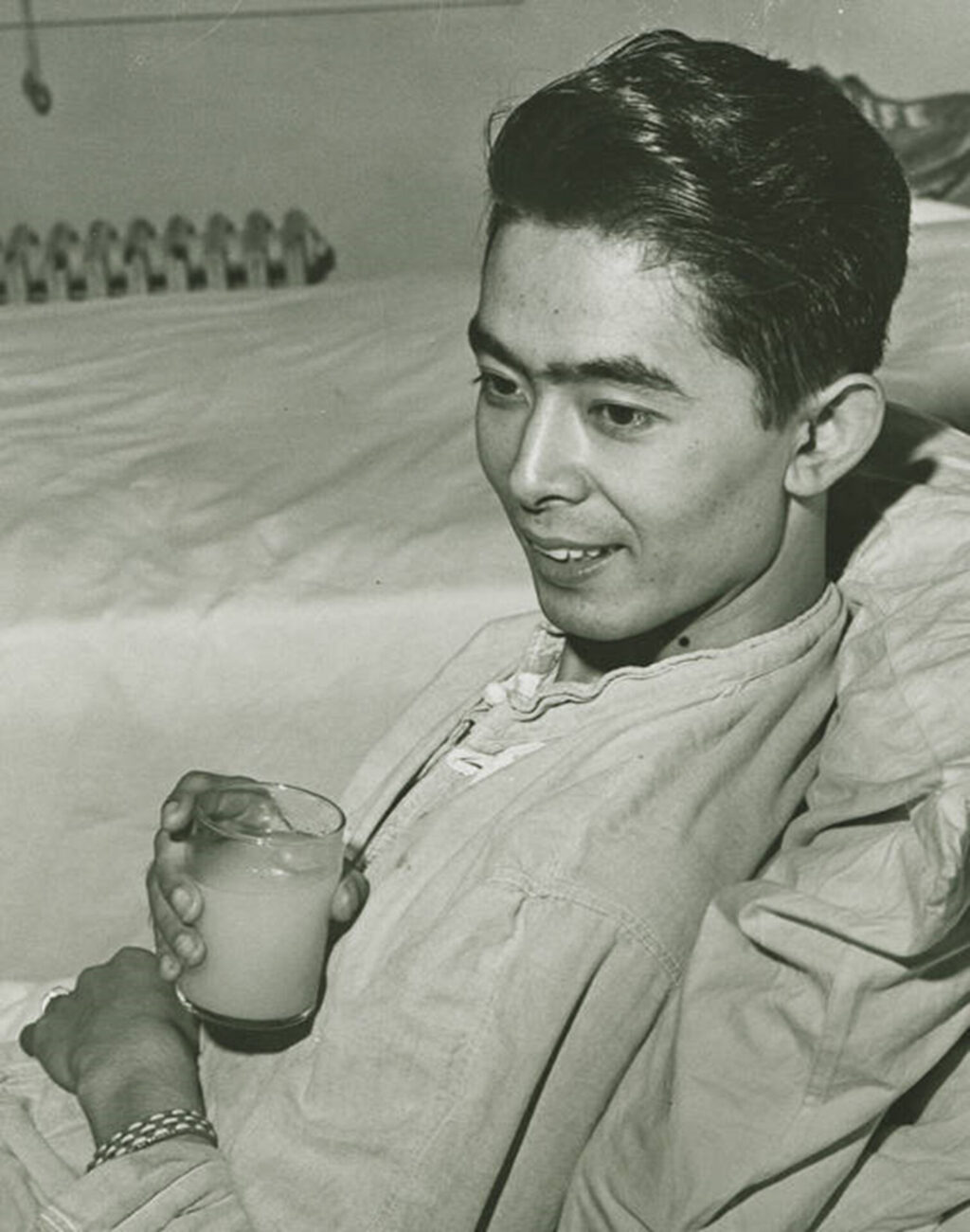
At some point in the campaign (the exact date was not found in our research), Udaka was hit by fragments of an 88mm artillery shell and wounded in his arms, both of his legs were broken, and his spine was badly injured. The three men next to him were killed instantly. He was evacuated to an aid station and then to a field hospital. Due to the severity of his wounds, he was sent to the US for further treatment and recovery. He was at an Army hospital first in Georgia, then in Alabama.
Below: Udaka recuperating at Northington General Hospital, Tuscaloosa, Alabama, 1945
S/Sgt. John Y. Udaka was discharged from the Army on February 7, 1946.
For his service during World War II, Staff Sergeant John Y. Udaka was awarded the Bronze Star Medal, Purple Heart Medal, Good Conduct Medal, American Campaign Medal, European-African-Middle Eastern Campaign Medal with two bronze stars, World War II Victory Medal, Distinguished Unit Badge, and Combat Infantryman Badge.
S/Sgt. Udaka was awarded the Congressional Gold Medal on October 5, 2010, along with the other veterans of the 442nd Regimental Combat Team. Conferred by the U.S. Congress, the award states: “The United States remains forever indebted to the bravery, valor, and dedication to country these men faced while fighting a two-fronted battle of discrimination at home and fascism abroad. Their commitment and sacrifice demonstrate a highly uncommon and commendable sense of patriotism and honor.”
After the war, John married Mieko Fujisawa on June 17, 1949, in Chicago, Illinois. She was born April 14, 1921, in Kings County, California, to Wakamatsu and Mitsuno (Yoshihara) Fujisawa. After being incarcerated at Rohwer WRA Camp in Arkansas, the Yoshihara family was released to Chicago.
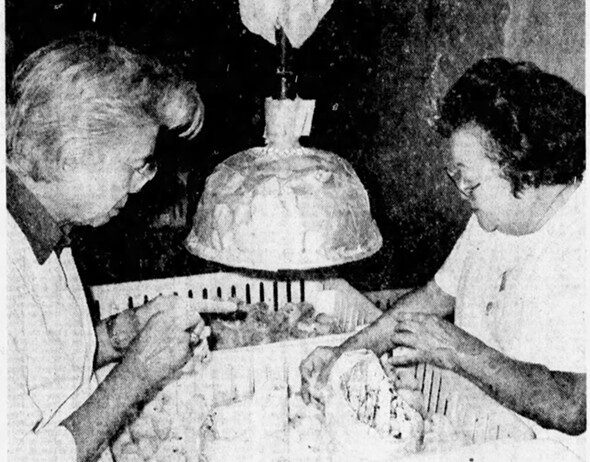
John and Mieko settled initially in Chicago where they operated a chick sexing business. He made trips to Europe to encourage the poultry business to use the chick sexing science, even attending the World Fowl Exposition in Paris. Over the years John and Mieko raised a son and a daughter.
In 1956, the family moved to Gadsden, Alabama. John and Mieko established Udaka’s Chick Sexing Service in 1957, and it is still in operation today.
In 1982, Udaka was interviewed by the Birmingham Post-Herald about his company. He said that his business was indispensable to area hatcheries that supply breeder stock to broiler producers. He guaranteed a 98 percent success rate in determining the sex of newborn chicks. This process ensures that female and male chicks were separated, a key process that saved hatcheries from raising too many roosters. Over the years he taught the science to apprentices and even sponsored instructors from Japan. He admitted that he had to overcome daily pain from his war injuries in order to continue his work.
Below: John and Mieko sorting newborn chicks in 1982
On November 14, 1987, John and Mieko were involved in a two-car collision on Highway 77 near Attalla, on the western outskirts of Gadsden. John and two others were injured and Mieko was killed. Her obituary stated that she had been in the chick sexing business with her husband for the past 40 years, including 30 years in Gadsden. The couple lived at 1248 Alcott Road.
In a 1991 interview in an Alabama newspaper about the 50th anniversary of the bombing of Hiroshima, Udaka recalled that on the day the city was bombed on August 6, 1945, he was lying half-conscious in a hospital bed in Thomasville, Georgia [Finney General Hospital]. He said:
You can imagine what I went through mentally. My father, my family were all in Hiroshima.
He related that in the past he had met with anger and bitterness from Americans who looked at him and saw not a decorated war veteran but a Japanese. By 1991, he felt that had changed, saying:
People understand us now. But not 50 years ago.
John Yoshiyuki Udaka died at the age of 93 on August 21, 2012. His funeral service was held in Gadsden on August 24 at the Collier-Butler Mortuary Chapel at 6:00 p.m. He was preceded in death by his wife Mieko, parents, and sister Mrs. Yutako Hashida. His survivors included his two children, four grandchildren, three great-grandchildren, brother Takuo, sister Eiko Honda (Mrs. Fujiaki Honda), and nephew Steve Honda. John was buried next to his wife in Block 7, Lot 166, Site 1, at Crestwood Memorial Cemetery in East Gadsden.
Researched and written by the Sons and Daughters of the 442nd Regimental Combat Team in 2026.