Soldier Story: Kiyoto George Nakai
Soldier Story
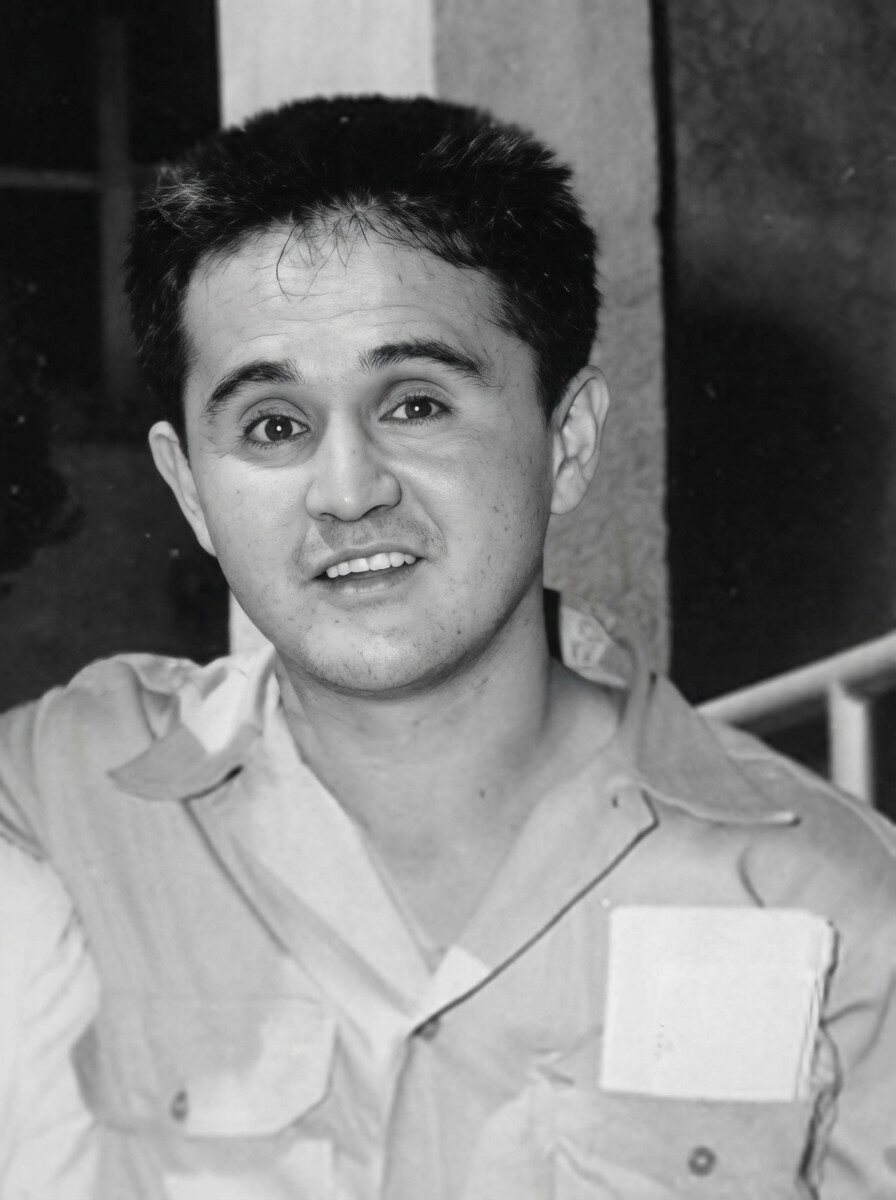
Kiyoto George Nakai
Private First Class
442nd Regimental Combat Team
2nd Battalion, G Company
Kiyoto Nakai was born on July 16, 1918, in Wahiawa, Oahu, Territory of Hawaii. He was the son of Gonichi and Takayo (Kakota) Nakai. His siblings were: brothers Masuo and Henry Takayuki, and sister Jean Kazue. Gonichi emigrated in 1904 from Konu District, Hiroshima Prefecture, Japan. Takayo arrived from Konu District in 1914. She and Gonichi were married in Honolulu on July 13 shortly after her arrival.
In 1920, the family lived on Cane Street in Wahiawa. With them was Gonichi’s father, 52-year-old Genkichi, who arrived in Hawaii in 1911. Gonichi was employed as a bookkeeper for a retail general store. Genkichi was widowed on December 26, 1926. By 1930, they lived at California Packing Corporation’s Mill Camp. Gonichi was the bookkeeper for the pineapple company. Kiyoto graduated from Leilehua High School in 1936.
By 1940, the family lived at 307 Kilani Avenue and Gonichi was the proprietor of his own retail grocery store. Takayo and Kiyoto both worked at the store.
Nakai registered for the draft on October 26, 1940, at Local Board No. 10, Wahiawa. He was 5’2” tall and weighed 125 pounds. He lived with his family on Kilani Avenue, c/o Nakai Store where he worked. Inserted under Employment in small print on the registration card was written in the following: 3/3/42, Haw’n. Constructors, Wheeler Field, Job #177.
Before enlisting in the Army, Kiyo, as he was known, helped his family by working at their store, G. Nakai Grocery Store, in Wahiawa.
On March 23, 1943, Nakai enlisted in the U.S Army in Honolulu. He was sent to the “tent city” nicknamed Boomtown at Schofield Barracks. On March 28, he was at the community farewell ceremony at Iolani Palace given by the community for the new soldiers of the 442nd RCT. The men left on April 4 on the S.S. Lurline. After arriving at Oakland, California, the men were sent by train for Camp Shelby, Mississippi.
At Camp Shelby, Private Nakai was assigned to 2nd Battalion, G Company. After nearly a year of basic and specialized training and field maneuvers, the 442nd left for Camp Patrick Henry, Virginia, on April 22, 1944. On May 2, the 442nd sailed from nearby Hampton Roads in a convoy of 100 ships enroute to the Theater of Operations.
After entering the Mediterranean, most of the 2nd Battalion, including Nakai and Company G, was diverted to Oran in North Africa to offload cargo, while the rest of the 442nd went to Italy, arriving at Naples on May 28. From Naples, the men of the 442nd marched to the train station and were taken to Staging Area No. 4 at nearby Bagnoli. On June 6, the 442nd left on LSTs for Anzio. From Anzio, they went by truck convoy through Rome and arrived at a large bivouac near Civitavecchia.
E Company was left behind in Bagnoli to await the arrival of the rest of 2nd Battalion from Oran. After they arrived on June 17, the 2nd Battalion went through the same processing as the rest of the 442nd at Bagnoli. However, they left on LSTs and went by sea directly to the large bivouac area 50 miles northwest of Rome at Civitavecchia where they met up with the rest of the Combat Team.
Nakai and the 442nd entered battle in the Rome-Arno Campaign near Suvereto north of Rome on June 26. The strategic objective was capturing of the seaport city of Livorno 50 miles north. Over the next 15 days, the 442nd steadily pushed the Germans north along the western side of the Italian peninsula. The towns they captured, liberated, or – in the case of unopposed entry – were the first to enter, were: Suvereto and Belvedere on June 26, Sassetta on June 27, Molino a Ventoabbto on July 3, and Hill 140 in the vicinity of Castellina on July 9.
The Combat Team saw especially fierce fighting just north of the Cecina River at Hill 140 beginning on July 3. Captured Germans from the 36th SS Regiment reported that they had been ordered to “hold until the defenses at Pisa were completed.” On July 9 in the vicinity of Casale, they faced determined resistance with the enemy using their terrain to full advantage. A map taken from a dead German indicated that they had every hill, house, and terrain feature zeroed in from prepared gun positions, with azimuth readings, ranges, and fields of fire elaborately developed. This knowledge was possible because of their long occupation of the ground they were defending.
After 15 days of combat, Pvt. Kiyoto Nakai was wounded on July 10, 1944, while on patrol with his squad near Castellina Marittima. A German 88mm artillery shell exploded a few feet in front of him. As a result of his wound, he was left totally blinded and 60 percent deaf in his right ear. The notice of his wounding appeared in the Honolulu newspapers on September 16, 1944. He later described the day that he was wounded:
It was really hot out there. We were crossing a field covered with haystacks and stubble, and the Germans laid a barrage over us. It was very slow and very hot. I got hit about 2 o’clock.” When asked if he had been scared, he replied: “Sure, everyone is scared. But you know everyone’s scared, so you just go ahead.
He was sent to the aid station and then to the Army field hospital and eventually was sent to an Army General Hospital in the US. While there, he and other wounded soldiers took classes, learned such tasks as how to take the bus, and also such activities as how to bowl, ride horseback, and swim without the use of their eyes.
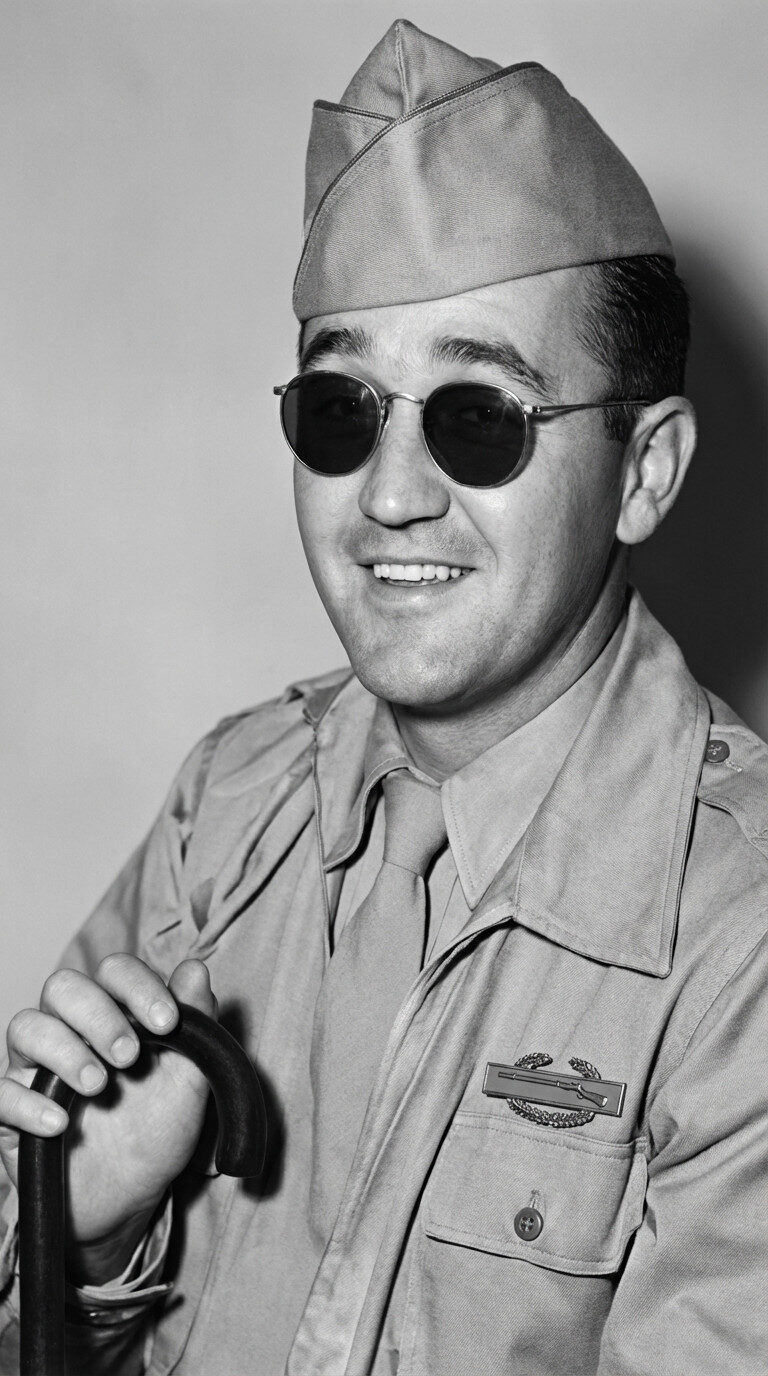
In the January 19, 1945, Honolulu Star-Bulletin, it was reported that Nakai was home on a 30-day leave. While home with his parents, he visited family and friends, relaxed, and even went fishing. He went to the Territorial Bureau of Sight Conservation on the grounds of the state capitol at Iolani Palace to ask about seeing-eye dogs.
Right: Being interviewed at Sight Conservation office, January 1945
He was especially proud of how bravely his mother handled the news of his injuries. When asked why he only wore his Combat Infantryman Badge rather than all his war medals, Nakai laughed and looked embarrassed as he simply replied that he left his other medals at home.
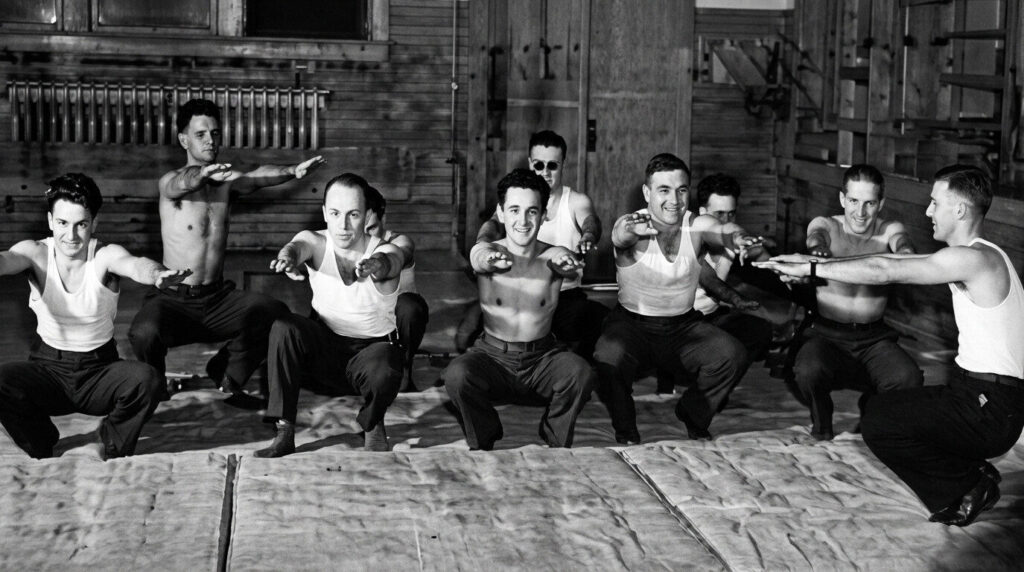
After his leave, he went for additional medical treatment at Army’s Blind Rehabilitation Service Program at Dibble General Hospital in Menlo Park near San Francisco, California. Dibble was one of two Army Hospitals where blinded soldiers were given special mental and physical rehabilitation. Upon arrival, patients were given a thorough orientation of the facilities and within a week left on their own to navigate. The men were given instruction in a wide range of activities – typing, playing musical instruments, ceramics, simple woodcraft. Gym and Braille were also available. They were expected to do everything for themselves – getting around, shaving, dressing, and feeding themselves – unless they specifically requested help. While there, Pfc. Nakai was fitted with two new front teeth. He attended a St. Patrick’s Day dinner dance sponsored by the San Francisco Restaurant Association at the Allied Arts Guild Hall in Menlo Park. Attending were 24 blind patients from Dibble and 29 Stanford University coeds. He also met Helen Keller, who spent time during the war visiting soldiers who had been wounded and left blind.
Below: Kiyo (3rd from left in front row) in a workout to learn good balance, Dibble Hospital
Upon his release, Nakai was sent to Old Farms Convalescent Home (also known as the Army Blind School) in Avon, Connecticut, for four months of mental and emotional rehabilitation and vocational training. This was part of the Army’s overall program until it was deemed that the patient was ready for discharge to civilian life.. Afterwards, in July he was sent to the Seeing Eye Dog, Inc., campus at Morristown, New Jersey. While there, he was given Cubby, a 2-year-old German Shepherd, who became his constant companion.
Below: Nakai with Cubby
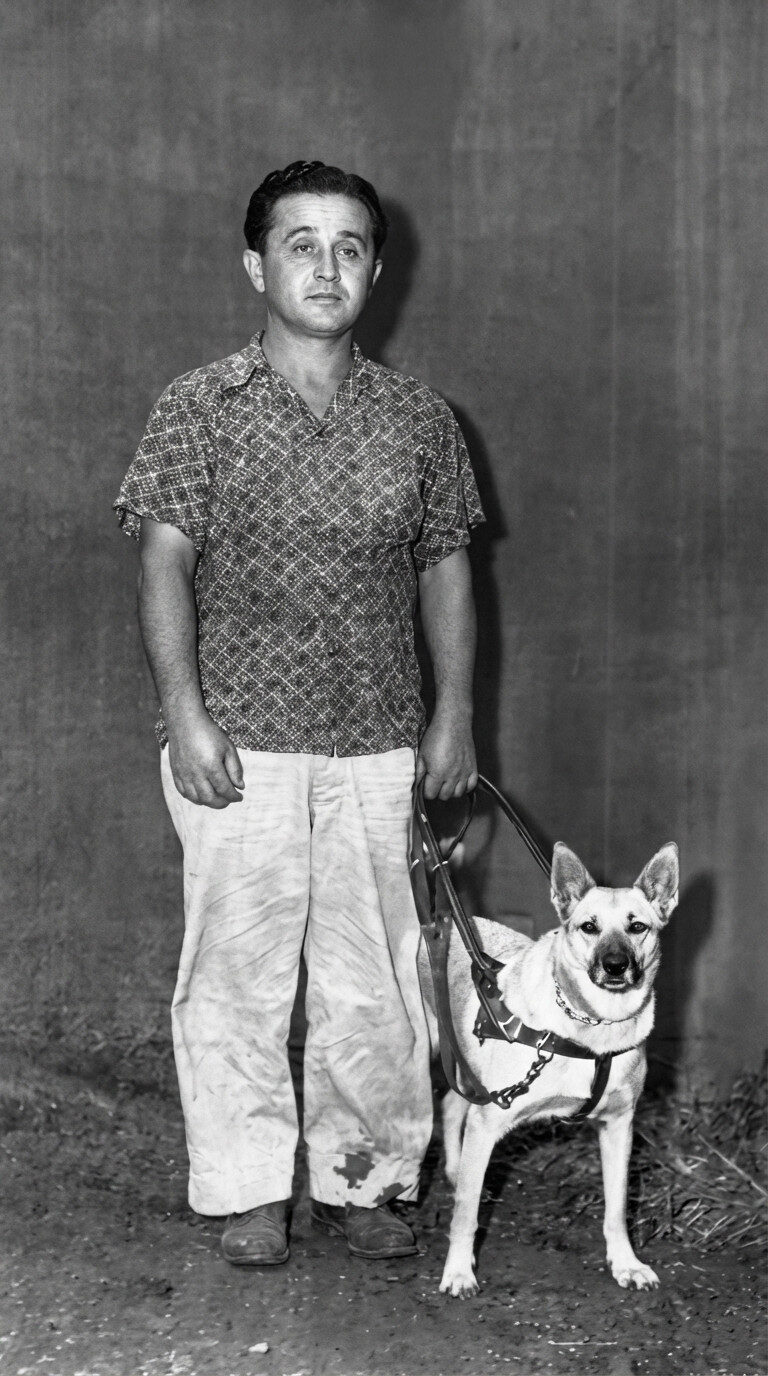
Below: Kiyo and Cubby disembarking on arrival home
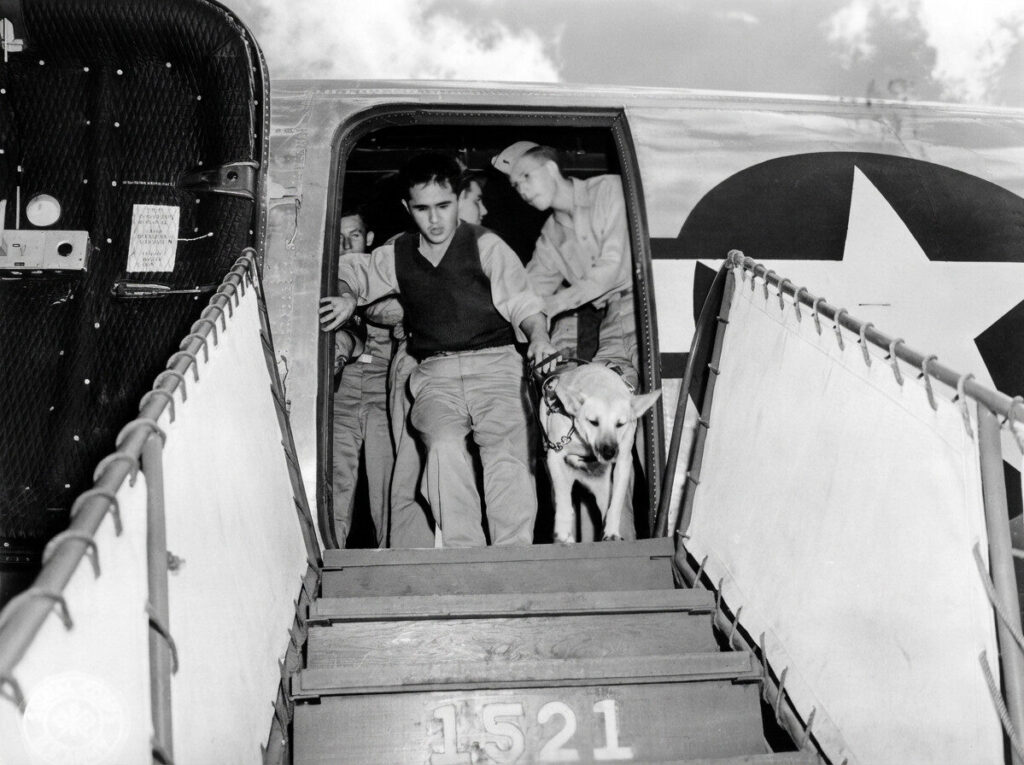
After receiving guide-dog training, Nakai and Cubby arrived in Honolulu on September 10. Governor Ingram M. Stainback had issued special, less-restrictive canine quarantine rules for Cubby on September 7, as he had done earlier for wounded veteran Pvt. Yoshinao (“Turtle”) Omiya (100th Battalion, D Company). Two full-time attendants were assigned to Nakai and Cubby for 120 days to ensure that all went according to these special quarantine rules.
Below: Kiyo and Miyako the day he arrived home; North Sector General Hospital, Schofield Barracks
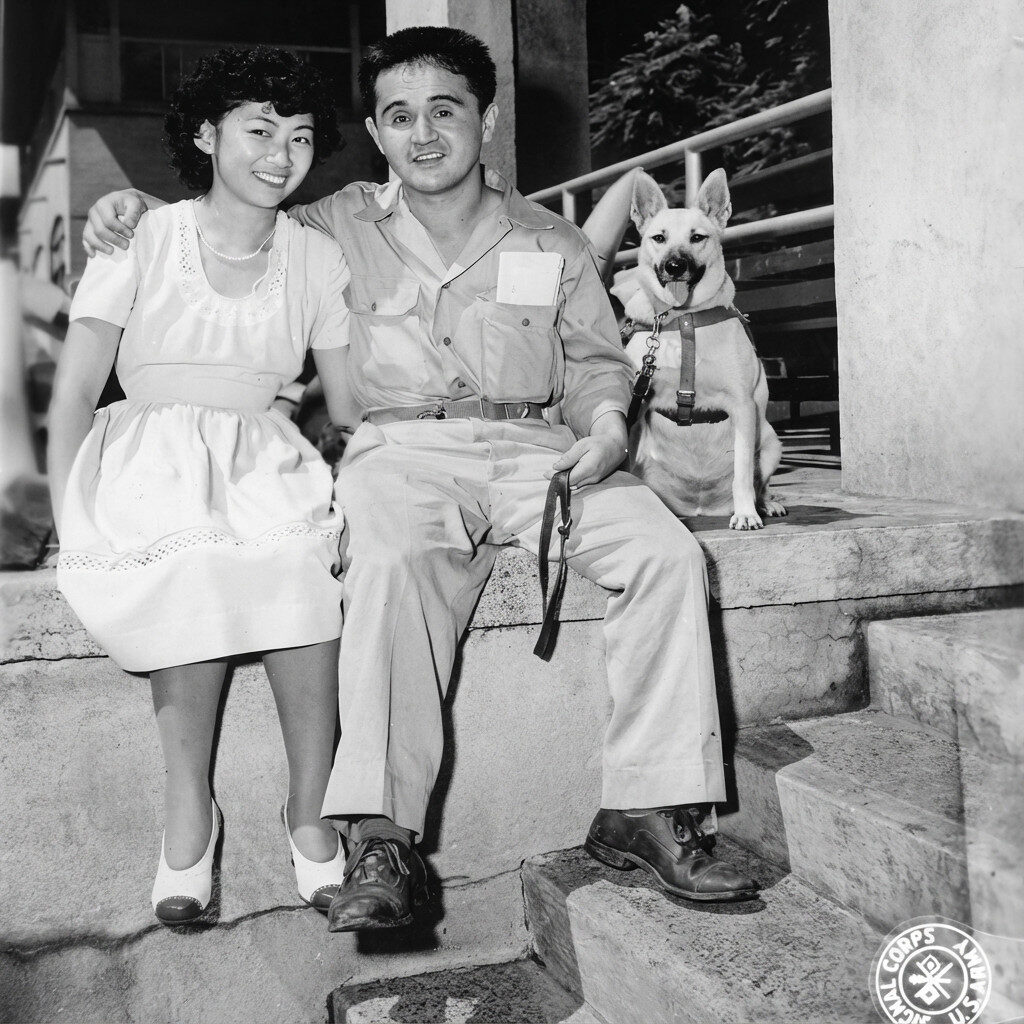
On September 27, 1945, Kiyoto Nakai of 834 Kilani Avenue in Wahiawa and his fiancée, Miyako Hiratani of 222 Kolekole Drive in Wahiawa, applied for their marriage license in Kaneohe. Miyako was born on February 25, 1920, to Shizuichi and Haruyo (Daigo) Hiratani.
On November 13, 1945, Kiyo was the guest speaker at the Leeward Oahu Lions Club dinner held at the Ewa Social Hall. The dinner was given in honor of all blind persons in the district. Music was provided by a blind peoples’ orchestra, featuring singer Lions Club member Sam Peleku Sr. of Nanakuli. Miss Leonilda Kekuewa of the Bureau of Sight Conservation also spoke on the history of the Bureau as it celebrated its 10th anniversary.
Pfc. Nakai was discharged from the U.S. Army on March 8, 1946, in Honolulu.
For his military service, Private First Class Kiyoto George Nakai was awarded the Bronze Star Medal, Purple Heart Medal, Good Conduct Medal, American Campaign Medal, European-African-Middle Eastern Campaign Medal with one bronze star, World War II Victory Medal, and Combat Infantryman Badge. Nakai was awarded the Congressional Gold Medal on October 5, 2010, along with the other veterans of the 100th/442nd Regimental Combat Team. Conferred by the U.S. Congress, the award states: The United States remains forever indebted to the bravery, valor, and dedication to country these men faced while fighting a two-fronted battle of discrimination at home and fascism abroad. Their commitment and sacrifice demonstrate a highly uncommon and commendable sense of patriotism and honor.
In March 1946, Nakai and his father Gonichi applied for a liquor license for their grocery store located at 834 Kilani Avenue in Wahiawa.
On August 8, 1947, when Kiyo and Miyako’s first child, a son, was born, they were living at 12 Hauola Avenue in Wahiawa.
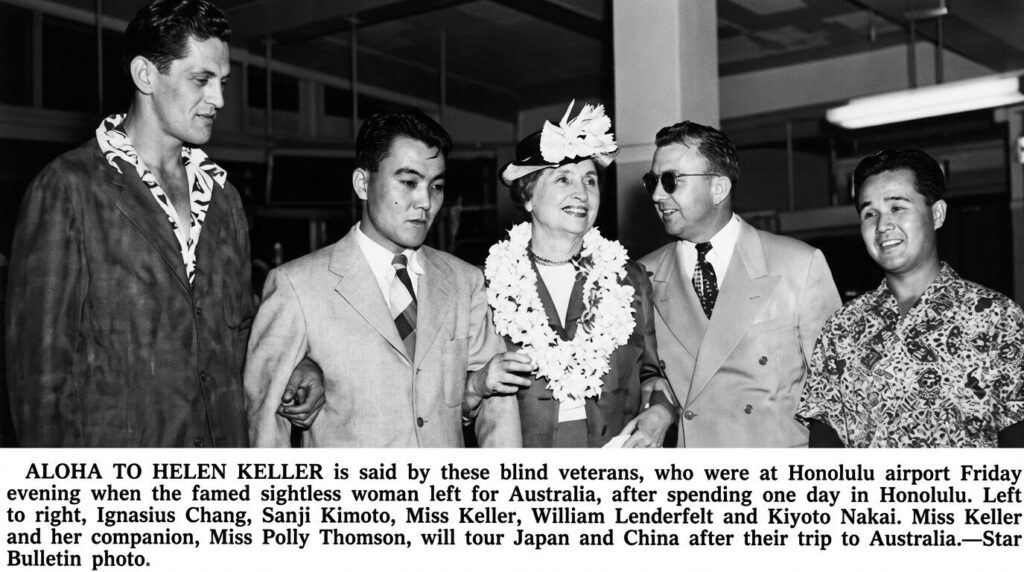
Below: Helen Keller at Honolulu Airport after visiting Honolulu in 1948; L to R: Ignasius Chang, Sanji Kimoto (K Company), Keller, William Lenderfelt (USMC), Kiyoto Nakai
In 1950, the family was still living at 12 Hauola Avenue and Kiyo worked as a salesman at the family grocery store.
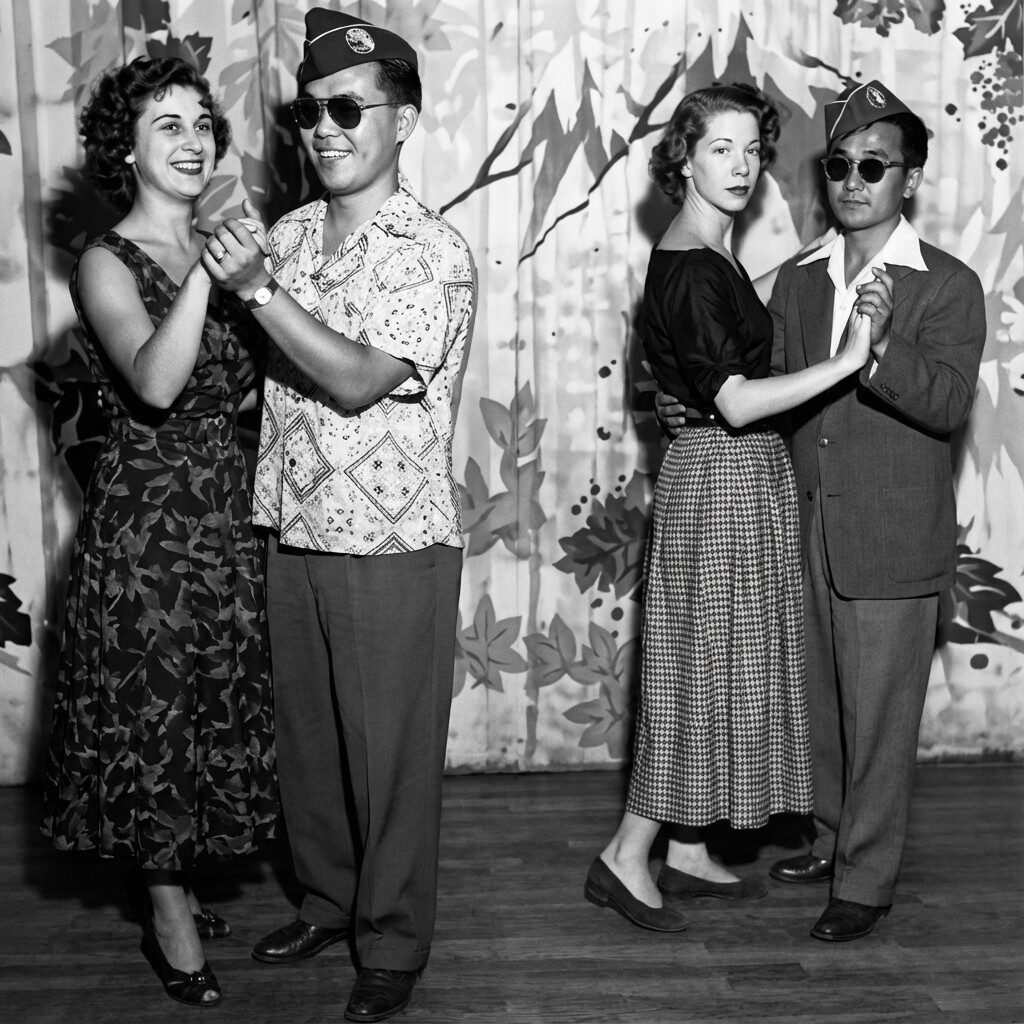
On May 20, 1950, the Disabled American Veterans (DAV) in Honolulu gave a dance at the Ewa Gymnasium to raise funds to send delegates to the upcoming national convention on the mainland. Kiyo was among the blind veterans who were given free dance lessons by the Arthur Murray Studio.
Below: L to R – Dance instructor Shirley Patterson, Sanji Kimoto, instructor Lue Verbeck, Kiyo Nakai at Arthur Murray Studio in 1950
The family left Hawaii on March 10, 1951, on the S.S. Lurline for San Francisco. From there, they travelled on to Chicago, Illinois, where Kiyo was at the Hines Veterans Hospital for five months. In September 1951 fellow veteran Clarence Taba (I Company) visited them after attending the DAV national convention in Milwaukee, Wisconsin. The two men then drove in the Nakai family Ford on the turnpike to Philadelphia. They scouted around for possible schools and apartment homes, as Kiyo was deciding if he would enroll at Overbrook School for the Blind.
However, he decided to attend a two-year course at the Kingston School for the Blind in Kingston, New Hampshire, to learn cabinetmaking. According to a large photo story about Kiyo that was published in 1953 in the Haverhill Gazette (12 miles south of Kingston), he did very well at this craft. As the article reported, he:
…can adjust the saw to any depth cut with the aid of small blocks carried in his apron pocket. To guide his cut, Kiyo places his left hand on the spinning block and uses his right to hold the flat chisel. Rounded chisels are more apt to flip into the air when they stick. The noisy machinery doesn’t bother him, but when something goes wrong mechanically, Kiyo knows when to stop by the sound of the machine. He does all his projects by himself, from roughing out the wood to the final finishing…When his two-year course in Kingston is finished, Kiyo hopes to open a shop of his own in Hawaii…He explains that he needs the shop not only to earn money, but to give him a means of spending his time.
Kiyo’s family later recalled: “He became a master cabinet and furniture maker, using Braille tools to assist in his craft. He was an inspiration to all around him.”
On March 18, 1954, while the Nakai family was living in New Hampshire, Kiyo’s mother Takayo died at the age of 52 at Queen’s Hospital in Honolulu.
In 1955, it was reported in the “Sport Fishing” column of the Honolulu Star-Bulletin that blind veteran Kiyo Nakai was out on the Valkyrie for an overnight trip to Molokai on May 21 with many of the boats of Honolulu’s sport fishing fleet. He “handled himself extremely well on the rolling cruiser, and proved an extremely good sailor. While mahimahi were caught that day, he wasn’t lucky enough to have one strike his line, but he enjoyed every minute of the trip.”
On August 28, 1955, Nakai was chosen to toss out the first ball for the baseball game between the visiting Japan High School All-Stars team and the Rural Oahu Prep All-Stars held in Waipahu before a crowd of 4,000. He represented the 442nd Veterans Club, sponsors of the Japan team’s series in Hawaii.
On July 3, 1956, the Nakai home, constructed by Henry Takeda at 1766 Royal Palm Drive on Lot 46-A in the Eames section of Wahiawa, was completed.
In 1966, Kiyo was the Vice President and a charter member of the newly formed Eames Fishing Club, which was organized for residents of the Eames Tract in Wahiawa. The club’s purpose was to foster cooperation, goodwill, good fellowship, and sportsmanship with similar clubs and organizations. Their opening banquet was held on December 3 at Kemoo Farm restaurant.
His father Gonichi Nakai died on April 4, 1969, at the age of 80.
Nakai died on September 25, 1974, at the age of 56, in Maluhia (Long-Term Care) Hospital in Honolulu. His funeral was held on September 26 at the Mililani Memorial Park Mortuary, followed by his burial with full military honors on September 27 at 9:30 a.m. at the National Memorial Cemetery of the Pacific at Punchbowl, Section S, Site 923. Survivors included his wife, two children, brothers Masuo and Henry T., and sister Jean K. Fukeda (Mrs. Frank Itsuo). Nakai was a member of the 442nd Veterans Club Rural Chapter and the Eames Kumiai [Note: Japanese for Association]. Miyako died on December 29, 2014, at the age of 94. She was survived by her two children and two grandchildren. She was buried at Mililani Memorial Park.
Years after Nakai’s death, his son wrote that his father was humble, quiet, and unassuming. He accepted people as they were and was able to see the good in them and forgive their flaws. He had curiosity and the desire to do things regardless of his blindness. And he was very generous, especially in making furniture and giving it as gifts to family and friends. He “had a simple sense of purpose and meaning…and, he lived his life accordingly.”
Researched and written by the Sons & Daughters of the 442nd Regimental Combat Team in 2025.