Soldier Story: Larry Tadayuki Tanimoto
Soldier Story
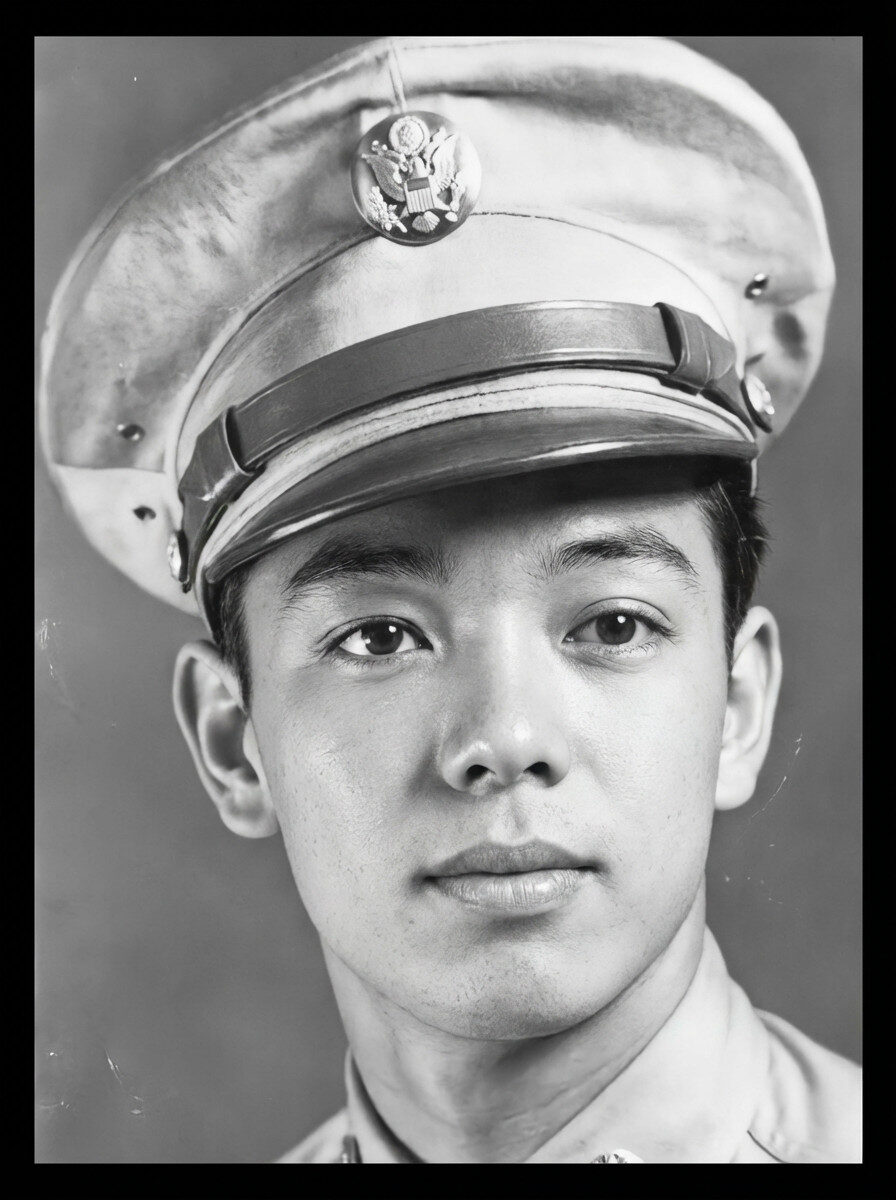
Larry Tadayuki Tanimoto
Sergeant
442nd Regimental Combat Team
3rd Battalion, I Company
Larry Tadayuki Tanimoto was born on May 9, 1919, in Honomu, South Hilo District, Hawaii island, Territory of Hawaii. He was one of eleven children of Jinkuro and Fute (Oshima) Tanimoto. The eight sons were: Paul Hikatsu, Tsutomu, Tsukasa, Ralph Haruaki, Masakatsu (died age 16 in 1931), Larry Tadayuki, Victor Kazunobu, and Lionel Yoshito. The three daughters were: Violet Sawayo, Fujiko, and Carol Ayame.
Jinkuro and Fute were married in 1901. They emigrated from Niho-machi, Hiroshima Prefecture, Japan, in 1904 and 1906, respectively. Jinkuro arrived on January 23, 1904, on the S.S. Gaelic; Fute on November 2, 1906, on the S.S. Korea.
In 1910 and 1920, Jinkuro was working as a teamster for the Honomu (sugar) Plantation, and the family was living in Camp 16 and Camp 15, respectively. By 1930, Jinkuro was a retail fish merchant in South Hilo. The following year, the Tanimoto family moved to Honolulu and lived at 2153 Booth Road in Pauoa Valley. Larry Tadayuki attended Pauoa Elementary School.
On June 14, 1934, Larry Tadayuki graduated from Kawananakoa Intermediate School. He then enrolled at McKinley High School, graduating on June 6, 1937.
In April 1940, the family was living at 228 Namokueha Street in Pauoa Valley. Father Jinkuro was listed as “absent. He was employed as a janitor for the Alexander Baldwin Company at Bishop and Market Streets. Sons Tsukasa and Haruaki were employed as plasterers and Kazunobu was a plaster helper at T. Sasaki plastering business, and Larry Tadayuki was a tinsmith at a plumbing shop.
Larry registered for the draft on October 26, 1940, Local Board No. 5 at the Tax Office in Honolulu. He was employed by the Independent Lighting & Fixtures, Ltd., 729 Alakea Street. His point of contact was his mother; they were living at 228 Namokueha Street. He was 5’6½” tall and weighed 142 pounds.
Larry enlisted in the U.S. Army on March 25, 1943, in Honolulu. His civilian occupation was listed as “Tinsmiths, coppersmiths, and sheet metal workers.” Before entering the service, he was working as a plumber for the Army. He was sent with other enlistees to the “tent city,” known as Boom Town, at Schofield Barracks.
On March 28, the new soldiers were given a community farewell at Iolani Palace. On April 4, they sailed on the S.S. Lurline to Oakland, California. After a train trip across the US, they arrived at Camp Shelby, Mississippi. After arrival, Larry was assigned to 3rd Battalion, I Company, 4th Platoon.
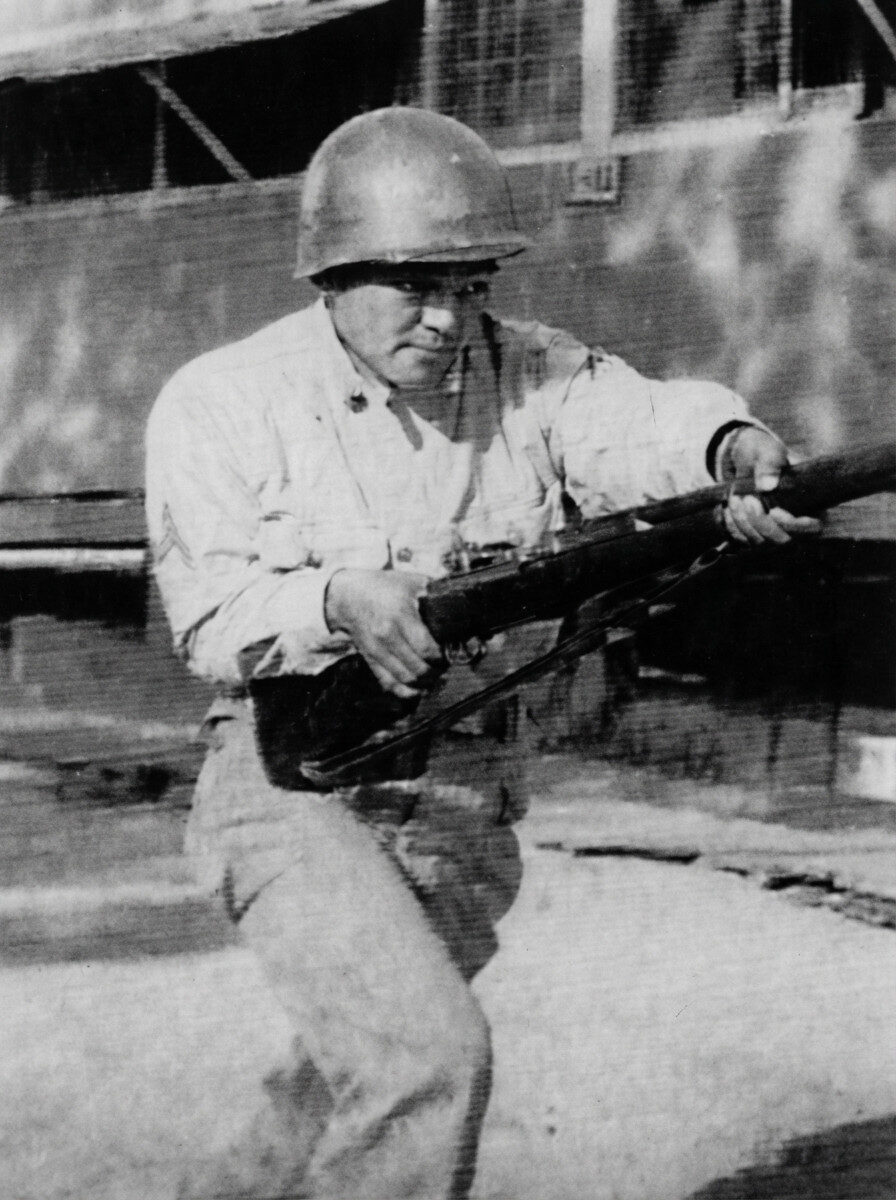
Basic training began on May 10 and lasted until August 23. On September 23, the 442nd announced its recent promotions. Larry Tanimoto was promoted to the rank of Corporal.
Right: Larry at Camp Shelby
After over a year of basic, unit, specialized, and combat training and field maneuvers, Tanimoto left Camp Shelby with the 442nd on April 22, 1944, for Camp Patrick Henry, Virginia. He shipped out to Europe with the 442nd on May 2, 1944, from nearby Hampton Roads, Virginia, in a convoy of over 100 ships.
The 442nd arrived at Naples, Italy, on May 28. The men marched to the train station and were taken to Staging Area No. 4 at nearby Bagnoli. On June 6, the 442nd left on LSTs for Anzio. Upon arrival the next day at Anzio, they marched five miles to their bivouac area. On June 9, they went by truck convoy through Rome and arrived at a large bivouac near Civitavecchia.
Tanimoto and the 442nd entered combat near Suvereto on June 26 in the Rome-Arno Campaign with their objective of capturing the seaport city of Livorno 50 miles north. Over the next three months, the 442nd steadily pushed the Germans north along the western side of the Italian peninsula.
On September 6, the 442nd was relieved from its positions along the Arno River west of Florence. They were shipped out from the port of Piombino on September 10, arriving at Naples the following night.
The Combat Team was sent to Marseilles, France, on September 27 for fighting in the Rhineland-Vosges Campaign. They arrived on September 30 and were in bivouac at nearby Septèmes until October 10. The Combat Team then traveled 500 miles north to the front lines in northeast France.
Their first objective was to liberate the important road junction of Bruyères in the Vosges Mountains. The intense battles to liberate Bruyères and neighboring Biffontaine lasted nine days, October 16-24. The Combat Team was then put into reserve in Belmont for a brief rest. Larry was treated for hives at this time and returned to duty. The cause may have been certain foods, an infection, or emotional stress.
After two days in Belmont, on the afternoon of October 26, they were ordered to the front lines again to aid in the rescue of the Lost Battalion – the 1st Battalion of the 141st (Texas) Infantry Regiment. This battalion had gotten ahead of the lines and was surrounded on three sides by the enemy. Attempts by the 141st and other units to free it had been unsuccessful, so the 442nd was called in to break through the Nazi siege and rescue the Texans.
The initial objective of the Texas “lost” battalion had been to clear the Germans from the entire long, densely forested ridge where it had become surrounded. After intense fighting beginning on October 27, the 442nd was successful in the rescue on October 30.
Third Battalion was then ordered to push on down to the end of this long ridge. Although Sergeant Tanimoto was the weapons platoon machine gun section leader, he asked to take out a patrol. On November 3, his patrol was ambushed by the enemy and Tanimoto was killed.
The fighting would go on until November 9. The German line was completely shattered, but 442nd losses were so great that the Combat Team was temporarily ineffective as a fighting force.
Sergeant Larry Tadayuki Tanimoto was interred in the U.S. Military Cemetery at Épinal about 20 miles from where he was killed.
On March 28, 1945, it was reported in the Honolulu Advertiser that Sgt. Tanimoto was among those 16 fallen soldiers whose next of kin recently received the Purple Heart Medal in private ceremonies by Lt. Col. Corwin H. Olds, Chaplain of the Central Pacific Base Command.
The Distinguished Service Cross, the second-highest military medal for soldiers who display extraordinary heroism in combat against an armed enemy force, was awarded posthumously to Sgt. Tanimoto for his actions at Biffontaine and La Houssière, at a large, two-hour ceremony held on May 16, 1945, at the airfield in Novi, near Genoa, Italy. Attending the ceremony were Lieutenant General Lucian K. Truscott, Commander of 5th Army, and Major General E.M. Almond, Commander of the 92nd Division. The citation reads:
Headquarters, European Theater of Operations, U.S. Army, General Orders No. 65 (1945)
Larry Tadayuki Tanimoto, Sergeant, U.S. Army
For extraordinary heroism in connection with military operations against an armed enemy while serving as an acting Platoon Leader in Company I, 3d Battalion, 442d Regimental Combat Team, attached to the 36th Infantry Division, in action against enemy forces on 29 and 31 October 1944 and 3 November 1944, in the Vosges Mountains, France. Sergeant Tanimoto, while participating in an attack on “Suicide Hill,” forced the surrender of two enemy gunners while making himself the sole target for another machine gun fifty yards away. He successfully led a heavily armed patrol in dispersing a numerically superior enemy mine-laying detail. While leading another patrol, an enemy machine gun wounded the scout and pinned the remaining men to the ground. Sergeant Tanimoto rose to his feet and killed two of the gun crew, giving his men an opportunity to outflank the nest. The heroic courage and loyalty displayed by Sergeant Tanimoto in the face of great danger, at the cost of his own life, exemplify the highest traditions of the military forces of the United States and reflect great credit upon himself, the 36th Infantry Division, and the United States Army.
For his military service, Sergeant Larry Tadayuki Tanimoto was awarded the Distinguished Service Cross Medal, Bronze Star Medal, Purple Heart Medal, Good Conduct Medal, American Campaign Medal, European-African-Middle Eastern Campaign Medal with two bronze stars, World War II Victory Medal, Distinguished Unit Badge, and Combat Infantryman Badge. He was posthumously awarded the Congressional Gold Medal on October 5, 2010, along with the other veterans of the 442nd Regimental Combat Team. Conferred by the U.S. Congress, the award states: “The United States remains forever indebted to the bravery, valor, and dedication to country these men faced while fighting a two-fronted battle of discrimination at home and fascism abroad. Their commitment and sacrifice demonstrate a highly uncommon and commendable sense of patriotism and honor.”
On December 9, 1945, Sgt. Tanimoto was among the hundreds of war dead of the 100th Infantry Battalion (Separate) and the 442nd RCT who were honored at a memorial service held at McKinley High School auditorium. The service was under the auspices of the veterans clubs of the 100th Infantry Battalion and the 442nd RCT, the Women’s War Service Association, and the Emergency Service Committee. The main speaker was Lt. Gen. Robert C. Richardson, commander of U.S. Army Pacific.
In 1948, the Army began the process of closing the smaller military cemeteries in Europe and offering the families an opportunity to have their loved one brought home. Although Épinal was to remain one of the major cemeteries, Larry’s family chose to have his remains returned.
As a result, his flag-draped casket arrived from San Francisco on a U.S. Army cargo vessel, the motorship Pier Bend, along with six others, on September 21, 1949. After the ship docked at Pier 40 at 10:00 a.m. in Honolulu’s Kapalama Basin, a memorial service was conducted by Army Chaplain Edwin L. Kirtley. Acting Governor Oren E. Long gave an address to the family and friends gathered, saying, “We honor these men for their valor. They fought because they believed in America.” The 264th Army Band played Evening Prayer and There Is No Death. Chaplain L. Lane McCannon offered a prayer, and Chaplain Joseph P. McBarron of Fort Shafter gave the Benediction.
Sgt. Tanimoto was reinterred on October 6, 1949, at the National Memorial Cemetery of the Pacific at Punchbowl in Honolulu, Section D, Site 389.
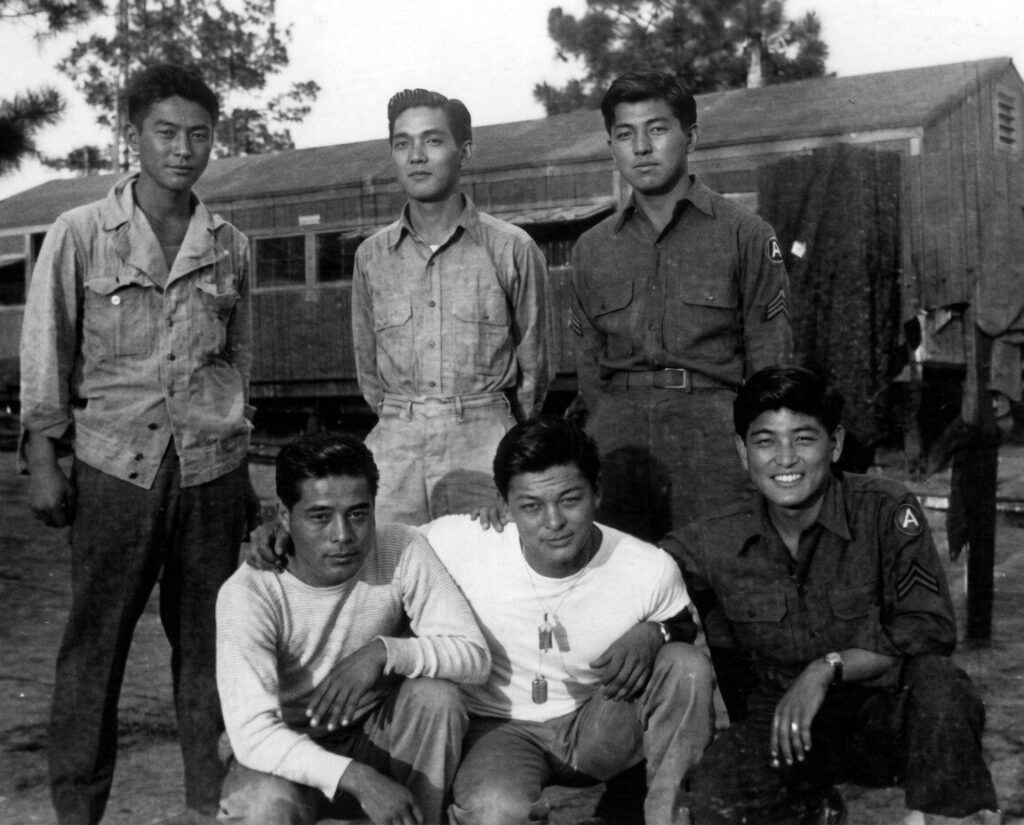
Below: 4th Platoon, L to R standing: Yoshitaka Uchimura, Takeo Sato (KIA), Tommy Tamashiro (KIA). L to R kneeling: Allen Tanaka, Larry Tanimoto (KIA), Edward Yamaguchi. Camp Shelby, summer of 1943
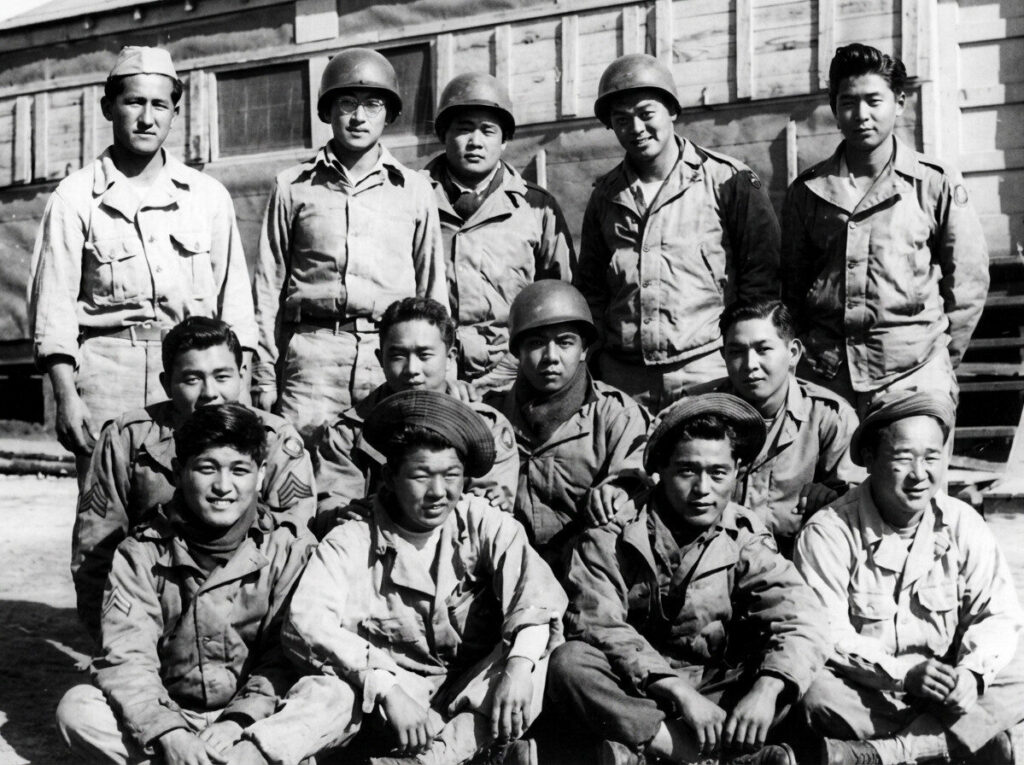
Above: 4th Platoon, L-R standing: (unidentified), Eiji Hama, Takeo Suma, Larry Tanimoto (KIA), Yoshitaka Uchimura; Kneeling: Tsuneo Shiigi, Kenji “Popeye” Segawa, Horace Sagawa, Takeo Sato (KIA); L to R sitting: Edward Yamaguchi, Toshiyuki “Brush” Shinozawa, Allen Tanaka, Harry “Pappy” Yamasaki (KIA)
Larry’s cousin, Sgt. Yukio E. Tanimoto of E Company was killed in action on April 23, 1945.
Researched and written by the Sons & Daughters of the 442nd Regimental Combat Team in 2021. Updated in 2026 with family assistance.