Soldier Story: Masuwo Tom Okuhara
Soldier Story
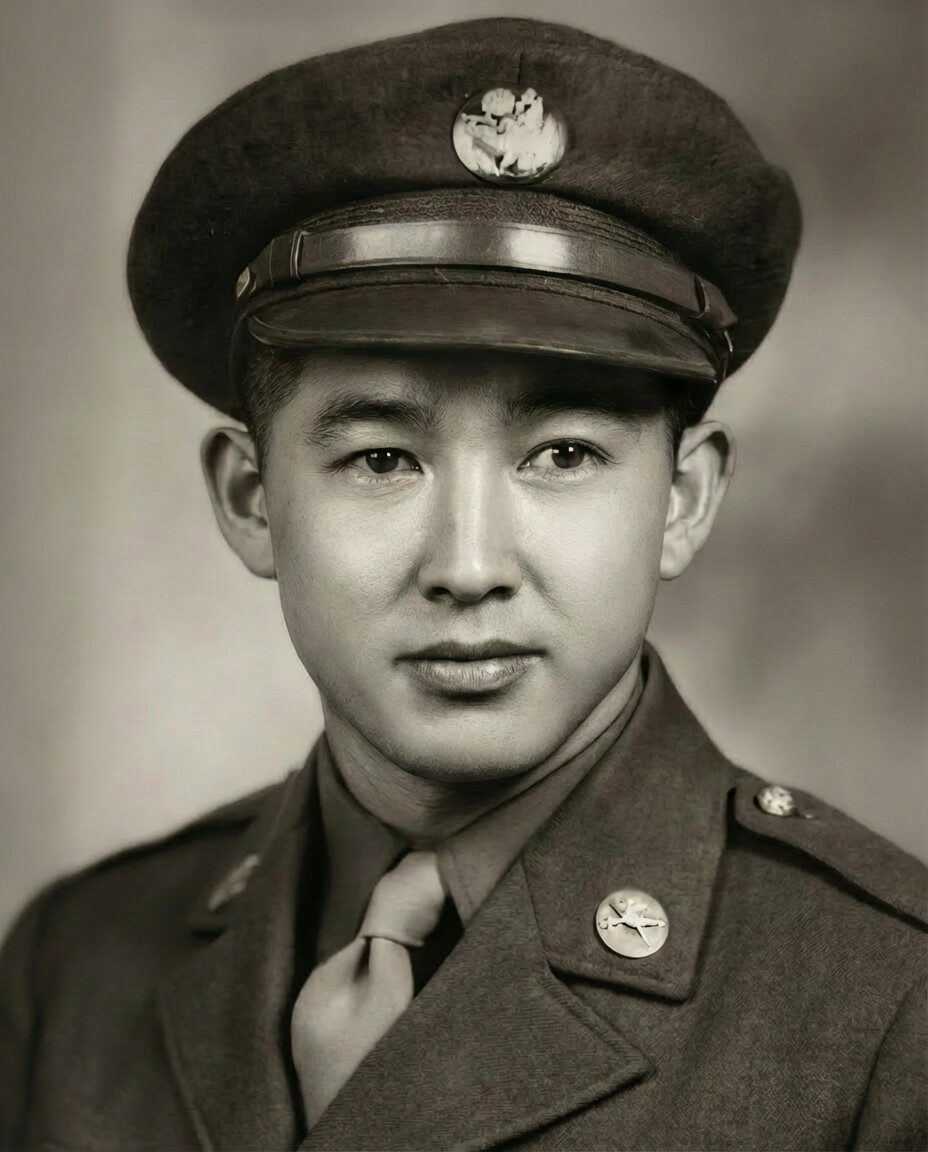
Masuwo Tom Okuhara
Technical Sergeant
442nd Regimental Combat Team
Military Intelligence Service
Masuwo Okuhara was born on February 12, 1923, in Acampo, California, the son of Masuhei and Yutayo (Shimizu) Okuhara. Mas, as Masuwo was known, had seven siblings: brothers Toshio, Eiji, Keizo, and Masaru; and sisters Bessie Shizuko, Grace Teruko, and Hiroko.
Father Masuhei arrived on the Korea Maru on September 5, 1904, at Honolulu, Territory of Hawaii, from the village of Kitsuwa Takafuta, Jinseki District, Hiroshima Prefecture, Japan. By 1910, he was living in a boarding house in San Joaquin County, California, with nine other young Japanese immigrants. Masuhei was employed as the driver of an express wagon.
Mother Yutayo arrived on the S.S. China on August 27, 1913, from the village of Arifuku Yoshino, Kono District, Hiroshima Prefecture. She and Masuhei were married in San Francisco upon her arrival. By 1917, they were living outside of Stockton, San Joaquin County, on Route 4, Box 124, and Masuhei was a farmhand.
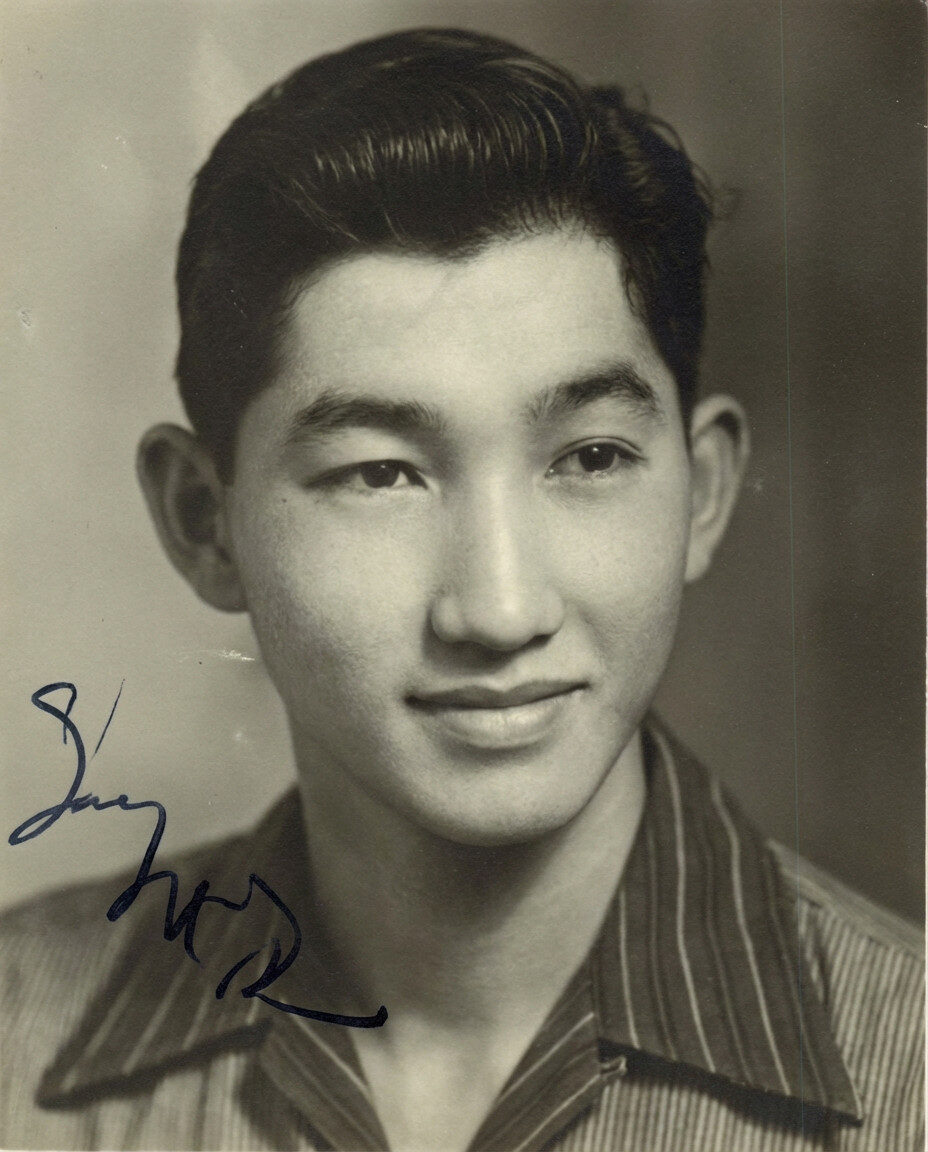
In 1930, the family was living on Acampo Road, Liberty Township, San Joaquin County, where Masuhei had been employed as a farmer on the H.M. Madison Ranch since 1924.
Right: Mas, Senior Class photo from yearbook
In 1940, the family was still living on Acampo Road, although Masuhei had become an independent farmer in 1939 and his two eldest sons were working with him. Mas graduated from Lodi High School in 1941.
The Okuhara family was evacuated in the spring of 1942 to the Stockton WCCA Assembly Center. Tom Okuhara signed his draft registration card on June 30, 1942, in Lodi, California. He was living in Unit 5-91-A at the Stockton WCCA Assembly Center at the time. His point of contact was his brother Toshio, at the same address. His home address was Route 3, Box 459, Lodi, San Joaquin County. He was 5’6” tall and weighed 125 pounds.
On October 18, 1942, the family was incarcerated at the Gila River WRA Relocation Center near Sacaton, Arizona, southeast of Phoenix. The family lived in unit 30-12-A. A few months after the family’s arrival, Mas’ brother Masaru was hospitalized with pulmonary tuberculosis. He died after eight months in the Rivers Community Hospital.
According to the Final Accountability Roster records, Okuhara was not officially released from Gila River until June 7, 1944, to Fort Douglas, Utah, for service in the Armed Forces.
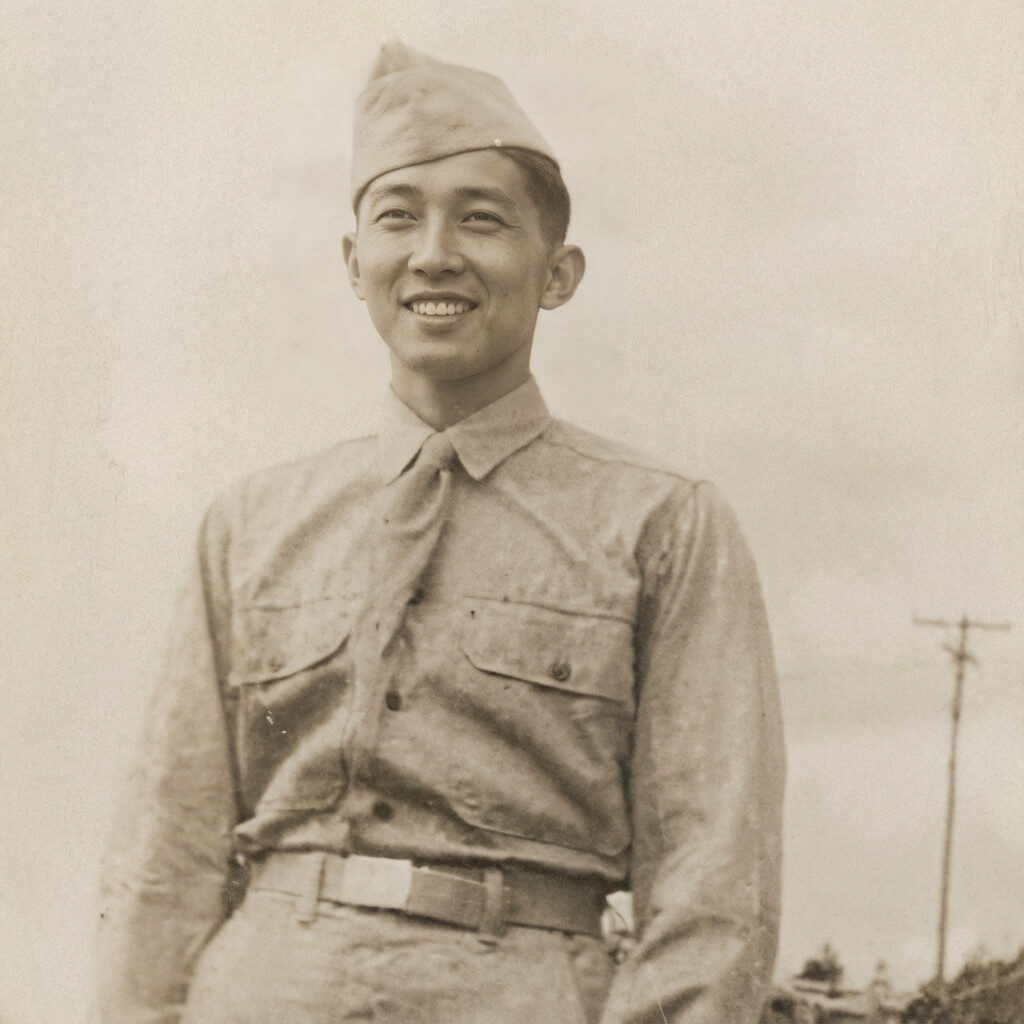
According to Army records, Okuhara enlisted in the U.S. Army on May 3, 1944, in Detroit, Michigan. His residence was listed as Pinal County, Arizona. He had completed four years of high school.
Left: Pvt. Okuhara at Camp Shelby
He was sent to Camp Shelby, Mississippi, and assigned to the 442nd Regimental Combat Team. Tom promptly joined the baseball team that was organized for the men. While he was in basic training, on August 10, 1944, the 1st Battalion of the 442nd – which had remained as a training cadre at Camp Shelby after the rest of the 442nd Combat Team had left for the Theater of War on April 22 – was officially renamed the 171st Infantry Battalion (Separate). This redesignation meant little to the men in training, however. They were eager to learn their infantry skills and be ready for shipment to the 442nd in combat in Europe.
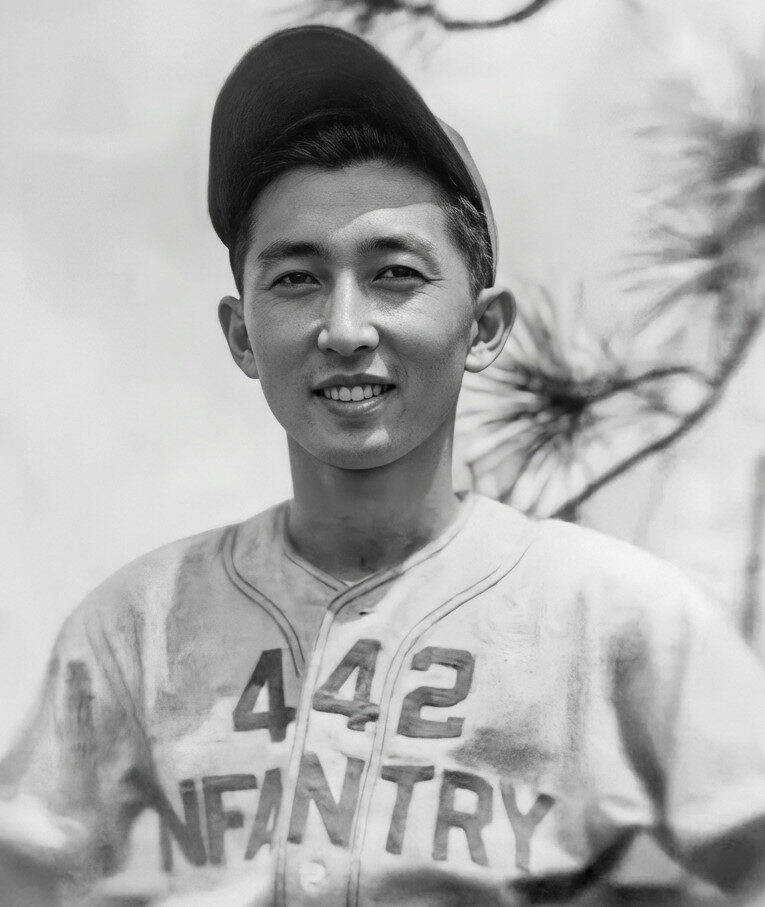
Right: Okuhara in his 442nd baseball uniform
At some point during basic training, personnel arrived at Camp Shelby from the Military Intelligence Service (MIS) to identify soldiers with Japanese language proficiency. Tom was one of the men chosen for transfer to the MIS. He was sent to the Military Intelligence Service Language School (MISLS) at Camp Savage, Minnesota, for intensive training as an interpreter/translator. During 1944, Camp Savage had reached its capacity and new arrivals and others were sent to Fort Snelling, Minnesota, for their language training at the MISLS there and Okuhara was trained there in Class 44-09.
In the March 21, 1945, Lodi Sentinel, it was reported that “Fort Snelling boasts the largest contingent of Lodi boys on the mainland in their language school, being prepped for eventual assignment ‘on the road to Tokyo.’” Private Mas Okuhara was among the dozens of names listed. In the summer of 1945, Tom was still stationed at Fort Snelling, where he was a pitcher on the baseball team. In December 1945, he was briefly admitted to a post dispensary for gastroenteritis, treated, and returned to duty. By the time of his discharge, he had risen to the rank of Tech Sergeant.
For his World War II military service, Technical Sergeant Masuwo Tom Okuhara was awarded the following: Good Conduct Medal, American Campaign Medal, and World War II Victory Medal. He was posthumously awarded the Congressional Gold Medal on October 5, 2010, along with the other Japanese American veterans of the Military Intelligence Service. Conferred by the U.S. Congress, the award states: “The United States remains forever indebted to the bravery, valor, and dedication to country these men faced while fighting a two-fronted battle of discrimination at home and fascism abroad. Their commitment and sacrifice demonstrate a highly uncommon and commendable sense of patriotism and honor.”
After the war, Okuhara returned to San Joaquin County. Right away, he became involved in baseball, playing for the Y.M.B.A. (Young Men’s Buddhist Association). In the fall, he was on the local young men’s basketball team as well. His father, Masuhei, also returned and resumed farming, including cultivating vineyards. He was a member of the Lodi Buddhist Church.
In 1950, Mas was living with his parents and siblings in Elkhorn Township, where brother Keizo was a farmer. Mas was employed as an engraver at a retail jewelry store in Stockton.
In 1953, Tom married Sumiye Wakai, a native of Lodi, on November 1, in San Joaquin County. She was the daughter of Mr. and Mrs. Shoichi Wakai and was born in 1930. They remained in Lodi and over the years raised a family of three sons and one daughter. Twin daughters Akemi Diane and Midori JoAnn were born on July 28, 1954, and died the next day.
On March 26, 1954, at the U.S. District Court in San Francisco Tom’s mother, Utayo Okuhara, became a naturalized U.S. citizen. Throughout his adult life, Tom Okuhara played baseball locally and he was eventually elected to the Lodi Sports Hall of Fame.
Masuwo Tom Okuhara died on March 19, 1996. He was inurned in San Joaquin County at the Cherokee Memorial Park, Evergreen Chapel, East Wall. His wife, Sumiye, died on October 6, 2022, and was inurned with him.
Researched and written by the Sons & Daughters of the 442nd Regimental Combat Team with assistance by the family in 2024.