Soldier Story: Michio Gerard Kimura
Soldier Story
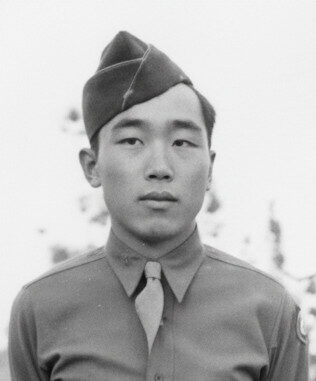
Michio Gerard Kimura
Private First Class
442nd Regimental Combat Team
3rd Battalion, M Company
Michio Gerard Kimura was born in Seattle, Washington, on July 1, 1918, to Kenji and Kikuno (Kaneshige) Kimura. He had one older sister, Mieko Gloria. His parents arrived from Naganoshi in Nagano Prefecture, Japan, in 1909 and Yamaguchi Prefecture in 1911, respectively.
In 1920, his father was employed as a bookkeeper for the Pacific American Fisheries in Ikaten, Alaska, although the family lived in Seattle.
In 1930, father Kenji was employed as Secretary at the Consulate of Japan in Seattle and mother Kikuno was a clerk in a dental office. They lived at 2015 King Street.
Michio, known as “Mickey,” attended Garfield High School in Seattle and played on the freshman football team in 1935.

Above: Row 3, far right
After high school Mickey enrolled in the University of Washington (UW) in Seattle. His name appears as a freshman, sophomore, and junior in Tyee, the UW yearbook, for 1940, 1941, and 1942 as a member of the Japanese (Students) Club. He was majoring in Chemical Science.
In 1940, the family was still at 2015 King Street and Mickey’s sister Mieko Gloria and her husband Yonesaku Ota (a wholesale produce salesman) and sons Martin Eichi and Karl Wright Ota also lived with them. Yonesaku Ota was the brother of Mickey’s good friend Kenji Ota.
On October 16, 1940, Kimura signed his draft registration card at Local Board No. 9 in Field Artillery Armory in Seattle. His parents were his points of contact. He listed his employer as the University of Washington; and he was 5’4” tall and weighed 138 pounds.
Following the Pearl Harbor attack Kimura decided to volunteer and was enlisted in the U.S. Army on January 15, 1942. Where was sent for training is unknown, but in early December 1942 the Minidoka WRA camp newspaper reported that he was visiting his parents at the camp and was stationed at Camp Phillips, Kansas. After the 442nd was organized in January 1943, he was transferred to the 442nd Regimental Combat Team at Camp Shelby, Mississippi. He was assigned to 3rd Battalion, M Company, the battalion’s heavy weapons company.
At this same time, in May 1942, his parents and his sister and her family (husband and four young sons) were evacuated to the WCCA Assembly Center, called “Camp Harmony,” located at the Puyallup Fairgrounds near Seattle. On August 22, 1942, they were incarcerated at Minidoka War Relocation Center (internment camp) near Jerome, Idaho.
Brother-in-law Yonesaku Ota was released from Minidoka to Spokane, Washington, on February 28, 1944. Mieko Gloria and their children (including a daughter who was born at Minidoka) were released to Spokane four months later on May 31. After the war ended in 1946, his mother Kikuno was released to Spokane on August 25, and his father Kenji a few weeks later on September 15 to Seattle.
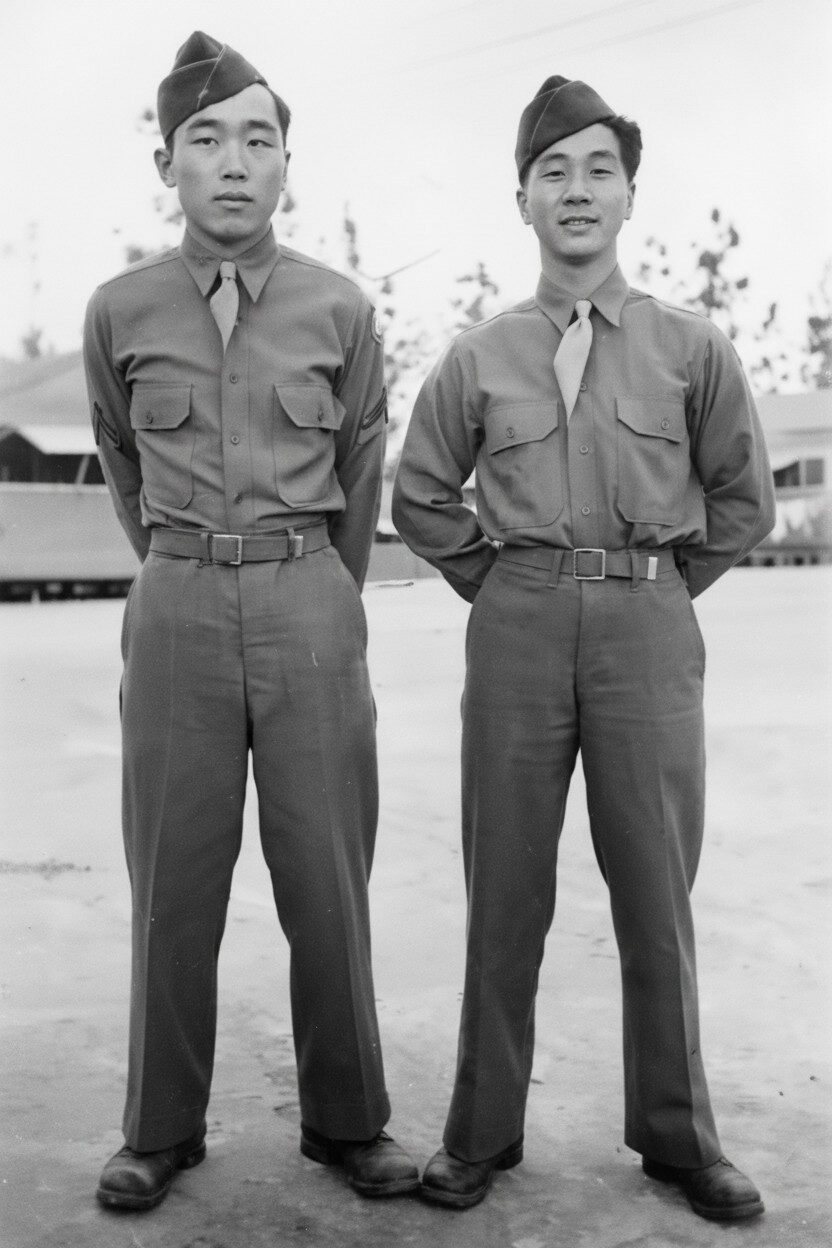
Above: Kimura with close friend and “brother-in-law” Kenneth Ota, March 3, 1944, at Camp Shelby
While his family was interned at Minidoka, Michio Kimura completed training with the 442nd. He left Camp Shelby with the Combat Team on April 22, 1944, for Camp Patrick Henry, Virginia. They shipped out to Italy from Hampton Roads on May 2 in a convoy of over 100 ships.
After arriving at Naples on May 28, the 442nd entered combat near Suvereto on June 26. After pushing the enemy north up the Italian peninsula for months, they were sent to France on September 27, 1944. They fought in the Rhineland-Vosges and Rhineland-Maritime Alps Campaigns. In the Vosges, they liberated the towns of Bruyères and Biffontaine. This was followed by the rescue of the “Lost Battalion,” the 141st (Texas) Regiment that found itself surrounded by the enemy. In the fighting that continued after the “Lost Battalion” rescue, Michio Kimura was wounded on 3 November and was awarded the Purple Heart Medal.
After devastating casualties in the Vosges mountains, they were sent to the Maritime Alps in southeastern France. Their mission there was to protect the southeast flank of the Sixth Army Group and guard against a possible enemy breakthrough from Italy into the southern coast of France.
In mid-March 1945, the 442nd was sent back to Italy for combat in the Po Valley Campaign. They had successfully pushed the enemy north to Aulla by the time the war ended in Italy on May 2. The 442nd remained in Italy for occupation duties at Ghedi Airfield, Lecco, and then the Pisa-Livorno-Florence area.
After returning to the US, Kimura was discharged from the Army in December 19, 1945.
For his military service, Pfc. Michio Gerard Kimura was awarded the following: Bronze Star Medal, Purple Heart Medal, Good Conduct Medal, European-African-Middle Eastern Campaign Medal with four bronze stars, World War II Victory Medal, Army of Occupation Medal, Distinguished Unit Badge with one oak leaf cluster, and Combat Infantryman Badge. He was awarded the Congressional Gold Medal on October 5, 2010, along with the other veterans of the 442nd Regimental Combat Team. Conferred by the U.S. Congress, the award states: “The United States remains forever indebted to the bravery, valor, and dedication to country these men faced while fighting a two-fronted battle of discrimination at home and fascism abroad. Their commitment and sacrifice demonstrate a highly uncommon and commendable sense of patriotism and honor.”
After the war, Kimura was employed by the U.S. Department of Defense (DOD) as a civilian contractor in Japan. He married a Japanese citizen, Kazuko Yoneda, in 1950, and over the years they raised three children.
On August 30, 1954, Kimura sailed from Seattle on the troop ship USNS James O’Hara for Japan. He was age 36 and living at 1820 Jackson Street in Seattle. He arrived back in Seattle from Yokohama on the troop transport ship USS General W.A. Mann on November 13, 1955. Travelling with him were his wife Kazuko and their young son and daughter.
After retirement from the DOD, he worked for The Boeing Company from 1966 to 1982.
In 2008, Kimura received an Honorary Baccalaureate degree from the University of Washington. He was included in the effort by the University to make amends for the forced removal of their 440 Japanese American students in late May 1942.

Michio G. Kimura died on October 12, 2010, and was inurned with his wife, Kazuko, who predeceased him in 1997, in the Mausoleum at Sunset Hills Memorial Park in Bellevue, near Seattle, on the lower level of Heritage Court. He was survived by his three children and four grandchildren.
Left: Columbarium niche of Michio and Kazuko Kimura
Mickey Kimura was remembered by his good friend and “brother-in-law” Ken Ota as a jolly fellow, a close friend of the Ota family, an avid stamp collector, and an artist. He made Ota a special piece of art work featuring the 442nd Torch insignia. He also always made sure that Seattle’s 442nd Veterans felt honored.
Kimura’s name appears on the Nisei Veterans Committee Foundation’s Japanese American Memorial Wall in Seattle, Brick #1223, Column 25, Row 9. It also appears on the Go For Broke Memorial in Los Angeles, Panel 12-A, Row 17.
See also the Soldier’s Story for Kenneth Kenji Ota, 2nd Battalion, F Company.
Researched and written by the Sons & Daughters of the 442nd Regimental Combat Team in 2021 and updated in 2026.