Soldier Story: Peter Setsuo Masuoka
Soldier Story
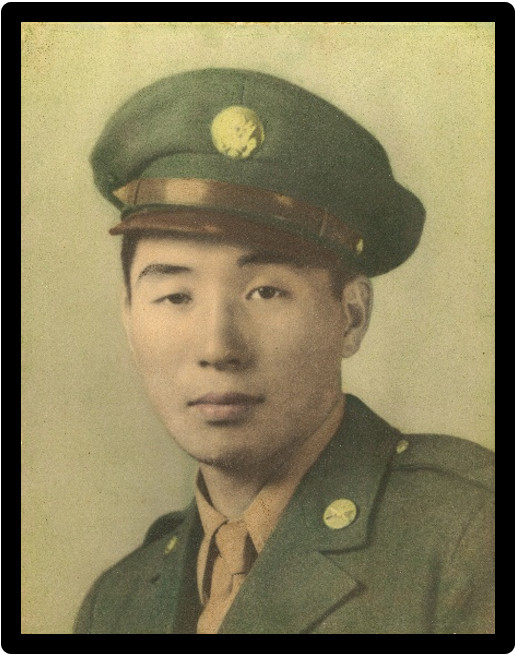
Peter Setsuo Masuoka
Staff Sergeant
442nd Regimental Combat Team
2nd Battalion, Headquarters Company
Peter Setsuo Masuoka was born on January 7, 1920, in Sebastopol, Sonoma County, California, to Harry Ushidaka and Chikayo Mary (Sugano) Masuoka. His siblings were: brothers Takeji, Henry Tadateru, Edward Takamasa, Frank Yoshio; and sister Margaret Makiko.
Father Ushidaka (born July 24, 1889) emigrated to San Francisco, California, from Okayama Prefecture, Japan, in 1906. He returned there in August 1913, where he married Chikayo Sugano (born June 18, 1888) that year. He arrived back in the US on the Chicago Maru on May 31, 1914, at Tacoma, Washington. Chikayo also arrived in the US in 1914. They settled in Sonoma County in 1916.
By 1917, Harry was working on the E.A. Peterson Ranch on RFD 1, Box 156 in Sonoma County when he signed his World War I draft registration card on June 5.
By 1920 the couple was living on China Alley in Sebastopol with their sons Tadateru and Takamasa. Harry was a laborer on a fruit farm.
By 1930 they were in Analy Township, Route 2/Hulbert Street Extension with four sons and daughter Margaret. Harry operated an orchard farm. In October 1934, Harry obtained a passport and he visited Okayama to see his oldest son Takeji in Tsushima-machi. He returned to California on the Asama Maru on January 31, 1935.
Pete, as Peter was known, attended Analy Union High School in Sebastopol, where he was a star on the B Class Tigers basketball team in 1937. In 1940, the family was still living on their own farm on Route 2/Hulbert Street Extension. Pete was senior class president when he graduated from high school in 1940. Upon graduation, he was the first person of Japanese ancestry in Sonoma County to be presented the American Legion Citizenship Award.
After high school, Pete enrolled at Santa Rosa Junior College located about nine miles from Sebastopol.
Masuoka signed his draft registration card on February 14, 1942, Local Board 45, Sonoma County. He was a student at Santa Rosa Junior College. His point of contact was his father Harry who lived at Route 2, Box 43, Sebastopol. Peter was 5’8” tall and weighed 160 pounds.
The family was incarcerated in the spring of 1942. They first went to the Merced WCCA Assembly Center, located in Merced at the Merced County Fairgrounds. On August 27, Peter entered Granada WRA Internment Camp as part of an “advance work party.” His parents, brother Frank, and sister Margaret entered on September 9. Their address was Unit 6H-8B. Granada was located in southeast Colorado and also known as Camp Amache. Frank was released a few months later on December 18 to Fort Logan, Colorado, to join the Army. Afterwards, Pete was released on April 6, 1943, to the same place to join the Army.
While at Granada, Chikayo was president of the Gold Star Mothers Club, which comprised 174 mothers of men in uniform. She had four sons serving in the U.S. Armed Forces. Their duties included everything from entertaining visiting servicemen to promoting sales of War Bonds. Their main service was bridging the gap between sons who spoke and wrote only in English and their mothers who did so in Japanese. They wrote and translated letters for these worried mothers. Peter’s parents and sister Margaret were released on August 15, 1945, to return home to Sebastopol.
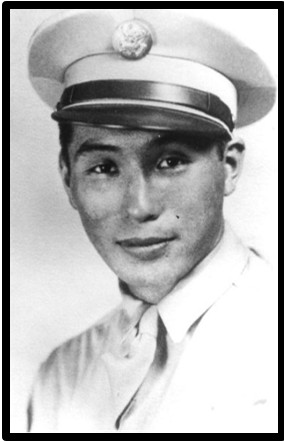
Peter Masuoka enlisted in the U.S. Army on April 16, 1943, at Fort Logan in Denver, Colorado. He was listed as having one year of college and his civilian occupation was “Athletes, sports instructors, and sports officials.” He was sent to Camp Shelby, Mississippi, to the 442nd Regimental Combat Team. Once there, he was assigned to 2nd Battalion, Headquarters Company.
Right: Masuoka in 1943
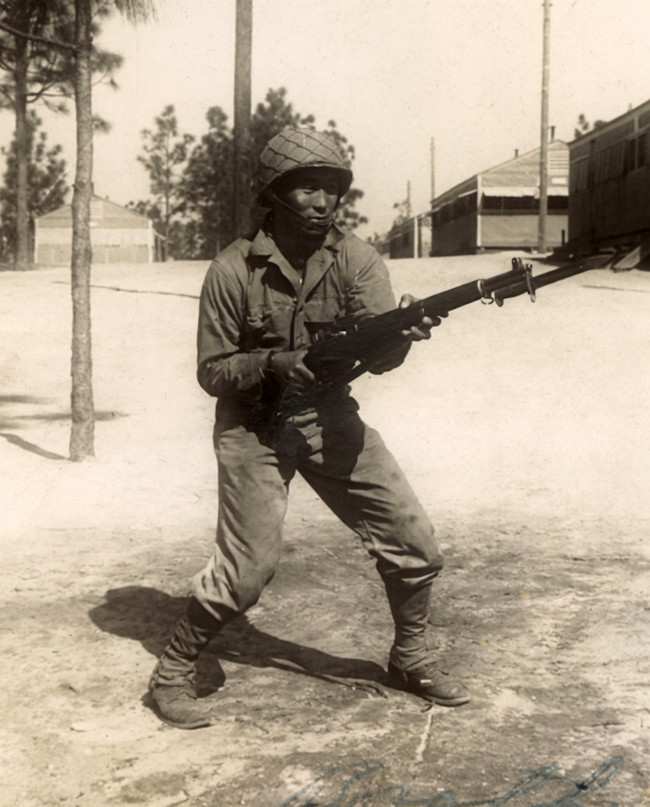
He went through basic training from May 10 to August 16, 1943. Afterwards, many men were give a 2-week furlough to visit such cities as New York or Chicago, or to visit families out west to settle affairs. On October 20, unit training for platoons and companies began and lasted about one month. On December 13, the Combat Team was taken into the field for exercises that ran through the end of the year, during which battalion staffs learned to work with regimental staff and to coordinate with other battalions.
Left: Masuoka at Camp Shelby, 1943
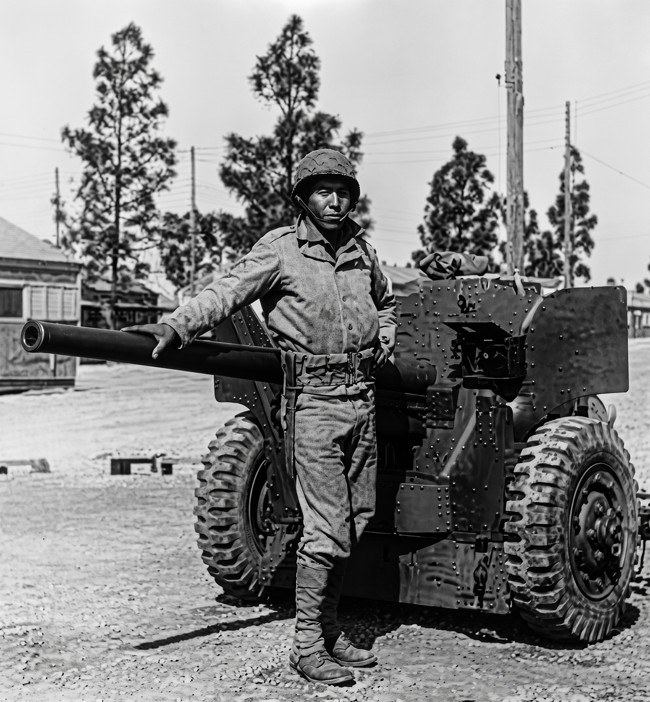
On January 28, 1944, the “D” Series maneuvers in DeSoto National Forest in Mississippi began with the 442nd’s participation. Once back at Camp Shelby, they spent time brushing up on small-unit tactics and reviewing/correcting weaknesses that had turned up during their weeks in the field. Also included was more combat firing and review of marksmanship, and the fundamentals of soldiering.
Right: Masuoka at Camp Shelby, 1943
Army Chief of Staff General George C. Marshall reviewed the Combat Team on March 4. Afterwards he told 442nd commander Colonel Charles W. Pence that he had been pleased with what he had seen. Ten days later, the 442nd was directed to prepare for overseas movement.
After a year of training, on April 22, 1944, Masuoka with the rest of the Combat Team boarded trucks at Camp Shelby and were driven to the train station where a mixed assortment of Pullmans and coaches took them to Camp Patrick Henry, Virginia.
The 442nd sailed in a large convoy of troop ships from Hampton Roads, Virginia, on May 2. Once in the Mediterranean, the ship carrying Company E dropped out of the convoy and steamed into Oran, on the coast of North Africa, to discharge cargo. The other ships, including Masuoka and 2nd Battalion’s Headquarters Company arrived at Naples, Italy, on May 28.
Troops marched or were carried by interurban trains to Staging Area No. 4 in Bagnoli, about 10 miles from the port. They left on LSTs and LCIs for Anzio on June 6, where on arrival they marched five miles to a bivouac area. On June 9 the 442nd left Anzio and were trucked around Rome to a large bivouac area at Civitavecchia, about 50 miles north, where they went through additional training and final preparations for going to the front lines. On June 10, the 442nd was attached to the 34th (“Red Bull”) Infantry Division, commanded by Major General Charles L. Bolte.
While at Civitavecchia, some men were given day passes to visit Rome. Matsuoka took advantage of this and saw the sights of the recently liberated city. He sent the photo shown here to his sister Margaret.
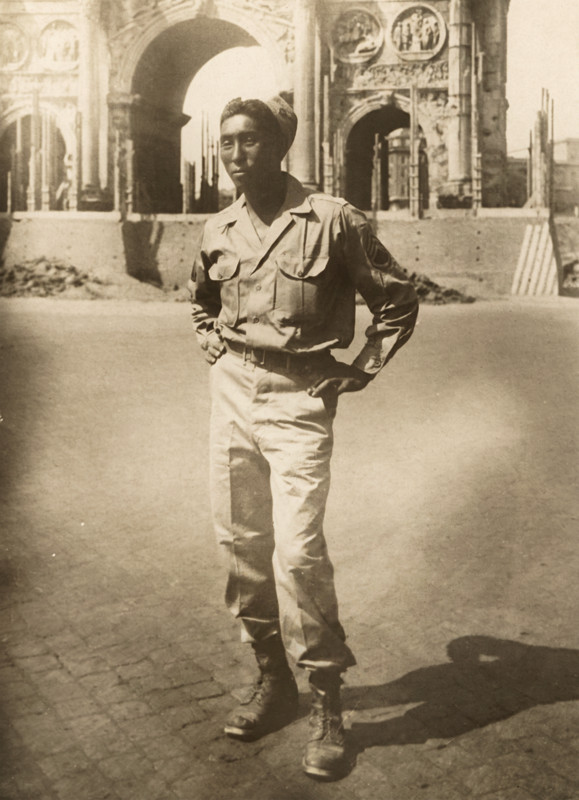
Left: Pete at Constantine’s Arch, Rome, Italy, June 1944
On June 22 the Combat Team moved to another bivouac near Gavoranno, and on the following day marched 13 miles to its final assembly area behind the lines. On June 26, 1944, the 442nd RCT moved forward in the pre-dawn hours to the front lines for their first combat engagement. They were relieving the 36th Infantry Division.
By September, the 442nd had pushed the enemy north to the Arno River and was assigned to the area west of Florence. At this time, it was decided that the 442nd would be sent to the Seventh Army in France. They were transported to the port of Piombino on September 10 and left the same day on Liberty ships for Naples, arriving the next day. While there, they were bivouacked in an area of olive groves and the men were given day-passes to Pompeii and Naples.
On September 27, the 442nd sailed to Marseilles, France, arriving on September 30. The next day, they were moved by train to a staging area near Septèmes. After several days, all units were moved by truck – with the exception of 3rd Battalion by train – over a three-day period, north along the Rhône Valley. They arrived at an assembly area in Charmois-devant-Bruyères on October 11 for combat in the Rhineland-Vosges Campaign. They were attached to the 36th Division.
While in the Vosges Mountains, the 442nd liberated the strategically located towns of Bruyères and Biffontaine, followed by the rescue of the “Lost Battalion” – the 1st Battalion, 141st (Texas) Infantry Regiment – that had advanced beyond its supply line and was surrounded by the enemy. The action came after nearly nonstop combat for the 442nd that began on October 15 with the fighting to take Bruyères.
Following the rescue of the Lost Battalion on October 30 the Combat Team kept fighting. The 100th Battalion was shifted to the south to protect the regimental right flank and line of supply, while 3rd Battalion was ordered to push on to the end of the long ridge that had been the Lost Battalion’s objective. The 2nd Battalion garrisoned Hill 617, protecting the left flank of the 36th Division and the right flank of the 3rd Division. On November 1-3 all units remained substantially where they were, holding defensive positions and patrolling to find out what the enemy’s dispositions were.
On November 3, 1944, Staff Sergeant Peter S. Masuoka was killed while serving as a volunteer to lead a squad of litter bearers. He volunteered when the original team leader became ill and was unable to lead the mission. The field hospital admission card states that he was a battle casualty, location of the wound was “unknown,” and the causative agent was “bullet, missile not stated.”
He was buried in the nearby U.S. Military Cemetery at Épinal, about 25 miles away.
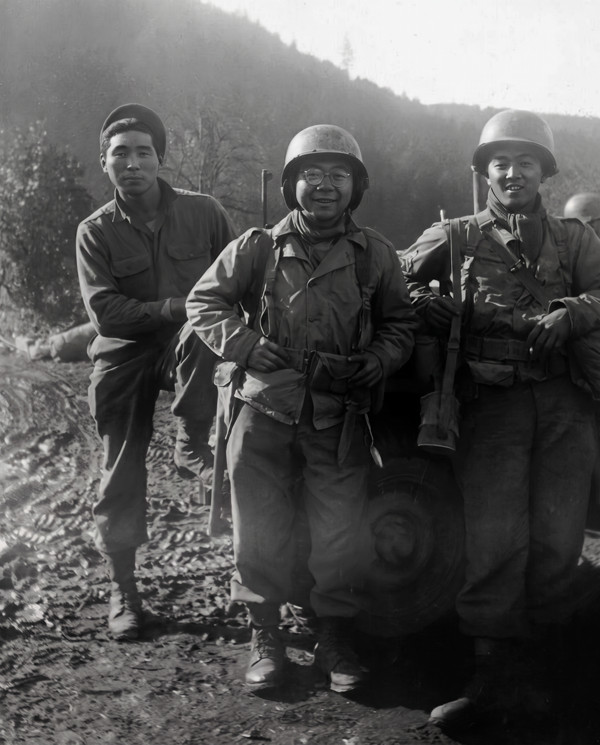
Below: Left to right, Pete Masuoka, Lens Murakami, unknown. This photo was taken on the day that Pete Masuoka was killed.
On November 20, Pfc. Edwin Ohki of 2nd Battalion’s E Company wrote to the Masuoka family:
Dear Mr. and Mrs. Masuoka, I am writing this letter among tears of sorrow as I worshipped your son Peter as the best and greatest soldier I have even known, and I always tried to be like him…Peter and Edward came to visit me and he (Peter) said, “When you get to Amache, tell my folks that I am fine and not to worry about me.”
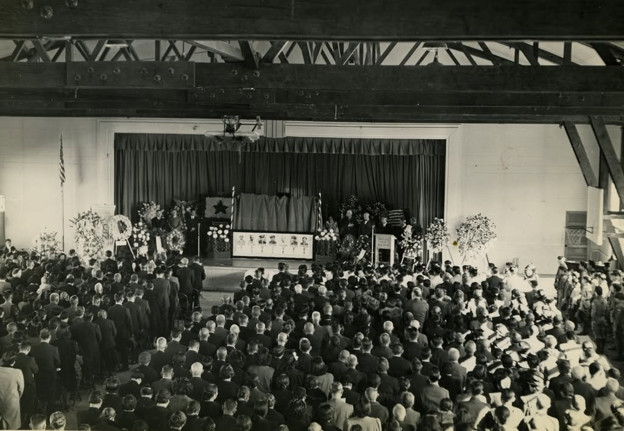
On November 22, 1944, a memorial service was held at Camp Amache’s high school auditorium honoring Peter and six other Amache soldiers that were killed while serving their country. Over 2,000 people attended the ceremony.
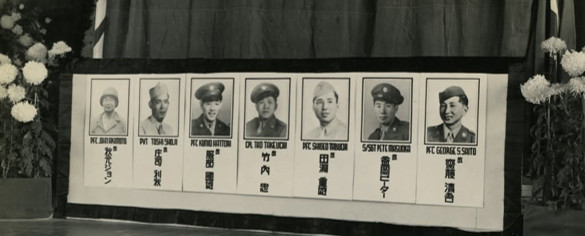
Photos above and below: Camp Amache Memorial Service, November 22, 1944. In the photo above, Masuoka is second from the right.
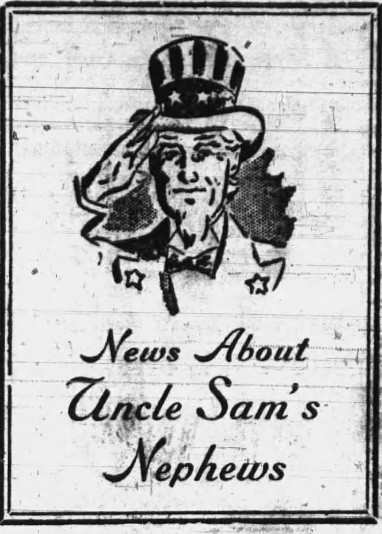
Staff Sergeant Masuoka’s death notice was printed on November 24, 1944, in a front-page column in his hometown newspaper, Sonoma West Times and News, entitled, “News about Uncle Sam’s Nephews.”
The Silver Star Medal was awarded posthumously on January 24, 1945, to Masuoka. The citation reads in part:
…Staff Sergeant Peter S. Masuoka…United States Army, for conspicuous gallantry and intrepidity in action against the enemy while serving with Headquarters Company, 2d Battalion, 442d Regimental Combat Team, attached to the 36th Infantry Division, on 3 November 1944, in the vicinity of Biffontaine, France. When his company was subjected to an intense artillery barrage, Sergeant Masuoka volunteered to lead a squad of litter bearers in the evacuation of several casualties. Exposing himself to terrific artillery fire, he skillfully administered first aid and evacuated the wounded. While working on a wounded comrade, Sergeant Masuoka was killed by enemy shellfire. Inspired by his courageous action, which was performed at the sacrifice of his life, his litter bearers continued administering first aid to the remaining casualties, successfully treating them and evacuating all the wounded men of the company. His actions, without regard for his own safety, reflect great credit on himself and the Armed Forces of the United States.
For his military service, Staff Sergeant Peter Setsuo Masuoka received the following awards: Silver Star Medal, Bronze Star Medal, Purple Heart Medal, Good Conduct Medal, American Campaign Medal, European-African-Middle Eastern Campaign Medal with two bronze stars, World War II Victory Medal, Distinguished Unit Badge, and Combat Infantryman Badge. He was posthumously awarded the Congressional Gold Medal on October 5, 2010, along with the other veterans of the 442nd Regimental Combat Team. Conferred by the U.S. Congress, the award states: “The United States remains forever indebted to the bravery, valor, and dedication to country these men faced while fighting a two-fronted battle of discrimination at home and fascism abroad. Their commitment and sacrifice demonstrate a highly uncommon and commendable sense of patriotism and honor.”
In 1947, the US began a program of closing most of its wartime overseas military cemeteries. The families of our war dead were given the choice of having their son returned home or reburied in one of the overseas cemeteries that would remain. Although Épinal would remain a military cemetery, the Masuoka family chose to have Peter returned home.
As a result of this decision, Peter’s remains were among those of 4,183 others – including 10 from California – aboard the USAT Lawrence Victory that arrived at New York on May 7, 1948.
His casket was sent to Sebastopol where his funeral service was held at the Japanese Buddhist Temple at 8:00 p.m. on July 2, 1948. He was then buried with full military honors at the Golden Gate National Cemetery in San Bruno at 10:15 a.m. on July 3, in Section C, Grave 296. On July 9, the Masuoka family printed a Card of Thanks in the Sonoma West Times and News, thanking their many friends for their kind remembrances and also thanking those who attended the service.
Postscript. Peter Masuoka’s parents later moved to the nearby town of Santa Rosa, where they lived at 2134 Laguna Road. They became naturalized U.S. citizens in the early 1950s at the Sonoma County Superior Court – Chikayo on November 9, 1953, and Harry on November 8, 1954. Chikayo died in April 1956 and Harry on March 27, 1972. He was survived by his sons Henry, Edward, and Frank, daughter Mrs. Margaret M. Murakami, and twelve grandchildren.
On May 25, 2023, his nephew Alan K. Masuoka wrote and published a book entitled, “Peter Masuoka, the Uncle I Never Knew.” It was the result of hours of historical research and personal interviews with family and friends.
Brother Henry Masuoka served in the U.S. Army in World War II, Korea, and Vietnam, retiring as a Lieutenant Colonel. Brother Edward Masuoka served in the U.S. Army from January 27, 1942, to December 14, 1945. Brother Frank Masuoka served in the Military Intelligence Service during World War II.
Researched and written by the Sons & Daughters of the 442nd Regimental Combat Team with assistance by his nephew Alan K. Masuoka in 2026.