Soldier Story: Ralph Kiyoshi Rokuta
Soldier Story
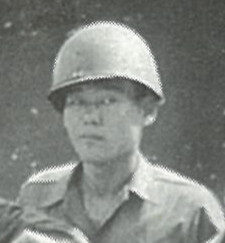
Ralph Kiyoshi Rokuta
Private
522nd Field Artillery Battalion, B Battery
442nd Regimental Combat Team
Ralph Kiyoshi Rokuta was born on July 31, 1922, in Kailua Kona on Hawaii island, Territory of Hawaii. He was the seventh of nine children born to Suetaro and Kima (Sakai) Rokuta, who arrived from Kumamoto Prefecture, Japan, in 1889 and 1908, respectively. His siblings were: brothers Charles Kenichi, James Sueo, Tomio, and Takashi (died young); and sisters Shizuko, Ethel Shizue, Edna Yukiko, and Sally Sumiko.
The eldest child, Shizuko, was born in 1909 when the family was living in Haiku, Maui. By 1912, they had moved to Kona on Hawaii island. By 1930 the family had moved up the coast and were living in North Kohala. Ralph’s mother Kima died in 1930. Ralph attended Konawaena High School, but the family had moved to Honolulu by early 1940 when they were living at 1271 North King Street. The family was supported financially by the three eldest brothers who had jobs in construction. Ralph graduated from Farrington High School on June 4, 1941.
After high school, Ralph worked for Hawaiian Pineapple on Dillingham Boulevard and lived with his family at 1271-L North King Street.
Rokuta signed his draft registration card at Local Board No. 7, located at Farrington High School, Room 143, on June 20, 1942, when he was 19 years old. He listed Haruo Masuda of 925 Robello Lane as his point of contact. Ralph lived his family at the North King Street address. He was 5’7½” tall and weighed 135 pounds.
Ralph Kiyoshi Rokuta enlisted in the U.S. Army on March 25, 1943. His civilian occupation was listed as “Semiskilled chauffer/driver of bus/taxi/trailer/tractor.” He had completed four years of high school. He was sent to Boomtown, the “tent city” for new soldiers located at Schofield Barracks. On March 28, the new soldiers were given a community farewell ceremony at Iolani Palace.
Ralph left Honolulu on the S.S. Lurline on April 4 with the rest of the new soldiers for Oakland, California, and the train ride across country to Camp Shelby, Mississippi, for training.
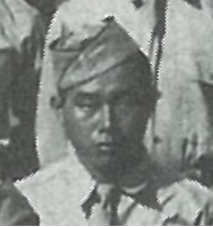
Right: Rokuta at Camp Shelby, 1943
After arrival at Camp Shelby, Rokuta was assigned to B Battery of the 442nd Combat Team’s 522nd Field Artillery Battalion. After a year of basic, unit, and specialized training, winter maneuvers in Louisiana, then D-Series maneuvers in the DeSoto National Forest near Camp Shelby, he left with the Combat Team from Camp Shelby on April 22, 1944, and traveled by train to Camp Patrick Henry, Virginia.
On May 2, the 442nd left from nearby Hampton Roads in a convoy of over 100 ships to the Mediterranean Theater of Operations. The 442nd arrived at Naples, Italy, on May 28. However, the S.S. Johns Hopkins, which carried the 522nd Field Artillery to Brindisi on the east coast of Italy on May 27. The next day the battalion traveled by train in boxcars to the staging area in Bagnoli near Naples where the rest of the 442nd had just arrived.
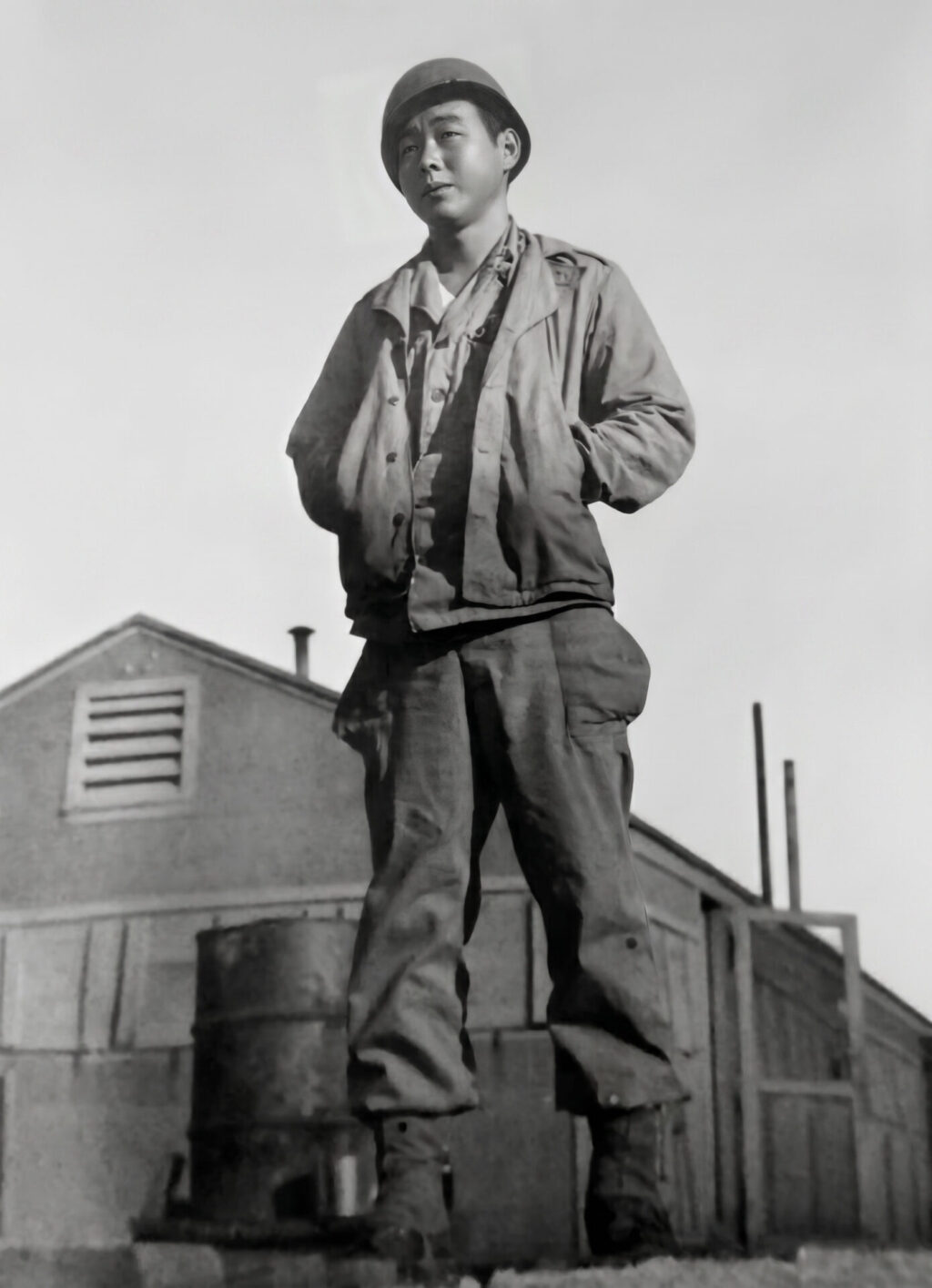
Left: Ralph at Camp Shelby, 1943
In Bagnoli the 522nd was able to pick up their trucks, howitzers, and other equipment. On June 6 the Combat Team left Bagnoli in LSTs (Landing Ship Tanks) for Anzio. The 552nd was shipped in LST 526. After two days there, they were trucked through the recently liberated city of Rome to a large bivouac near Civitavecchia, about 50 miles north.
The 442nd went into combat on June 26 near Suvereto, about 50 miles north of Civitavecchia.
Ralph Kiyoshi Rokuta was in B Battery’s Ammunition Section and was an ammunition handler. In the 522nd’s unit history, Fire For Effect, the men noted that the most rounds of ammo fired by the 522nd during a 24-hour period were 4,544 rounds in the area of Colle Mezzano during the Rome-Arno Campaign from 6:00 p.m. on July 5, 1944, to 6:00 p.m. the next day. This was during the ferocious battle for Hill 140, just north of the Cecina River.
The 522nd was known for its “time fire/air bursts,” which is the premature explosion of the projectile about 20 yards above the ground so that the shrapnel would scatter in a wide area to penetrate the enemy’s foxholes. This was particularly effective during the Hill 140 fighting. The 522nd was very well known among the infantry companies for their accuracy in time fire/air bursts. They were considered experts in the way they set the time fuse for the projectile. They were also known for their ability to fire rapidly – for example, when ordered to fire three rounds they fired all three before the first round even reached the target.
After driving the enemy north to the Arno River, the 442nd was pulled from the lines and sent to Naples for shipment to France, where they joined in the Rhineland-Vosges Campaign. They arrived at Marseilles on September 29 after a 2-day voyage, and bivouacked at nearby Septèmes prior to traveling over 500 miles north by truck or rail boxcars to the Vosges.
Rokuta was in combat for the next month during the bitter fighting to liberate the important rail junction of Bruyères, neighboring Biffontaine and Belmont, and the “Rescue of the Lost Battalion,” the 1st Battalion, 141st (Texas) Infantry that had advanced beyond the lines and was surrounded on three sides by the enemy. The weather was cold, wet, snowy, and miserable, as the men fought in the heavily wooded forests still in their summer uniforms. They were subjected to living in foxholes, and incoming artillery raining down on them in “tree bursts.”
After the fierce fighting in the Vosges, the 442nd was now at half-strength, and was sent to the south of France. There, they could rebuild to full combat strength while participating in the Rhineland-Maritime Alps Campaign, which was mostly a defensive position guarding the French-Italian border from attack by the German Army in Italy. The 522nd was stationed up in the mountains in Sospel and eventually moved to Menton on the coast. The Combat Team was there from November 23, 1944, until March 1945.
By this time, the Combat Team was back up to combat strength and ready to return to the front lines. The decision on where the 442nd would be sent was a matter that reached the highest echelons of power. After arguing about who would get the much-sought-after 442nd, it was finally decided that the bulk of the Combat Team would return to Italy for the Po Valley Campaign and the 522nd would be sent to Germany for the Central Europe Campaign. General Eisenhower wanted as much fire power as possible in the final drive across the German heartland. As a result, the 522nd left Menton by convoy on March 9, 1945, and crossed the Saar River to enter Germany on March 12, 1945, at Kleinbittersdorf.
During its seven weeks of combat duty in Germany, the 522nd was assigned to general fire support missions reinforcing the firing and assault advances of numerous units of the 7th Army as they rapidly chased the Germans toward the Austrian border. They fired 15,219 rounds of artillery fire, making 52 different displacements while covering 617 miles enroute.
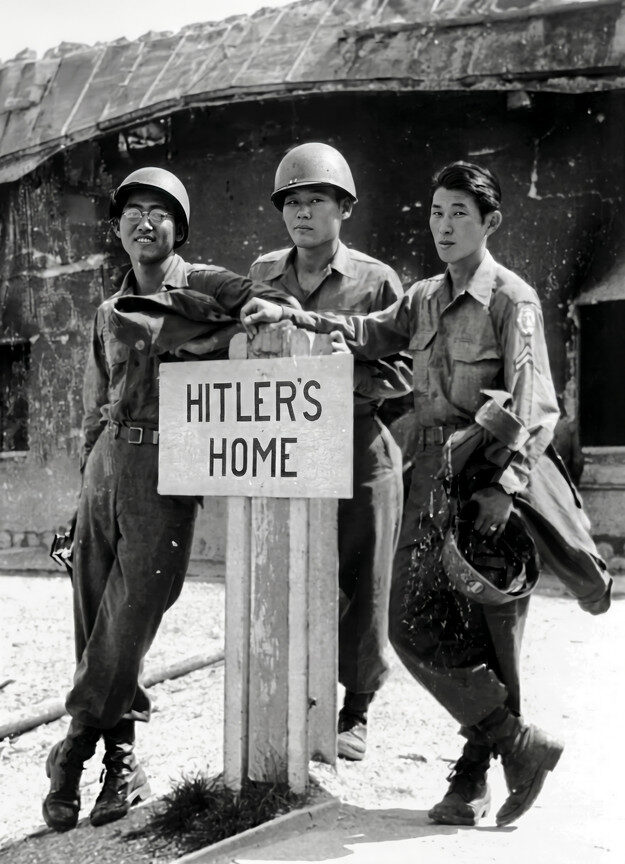
Above: L to R standing in front of Eagles Nest during the occupation – Pfc. Yoshinobu Yamato, Pfc. Ralph Rokuta, and Corp. George (“Rocky”) Tanna
By the end of April all enemy resistance had completely ceased. Lieutenant General Alexander M. Patch, commander of 7th Army, ordered a cease fire on May 6. The 522nd was detached from the 101st Airborne Division and attached to the 30th Field Artillery Group. On May 9, the day after V-E Day, the 522nd moved out of Schaftlach in a motor convoy and travelled 77 miles north on the autobahn to Steppach, where they set up the battalion CP (command post). B Battery was sent onward to the town of Genderkingen where they were quartered in tents. On July 18, B Battery was moved to the nearby town of Mertingen.
During the occupation, some soldiers were assigned to guard duty, with others participating in Brigade baseball, track and field, and swimming competition, plus various other sports such as basketball, softball, ping pong, horseshoe pitching, etc. Men were also able to further their education in USAFI (U.S. Armed Forces Institute) courses and unit school programs. And they were also given passes to nearby Königsee, Lausanne, Nice, Brussels, Paris, and London.
The 522nd was deactivated on October 5, 1945. When a soldier was able to return home to the US was determined by the point system. Points were accrued based on such considerations as time served in theater, wounds received, number of dependents back home. About 375 men who had volunteered from Hawaii and had a minimum of 70 points were sent home right away. The remainder of the men were mostly from the US mainland and they were transferred to the 53rd Quartermaster Base Depot near Nuremberg.
For his service in World War II, Private Ralph Kiyoshi Rokuta was awarded the following:
Good Conduct Medal, American Campaign Medal, European-African-Middle Eastern Campaign Medal with four bronze stars, World War II Victory Medal, and Army of Occupation Medal. He was posthumously awarded the Congressional Gold Medal on October 5, 2010, along with the other veterans of the 442nd Regimental Combat Team. Conferred by the U.S. Congress, the award states: “The United States remains forever indebted to the bravery, valor, and dedication to country these men faced while fighting a two-fronted battle of discrimination at home and fascism abroad. Their commitment and sacrifice demonstrate a highly uncommon and commendable sense of patriotism and honor.”
Research did not reveal the exact date of Private Rokuta’s arrival back in Hawaii. He was, however, sent home quickly and he was discharged from the U.S. Army on November 18, 1945, at the Army Separation Center on Oahu. He moved back into the family home on King Street. In 1950, he and sisters Edna and Sally were the only family left at home with their widowed father. Ralph was employed as a house painter for a painting contractor.
On June 7, 1954, Ralph Rokuta and Roberta Chung Pyo Lee, both of Honolulu, married in Hilo, Hawaii island. Bobbie, as Roberta was known, was born on February 29, 1928, in Seoul, Korea.
In December 1954, they were living in Honolulu at 2002-A Pauoa Road. On July 31, 1955, Ralph’s father Suetaro died. Afterwards (by March 1956) Ralph and his family had moved into the Rokuta family home at 1271-L North King Street. Over the years Ralph and Bobbie raised a family of two sons. Ralph was employed as a painter for Morishige Contractors and later for Oahu Painting Company. Bobbie owned and operated Artistic Beauty Salon at 1411 South King Street, which she opened on May 1, 1964. She had previously worked at Hino Hairstyles in Waikiki. By 1964 the family had moved to 46-154 Ohala Street in Kaneohe, on the windward side of Oahu.
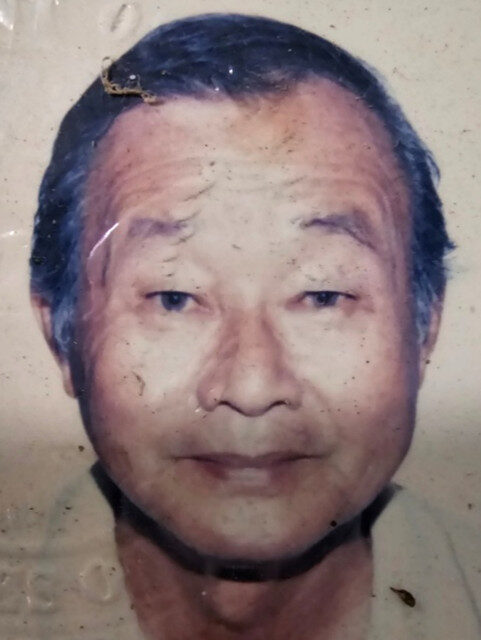
Left: Ralph in later years
Ralph Kiyoshi Rokuta died on September 7, 1997. He was survived by his wife Bobbie C.P., two sons, brother James S., and sisters Shizuko (Mrs. Kazuto) Matsumoto, Shizue (Mrs. Takeichi) Tokunaga, Mrs. Edna Saito, and Sally (Mrs. John) Tomita. Following funeral services at 12:00 p.m. on September 14 at Hosoi Garden Mortuary, he was buried at 10:00 a.m. on September 18, 1987, at the Hawaii State Veterans Cemetery in Kaneohe, in Section 48-A, Site 2.
Below: Bobbie Rokuta
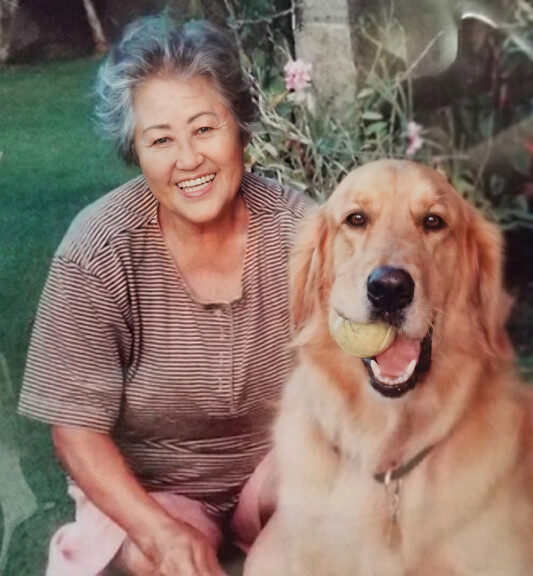
Bobbie Rokuta died at the age of 92 on May 20, 2020, at Queen’s Hospital in Honolulu. She was buried next to her husband on his birthday, July 31. She was remembered by her sons as:
…ambitious, caring, and generously giving of herself. Mom always worked hard, for all that she knew, spoke fluent Japanese, and made so many laugh.
Below are memories of Ralph shared by one of Rokuta’s sons.
Dad was always a kind of soft spoken but pretty tough guy – that term quiet but effective. Showed me bullet wounds in his leg, never forget that. I have a few pictures of him in his army gear and with his helmet on, in Italy. Always a handsome man, and always a very hard-working man! He passed at only age 75, because of “Western medicine” doctors. As he always declined anything for free, he should have gone to Tripler Military Hospital, but instead went to the doctors and hospitals that shortened his life. What a big blow to us. Always proud of my father. He always loved my Golden Retrievers.
Researched and written by the Sons & Daughters of the 442nd Regimental Combat Team in 2026 with assistance by his son.