Soldier Story: Robert Shigeru Murata
Soldier Story
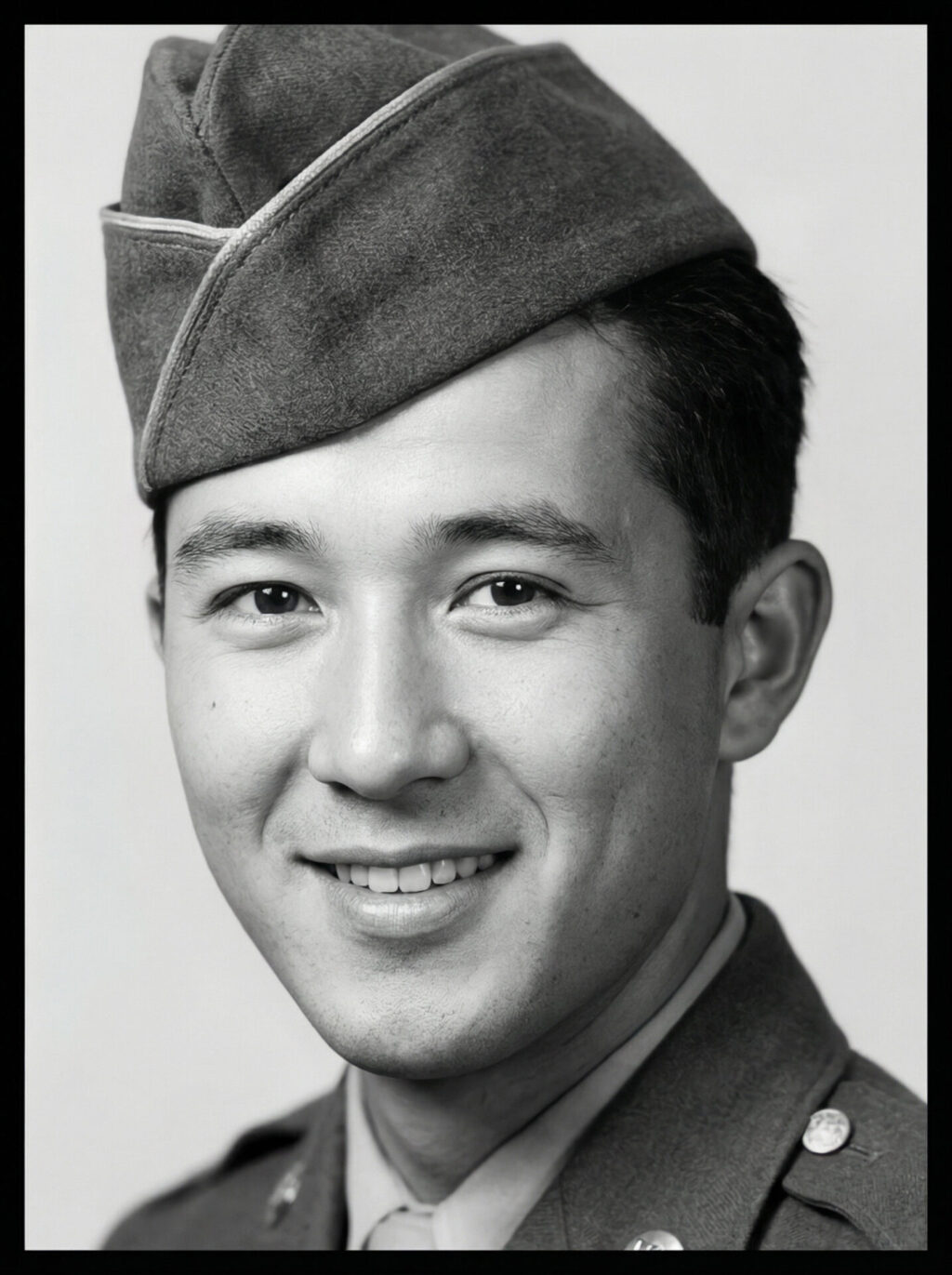
Robert Shigeru Murata
Sergeant
442nd Regimental Combat Team
3rd Battalion, L Company
Robert Shigeru Murata was born on October 8, 1922, in Honolulu, Territory of Hawaii. He was the eldest child of Kuramatsu and Sami (Morishige) Murata. His siblings were: brothers Sunao and Richard Tametoshi; and sisters Helen Chiyoma and Florence Yaeko. Also, he had older half-brothers Henry Kiyoshi, Noble Noboru, Harry Shizuo, Takashi, and Toshimi, and sister Shizuko from his mother’s first marriage to Shozuchi Yoichi Yamasaki.
Father Kuramatsu emigrated from Kumamoto Prefecture, where he was born in 1877. On October 26, 1918, when he signed his World War I draft registration card, he was employed doing day work, lived on McGrew Lane, and gave his nearest relative as Yato Murata of McGrew Lane. Mother Sami was born on April 2, 1890, in the village of Kitakawachi, Yamaguchi Prefecture, Japan, She arrived on the Nippon Maru on May 16, 1908, at the age of 18 and married Shozuchi Yamasaki shortly afterwards.
On May 18, 1920, Shozuchi and Sami Yamasaki sailed to Kobe, Japan, on the Shinyo Maru with four of their children: Noboru, Shizuko, Takashi, and Toshimi. By 1922 she was married to Kuramatsu Murata.
In 1930, Kuramatsu and his wife Sami and their children, including the Yamasakis, were living at 70 Waiakahulu Lane, corner of McGrew Lane. He was working as a carpenter.
In June 1937, Bobby, as Robert was known, was among 100 boys from several schools who were spending the summer working in the sugarcane fields at Waialua Plantation. Bobby was one of the boys from Central Intermediate School. The students were housed at Andrew Cox School and the Bachelor’s Club.
A year later, on June 8, 1938, Bobby Murata graduated from Central Intermediate. He then enrolled at McKinley High School. In February 1939, he was among the new members inducted into the school’s T. Jaggar Science Club.
In 1940, the family lived at 1608 McGrew Lane. Kuramatsu was retired and the family was supported by the three Yamasaki brothers – Kiyoshi, Noboru, and Takashi.
After graduating from McKinley High School, Bobby Murata enrolled at the University of Hawaii (UH). At the time all male students were required to be in the UH Reserve Officers Training Corps (ROTC) for their first two years.
When Pearl Harbor was attacked on February 7, 1941, Murata reported to the school with other ROTC cadets – as ordered by announcements on the radio – and each cadet was given a Springfield rifle and five bullets. They were sent out to “engage” Japanese paratroopers who were thought to have landed in St. Louis Heights. After not encountering any enemy soldiers (the sighting was a rumor), the cadets returned to the UH campus.
At this point, most of the cadets accepted their transfer orders to the Hawaii Territorial Guard (HTG). However, Murata did not. UH suspended classes and for the next few weeks the former cadet students, such as Murata, who were not in the HTG, were at “loose ends.”
Determined to serve the war effort, the former UH cadets petitioned Military Governor Lieutenant General Delos C. Emmons to be allowed to serve in any way possible. On February 25, 1942, their petition was accepted by Emmons. Murata and the other expelled cadets were assigned to a 169-man auxiliary unit called the Varsity Victory Volunteers (VVV). They were stationed at Schofield Barracks and helped with various construction projects at military installations around Oahu. Their steady and reliable performance played a significant role in assuaging the loyalty doubts of the Army leaders and President Franklin D. Roosevelt.
For the next 11 months – from February 25, 1942, to January 28, 1943 – the VVV worked for the U.S. Army Corps of Engineers, 34th Construction Engineer Regiment, stationed at Schofield Barracks.
Murata signed his draft registration card on June 30, 1942, Local Board No. 6 at Kawananakoa School. His point of contact was his older brother Henry Yamasaki of the family home at 1608 McGrew Lane. Murata was employed by the Corps of Engineers Auxiliary, 34th Construction Engineer Regiment at Schofield Barracks. He was 5’1” tall and weighed 109 pounds.
Murata enlisted in the U.S. Army on March 25, 1943. He was employed by Hawaiian Pineapple Company prior to enlistment. His brother Harry Yamasaki, 11 years his senior, enlisted the same day. They were sent to the “tent city” known as Boomtown at Schofield Barracks with the other new volunteers. They soldiers were given a farewell ceremony by the community at Iolani Palace on March 28.
On April 4, the new men of the 442nd left Honolulu aboard the S.S. Lurline for Oakland, California. Upon arrival, they were sent by train to Camp Shelby, Mississippi for training. Once at camp, Murata was assigned to 3rd Battalion, L Company. His brother Harry was assigned to 3rd Battalion, I Company.
Bobby, as Murata was known, joined the 442nd Boxing Team. On May 28, he participated in a boxing exhibition in the 3rd Battalion area. He was in the Novice class, 112 pounds, and his opponent was Tokuji Emoto of Company D.
After nearly eight months of training and field maneuvers, Murata and Yamasaki left with the rest of the 442nd on April 22, 1944, for Camp Patrick Henry, Virginia. They left in a convoy of 100 ships from nearby Hampton Roads on May 2 and arrived at Naples, Italy, on May 28. L Company was aboard the Liberty Ship S.S. George W. Campbell.
The 442nd entered combat in the Rome-Arno Campaign near Suvereto, north of Rome, on June 26, 1944. They steadily pushed the Germans north to the Arno River, encountering especially fierce fight just north of the Cecina River at Hill 140.
After pushing the Germans north to the Arno River, the 442nd was near Pisa in late July. Sometime during July, Murata was admitted to a field hospital for a short time and then returned to duty. The diagnosis was not shown on the hospital record.
The 442nd was pulled from the lines and shipped on September 27 to Marseilles, France, for combat in the Rhineland-Vosges Campaign. The fighting in the Vosges was the most brutal the 442nd had encountered. The cold, wet weather, hilly terrain of heavily wooded forests, and tenacity of the enemy to not give an inch were all factors.
After liberating the important rail and road junction of Bruyères, and the villages of Belmont and Biffontaine, the 442nd on October 24 was taken off the line and sent to Belmont for a brief rest. On October 26 they were ordered to the lines again in order to rescue the “Lost Battalion” – the 1st Battalion, 141st (“Texas”) Infantry that had advanced beyond their support and were surrounded on three sides by the enemy. Attempts by other units to rescue them had not been successful and the 442nd was called in.
On the afternoon of October 27, all three battalions were in line abreast, with Murata’s 3rd Battalion in the center. The attack moved very slowly, meeting heavy resistance from enemy infantry and incessant mortar concentrations. By that night, the 100th and 3rd Battalions had made perhaps 500 yards and captured 70 prisoners. Darkness forced them to abandon the advance until the following day. The enemy units had been identified and not been encountered before – so were apparently fresh troops.
The 100th and 3rd Battalions attacked at dawn on October 28, and had advanced some distance before they were stopped cold by an extremely strong defensive position, the approaches to which were heavily mined. The ridge down which the battalions were advancing was extremely narrow and the slopes on the flank were precipitous. Artillery fire was heavy and casualties were very high.
Sgt. Murata was hit by an artillery shell in the abdomen, colon, and liver. He was evacuated to a field hospital where he was also diagnosed with pneumonia. Penicillin was administered and he was given a partial colectomy. He died from his wounds on October 29, 1944. The following day, the “Lost Battalion” was finally rescued.
Sgt. Robert Murata was buried in nearby Épinal American Cemetery. His older half-brother Pfc. Harry Shizuo Yamasaki of 3rd Battalion, I Company, was killed a week later on November 5 and was also buried at Épinal.
For his military service, Sergeant Robert Shigeru Murata was awarded the: Bronze Star Medal, Purple Heart Medal, Good Conduct Medal, American Campaign Medal, European-African-Middle Eastern Campaign Medal with two bronze stars, Distinguished Unit Badge with oak leaf cluster, and Combat Infantryman Badge. He was posthumously awarded the Congressional Gold Medal on October 5, 2010, along with the other veterans of the 442nd Regimental Combat Team. Conferred by the U.S. Congress, the award states: “The United States remains forever indebted to the bravery, valor, and dedication to country these men faced while fighting a two-fronted battle of discrimination at home and fascism abroad. Their commitment and sacrifice demonstrate a highly uncommon and commendable sense of patriotism and honor.”
On November 24, 1944, the family held a memorial service for Robert S. Murata at 3:30 p.m. at Honpa Hongwanji Mission on upper Fort Street. On November 28 the family published a Card of Thanks in the newspaper for all the kindnesses and floral tributes given by family and friends.
On June 12, 1945, the University of Hawaii paid tribute to its 60 former students who were killed in the war, as a moment of silence was observed during the commencement exercises at 4:30 p.m. in the outdoor theater on campus. At the time, there were 1,204 members of the faculty and student body on active military service.
On April 21, 1946, the former VVV men held a memorial service for their seven members who were killed in action during the war. The ceremony was held at 3:00 p.m. at the Church of the Crossroads. Services were held for Daniel Betsui, Jenhatsu Chinen, Robert Murata, Grover Nagaji, Akio Nishikawa, Hiroichi Tomita, and Howard Urabe, all former UH students. The Reverend Mineo Katagiri of Nuuanu Congregational Church, presided. Hung Wai Ching, former secretary of the UH YMCA, was the speaker. The service included the presentation of specially printed and framed certificates for Gold Star Mothers. All former VVV members, friends, and the ASUH (Associated Students of UH) were invited.
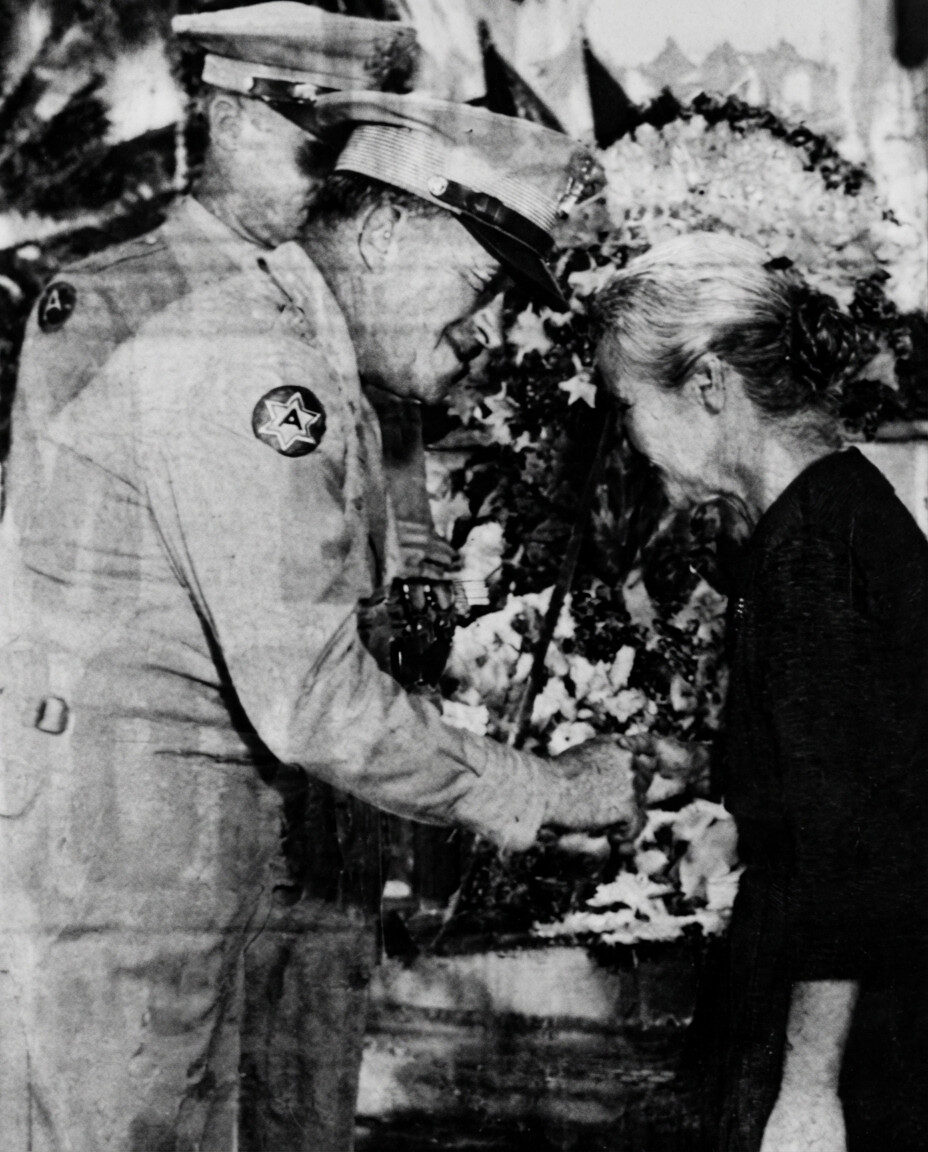
Right: Mrs. Murata receiving a Gold Star button
On May 30, 1948, Robert’s mother, Mrs. Sami Murata, received a Gold Star button from Major General George H. Decker, Chief of Staff of U.S. Army-Pacific at Memorial Day services at the War Memorial on King Street. The button was a token of appreciation given to the next-of-kin of soldiers killed in the war. It was noted that Mrs. Murata gave two sons to the conflict.
The following day, a Memorial Day service was held at Honolulu’s War Memorial on King Street. Army Chaplain Lieutenant Colonel Edwin L. Kirtley opened with a prayer at 8:30 a.m. Floral wreaths were presented by 14 veterans organizations, including a large floral 442nd Torch insignia. Representatives from the Armed Forces then unveiled a large US flag made of 7,000 red and white carnations for the stripes and 49 double tuberoses for the stars on a bed of blue delphiniums. Acting Governor Oren E. Long gave a short talk and Taps was played by buglers on opposite sides of King Street.
A year earlier, in 1947, the US began a program of closing most of the overseas wartime military cemeteries and gave the families the option of having their loved one reburied in one of the cemeteries that would remain or being returned home. The Murata family chose to have both of their sons returned to Honolulu. As a result, the remains of Sgt. Robert S. Murata arrived home on September 1, 1948, on the USAT Dalton Victory. He was among 78 soldiers whose remains arrived in Honolulu from San Francisco at Pier 40 at 1:00 p.m. This was the first of the ships bearing Hawaii’s fallen sons to return home.
Earlier that morning in waters off Diamond Head the Coast Guard cutter Iroquois and the Navy destroyer escort George circled the choppy seas to meet the Dalton Victory. Four 442nd veterans were aboard the Iroquois and each dropped a giant orchid, rose, and anthurium wreath into the ocean next to the Dalton. As the ship entered the harbor, a 21-gun salute was fired from Fort Armstrong, and Army, Navy, and Marine planes flew overhead. As the ship docked at Pier 40, church bells tolled throughout Honolulu.
Hundreds and family and friends were there to greet the ship. George Miki, President of the 442nd Veterans Club, and Earl Finch of Hattiesburg, Mississippi, were on the dock to welcome the soldiers home and talk to the parents who were awaiting the arrival of the ship. The flag-draped caskets were held at the Army mausoleum at Schofield Barracks pending burial arrangements.
The following day there was a memorial procession with the caskets of two anonymous soldiers carried on caissons through downtown to a service at Iolani Palace, where they later lay in state in the Throne Room.
The remains of brother Harry Yamasaki arrived at Honolulu on September 18, 1948, on the USAT Sgt. Truman Kimbro. On November 2, halfway between the deaths of Robert and Harry, a private memorial service was held at the Army mausoleum.
The two brothers were buried next to each other at the National Memorial Cemetery of the Pacific at Punchbowl, on August 9, 1949, at 3:00 p.m. in Section D, Site 215. On August 11 the family published a Card of Thanks in the newspaper for all of the kindnesses and floral tributes from family and friends.
Postscript. On May 14, 2012, the 70th anniversary of the formation of the Varsity Victory Volunteers, the University of Hawaii awarded posthumous degrees to the seven ROTC cadets, including Sergeant Robert Shigeru Murata, who were killed during World War II while serving with the 442nd Regimental Combat Team. The diploma reads:
The Regents of The University of Hawai’i on the recommendation of the Faculty of University of Hawai’i at Mānoa have conferred upon
Robert Shigeru Murata
the degree of Bachelor in Memoriam with all its privileges and obligations
Given at Honolulu, Hawai’i, this twenty-fifth day of March, two thousand twelve
Researched and written by the Sons & Daughters of the 442nd Regimental Combat Team in 2026.