Soldier Story: Rodney Yoshinobu Miyamoto
Soldier Story
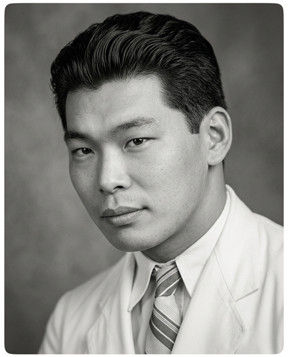
Rodney Yoshinobu Miyamoto
Sergeant
442nd Regimental Combat Team
3rd Battalion, K Company
Rodney Yoshinobu Miyamoto was born August 12, 1922, in Honomu, near Hilo, Hawaii island, Territory of Hawaii, to Morikazu and his wife Hawayo (Kimura) Miyamoto. His siblings were: brothers Henry Seiji and Hiroshi; and sisters Betty Tazuko and Helen Shizuko.
Father Morikazu, known as “Dick,” was born at Kahepa Camp of the Honomu Sugar Company to immigrants Tamakichi and Momi (Manzoku) Miyamoto. They arrived from the town of Niho, Aki District, Hiroshima Prefecture, Japan, in 1896 and 1897, respectively.
Mother Hawayo Miyamoto was born in Hilo to Otomatsu and Wasa (Tanaka) Kimura who emigrated from Hiroshima Prefecture in 1890.
When Rodney was two years old, the family moved from Honomu to Hilo. In 1930 they lived on Mamo Street and Morikazu was a carpenter for a contracting company. By 1940 the family had moved to 222 Kukuau Street and Morikazu was a painter at a contracting company. While at Hilo High School, Rodney was co-captain of the football team before graduating in 1941.
The family had moved to Honolulu by the time Rodney registered for the draft on June 30, 1942, at Local Board No. 7. His father was his point of contact. Rodney lived with his family at 2014 Uhu Street and he was employed by Lumber Fabricating Company on Ward Street. He was 5’8-1/2” tall and weighed 160 pounds.
On March 25, 1943, Miyamoto enlisted in the U.S. Army. His civilian occupation was listed as “Carpenter apprentice.” He was sent to the “tent city” known as Boomtown at Schofield Barracks with the other new soldiers. He was among the nearly 2,000 soldiers who were given a community farewell ceremony in front of Iolani Palace on March 28. He shipped out on the S.S. Lurline with the rest of the 442nd RCT on April 2, arrived in Oakland, California, on April 9, and travelled by rail across the country to Camp Shelby, Mississippi.
He was assigned to 3rd Battalion, K Company. After a year of basic, unit, and combat training, followed by field exercises and maneuvers, Rodney left Camp Shelby with the 442nd on April 22, 1943, and arrived a few days later at Camp Patrick Henry, Virginia.
They sailed from nearby Hampton Roads in a convoy of ships to the Mediterranean Theater of Operations on May 2, 1944, arriving at Naples, Italy, on May 28. The Combat Team spent a week at Staging Area No. 4 in Bagnoli, near Naples, before leaving on LSTs for Anzio on June 6, where they marched five miles to a bivouac area. From Anzio, the 442nd went to a large bivouac area near Civitavecchia, north of Rome, where they went through additional training and final preparations for going to the front lines.
The 442nd had been placed under the command of the 34th Infantry Division, Fifth Army. On June 22 they moved to a bivouac near Gavoranno. The following day they marched thirteen miles to the final assembly area with orders to replace a regiment of the 36th Infantry Division on the front lines. On June 26, 1944, the 442nd RCT moved forward from Gavoranno in the pre-dawn hours for their first combat engagement, near Suvereto. Through July and August they defeated the Nazis in battle after battle, driving them north up through the Italian peninsula.
In combat on July 18, Miyamoto was in a battle situation that later earned him a Bronze Star Medal.
In August, Miyamoto was admitted to an Army hospital with neuralgia from an old knee problem and a possible nematode infection, but he was treated and returned to duty. Although the exact date in August was not in the record, it may have been during the early part of the month. At that time the 442nd was in an Army rest area near Vada, south of Livorno, after weeks of battle on the front lines and before 3rd Battalion took a position on August 20 along the Arno River west of Florence.
By this time, the Supreme Allied Command had decided that the 442nd would be sent to the Seventh Army to engage in the battles to liberate France. They were transported to the port of Piombino on September 10 and left the same day on Liberty ships for Naples, arriving the next day. While there, they were bivouacked in an area of olive groves and the men were given day-passes to Pompeii and Naples.
The Combat Team left for France on September 27. Once they arrived at Marseilles, they were in a bivouac area in nearby Septèmes until October 9, when they were transported north by truck convoy or rail boxcars to fight in the Rhineland-Vosges Campaign.
They arrived in the assembly area at Charmois-devant-Bruyères at midnight on October 13. At 2:00 p.m. the next day, they began moving into position to attack the important rail and road center of Bruyères the following morning. After several days of intense fighting, the enemy had been cleared from the town and its surrounding hills, and on October 23, the 442nd was ordered to take the next town, Biffontaine. Finally, on October 24 they were taken off the front lines and put in reserve in nearby Belmont for a rest after eight days of heavy fighting, little to no sleep, harsh weather conditions, and many casualties.
On the afternoon of October 26, the short rest was abruptly ended when the 442nd was ordered to go into the lines the next morning and fight through to rescue the “Lost Battalion,” the 1st Battalion of the 141st (Texas) Infantry Regiment. After moving too fast and over-reaching its support, they had become surrounded by the enemy and were unable to extricate themselves. The 2nd and 3rd Battalions of the 141st Infantry Regiment and other units had tried to rescue them, but were thrown back each time they attacked. So, the 442nd was called in for the rescue.
The 442nd’s 3rd Battalion, including Miyamoto and K Company, moved out at 4:00 a.m. on October 27. The men were forced to march in column, with each man holding on to the pack of the man in front of him, as they could not see each other in the darkness. By 2:00 p.m. they were in line with the other two infantry battalions of the 442nd. The attack moved slowly and encountered heavy resistance from enemy infantry and incessant mortar concentrations. At 3:30 p.m. Miyamoto’s K Company was counterattacked by a tank and a half-track, followed by enemy infantry. The fighting was severe. After one 442nd soldier took out the tank with his bazooka, the enemy infantrymen pulled back in the early twilight. The 3rd Battalion made no attempt to follow up due to the pitch darkness.
All units resumed the attack on the morning of October 28, with resistance as fierce as ever. Third Battalion encountered a series of manned roadblocks in its advance up the hill, and K Company was stopped by enemy fire from several machine guns, riflemen, and grenadiers.
After the successful rescue of the “Lost Battalion” on October 30, the 442nd continued to fight in the area until November 17. They were understrength due to high casualty rates, and were therefore sent to the south of France for participation in the Rhineland-Maritime Alps Campaign.
Beginning on November 21, 1944, the 442nd was in the area of Nice, Menton, and Sospel. Their mission was to protect the right flank of the 6th Army Group and guard against an improbable, although possible, enemy breakthrough down the southern coast of France. If the Germans had attacked in sufficient strength, there was nothing to stop them between the border and Marseilles except the 442nd Regimental Combat Team.
As the men were often given day passes to enjoy the nightclubs and bars of Nice, this time earned the nickname “Champagne Campaign.”
The following paragraphs contain information found in our research that describes Sgt. Miyamoto’s service from the end of December 1944 when he was in the Champagne Campaign until he returned to the US a year later.
On December 20, 1944, Special Order No. 337 was issued. It was executed two weeks later, on January 2, 1945, when Sgt. Miyamoto and Private First Class Fumio Hayashikawa were reassigned from the 2nd Replacement Depot to Central Advanced Section (CAS) in Nancy, France. They and 61 other Company K men were moved by trucks from the mountain town of L’Escarène down to Menton on the Mediterranean coast. These orders indicated that as the 442nd prepared to return to the battlefield, the soldiers who were found to not be physically fit for the rigors of combat were classified as “Limited Assignment.” This meant they would be assigned to units that were typically providing logistics support for the combat units. The CAS in Nancy was a very large logistics support Army organization commanded by Major General Arthur Wilson and provided support to the 6th Army Group of the U.S. 7th Army and the 1st French Army on the France-Germany border. They were preparing for the spring offensive to defeat and occupy Germany, bringing an end to the war in Europe.
On March 21, 1945, a Special Order was published by the CAS identifying the unit assignments of all the Limited Assignment soldiers who had been in the 442nd RCT. There were 322 Limited Assignment Japanese-American soldiers on this order. Miyamoto and four other 442nd men were assigned to the 1806th Supervisory Labor Company. The other men were: S/Sgt. Tsuneo Shiigi of I Company, Sgt. Noboru Moriyama, Sgt. Keijiro Umebayashi of A Company, and Corporal Toshio R. Mizusawa of B Company. On March 24, these five men comprised the 1806th Labor Supervisory Company at Vesoul, 96 miles south of Nancy. They were headed by a Lieutenant and were responsible for supervising the work of civilians for some aspect of logistics support of the U.S. 7th Army and the 1st French Army.
After recovering its numbers – as the Limited Assignment soldiers were sent to their new duties and new soldiers arrived to replace them – the 442nd was sent back to Italy on March 25, 1945, for the Po Valley Campaign.
On July 3, 1945, Sgt. Rodney Miyamoto’s physical “C1” status was changed per direction of the 19th General Hospital in Nancyfrom “B” to “D.” Another 442nd man with him, S/Sgt. Tsuneo Shiigi, was changed from “B” to “A” status.
On July 13, the Morning Report for Headquarters of the 1806th Supervisory Labor Company in Nancy showed that Sgt. Miyamoto had been on temporary duty in the city of Reims and was now back on duty in Nancy.
By November 3, 1945, Sgt. Miyamoto had been on assignment to Headquarters of the 10th Labor Battalion, Supervision Area, Oise Intermediate Section, Theater Services Forces. He was released from that assignment and transferred with other men to the 442nd Ordnance Basic Automotive Vehicle Maintenance Company at Camp New York, APO 513. This unit was located in the area of Nancy.
Finally, in late 1945 Sergeant Rodney Miyamoto left Europe and arrived back in the US at New York City on December 2, 1945. He then flew west on a military transport airplane and arrived at Camp Beale, California, on December 9 for shipment to Hawaii.
On January 22, 1946, he arrived at Honolulu on the troop ship USAT U.S. Grant with several hundred other returning veterans. This was the first arrival of veterans who were greeted by the Royal Hawaiian Band playing at Pier 40-B, and the community went all out for the men, with ladies’ groups bringing snacks and lei for the soldiers.
Miyamoto was discharged from the U.S. Army on January 26 at the Army Separation Center on Oahu. He flew to Hilo for a reunion with extended family and friends from February 9 to 28, and was then back living with his parents, siblings, wife, and two children at 1221-B Uhu Street in Honolulu.
For his World War II service, Sergeant Rodney Yoshinobu Miyamoto was awarded the Bronze Star Medal with one oak leaf cluster, Good Conduct Medal, American Campaign Service Medal, European-African-Middle Eastern Service Medal with three bronze stars, World War II Victory Medal, Army of Occupation Medal, Distinguished Unit Badge, and Combat Infantryman Badge.
Rodney was an active member of the 442nd Veterans Club, and coach of their basketball team in the early post-war years. In 1947 he reenlisted in the U.S. Army and decided to make it a career.
On May 21, 1949, Rodney married Violet Misae Matayoshi. She was born on July 19, 1927, to Taketa and Unta Matayoshi of Puunene, Maui.
Rodney and Violet lived in Honolulu and over the years raised a family of three sons and two daughters. He served as a Sergeant First Class in Korea in 1955 with the 18th Transportation Company (Heavy Boat) in Inchon.

For his service in Korea, SFC Miyamoto was awarded the National Defense Service Medal, Korean Service Medal, Good Conduct Medal, Rifle Marksman Badge, United Nations Service Medal, and Good Conduct Medal clasp with two bronze loops. In his third reenlistment he earned a Letter of Appreciation and a Letter of Commendation.
Rodney Miyamoto retired from the U.S. Army on September 9, 1964, after over 20 years of active duty. At retirement, he had earned his third Good Conduct Medal and one oak leaf cluster on his National Defense Service Medal.

Violet Miyamoto died on November 22, 2004, and was inurned in Court 7, Wall D, Row 200, Site 203, in the Columbarium at the National Memorial Cemetery of the Pacific at Punchbowl.
Rodney Y. Miyamoto died on February 18, 2021, and was inurned with his wife at Punchbowl. The plaque on their niche was inscribed Forever in our Hearts. He was predeceased by his wife, one son, and one daughter. Survivors included two sons, one daughter, nine grandchildren, and seven great-grandchildren.
Researched and written by the Sons & Daughters of the 442nd Regimental Combat Team with assistance of the Miyamoto family in July 2021 and updated in 2026.