Soldier Story: Roy Joseph Kitagawa
Soldier Story
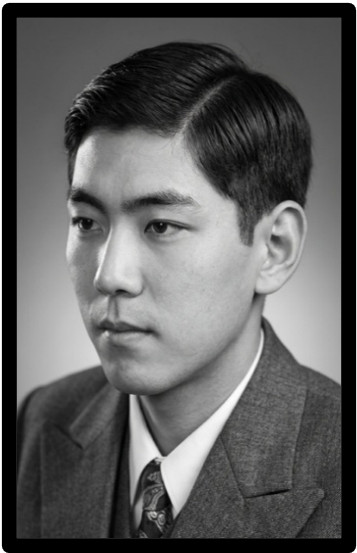
Roy Joseph Kitagawa
Private First Class
442nd Regimental Combat Team
2nd Battalion, E Company
Roy Joseph Kitagawa was born on March 12, 1921, in Minot, North Dakota. He was the eldest son of Ben Bunhichi and Kiku (Nishimura) Kitagawa. His siblings were: brother Harry (often misspelled Holly) and sisters Jenny and May; and an older half-sister Suano. His parents emigrated from Japan in 1901 and 1918, respectively. Father Ben was born in 1876 in Shiga Prefecture; mother Kiku was born in 1883. Ben had worked for the Great Northern Railway since his arrival in the US.
Father Ben was a widower when he married Kiku. He and his first wife, Kono, had seven children. With the exception of the youngest, Suano, the others died in infancy to childhood. Kono died soon after Suano’s birth in 1915. Roy returned to Japan in 1918, married Kiku, and brought her to North Dakota.
In 1920, Ben and Kiku were living in Minot and he was a janitor for the Great Northern Railway.
In 1930, the family was living at 111 3rd Street. Ben was employed as an engine wiper for the railway.
Below: Ben and Kiku with their four children in 1935
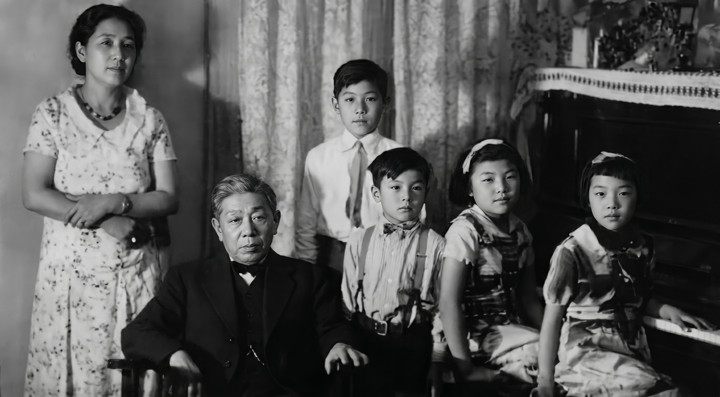
In 1936, Kiku Kitagawa died and was buried at Rosehill Memorial Park cemetery in Minot. Roy graduated from Minot High School in 1939. He played touch football and league basketball in his sophomore and junior years. After graduating, Roy worked as a delivery boy.
In 1940, the family lived at 211 2nd Street. Ben was employed as a delivery man for the N.V.A. A Japanese immigrant named Roy Kanabata, age 57 and a cook in a café, was a lodger in the home.
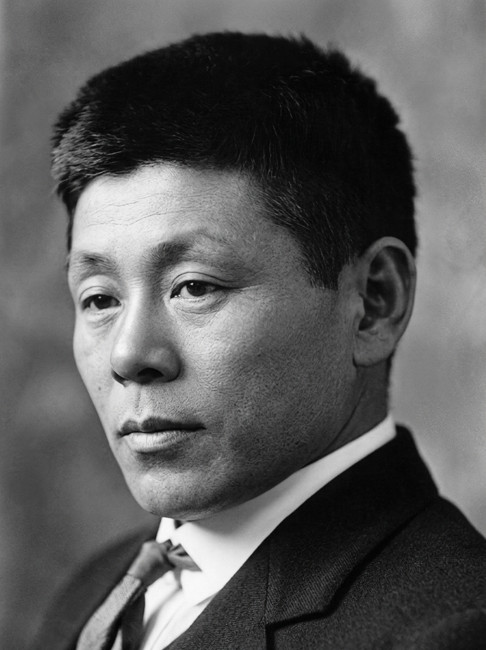
Right: Father Ben Kitagawa
Roy Kitagawa signed his draft registration card on February 16, 1942, at the Ward County Local Board. He was living with his family at 211 3rd Street SW in Minot. His father Ben was his point of contact. Roy was 5’6” tall and weighed 127 pounds.
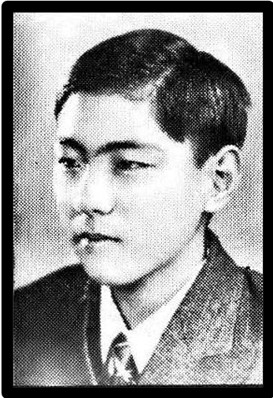
Left: Roy’s senior class photo in his high school “Sentinel” yearbook
Kitagawa enlisted in the U.S. Army on August 17, 1942, at Fort Snelling, Minnesota. Our research did not reveal where he was sent for basic training or where he was stationed afterwards. In 1944, he was chosen to become part of the 442nd Regimental Combat Team. He was sent to Camp Shelby, Mississippi, for additional training by the 171st Infantry Battalion (Separate), the training cadre left behind when the 442nd was deployed to Italy in May 1944.
Kitagawa was sent to Europe on a troop ship with other soldiers heading to the Theater of War. After arriving in Italy likely in August, he was sent to a Replacement Depot to await being called to join the 442nd.
Pfc. Roy Kitagawa was among the 672 replacements to the 442nd RCT who joined them in Naples, Italy, on September 18, 1944. Most of these men were from the continental US. The Combat Team had just completed fighting in the Rome-Arno Campaign from June 26 to September 6. They were in Naples awaiting shipment to France for the Rhineland-Vosges Campaign.
Pfc. Kitagawa was assigned to 2nd Battalion, E Company. He and the other replacements had to be quickly trained and integrated into their companies. On September 27, the 442nd sailed on the troop transport ships U.S.S. Samuel Chase, U.S.S. Joseph T. Dickman, U.S.S. Henrico, and U.S.S. Thurston to the southern coast of France.
Upon arrival on September 30, the men moved ten miles by train to a staging area in the vicinity of Septèmes. On October 8, they left by trucks (except for 3rd Battalion who went in boxcars) and traveled north up the Rhône Valley, arriving at Charmant-devant-Bruyères on October 11. They were attached to the 36th Division, 7th Army.
The Combat Team moved into position for an attack on October 15 on their objective – the important road and rail center of Bruyères, which lay surrounded on three sides by hills that were designated Hills A, B, C, and D. Pfc. Kitagawa’s 2nd Battalion was assigned to take Hill B, directly north of the town itself. These hills were several hundred feet in height and covered by tall pines and thick underbrush. The weather was overcast, foggy, rainy, and cold, and the men were still in their summer uniforms. German artillery hit the trees and the branches shattered in “tree bursts,” showering the men with hundreds of jagged wood and steel splinters.
The fighting was fierce and captured prisoners talked freely about being ordered to “fight to the last man.” Given the proximity to the German border, only 56 miles, they were fighting at all cost to prevent the Allies from entering their homeland.
On October 16, Companies E and F occupied Hill 555 northwest of Bruyères. As they came down off the hill and attempted to cross the open valley to attack Hill B, they were pinned down by a tremendous volley of fire coming from their objective. The enemy then mounted a counterattack in battalion strength and Company E felt its full force. The Combat Team’s 522nd Field Artillery countered with hundreds of rounds of fire, which broke the enemy’s assault. Our men in their slit trenches had to fight in the half-light of evening before the last of the enemy was driven off.
Early on October 17, two companies of Germans made another attack against Companies E and F on Hill 555. That battle raged all day with enemy tanks joining in. Our men formed six bazooka teams that finally beat off the enemy tanks.
After another day of fierce resistance and violent fighting, the 442nd finally took Hills A and B on October 18. By the end of the day, two companies entered Bruyères and for all intents and purposes the town had fallen to the 442nd.
The next objective was Hill D to the east of town. Pfc. Kitagawa’s 2nd Battalion along with 3rd Battalion attacked on October 19, and it was taken by noon. The leading companies quickly reorganized for an attack on the railroad embankment east of town on the edge of the Forêt de Belmont where the Germans had dug in. As the 442nd could not advance, 2nd and 3rd Battalions formed a salient 2,000 yards into enemy territory. To the left rear of their position, the remaining Hill C was still firmly in enemy hands. Overnight, a strong German force infiltrated back to Hill D and were threatening the rear elements of 2nd and 3rd Battalions.
Continued heavy fighting over the next few days raged on. Finally, on the night of October 21, 2nd Battalion was pulled back into regimental reserve for a very brief respite, only to be called on the next day to protect the right flank of the 100th Battalion who were now overlooking the village of Biffontaine on three sides. As they did so, an enemy force of a hundred men attacked Companies E and F on Hill 703, known as Col de l’Arnelle. After considerable fighting at close quarters, the two companies beat off the attack and took six prisoners.
It was on this day, October 22, that Pfc. Roy J. Kitagawa was wounded severely by a gunshot to his chest. He was taken to a field hospital where he died from his wounds.
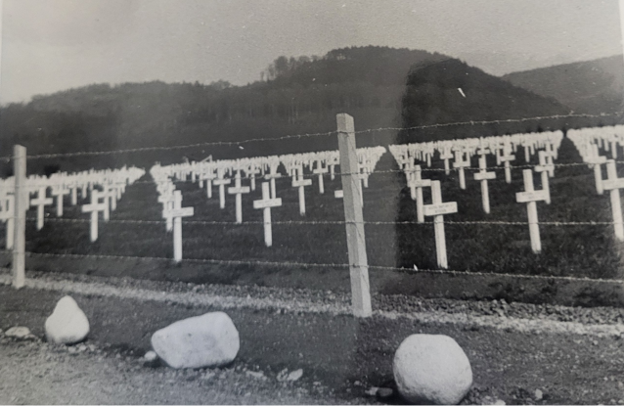
Pfc. Kitagawa was buried in the newly created U.S. Military Cemetery in nearby Épinal, about 21 miles west of the front lines.
For his military service, Pfc. Roy J. Kitagawa was awarded the following medals: Bronze Star Medal, Purple Heart Medal, Good Conduct Medal, American Campaign Medal, European-African-Middle Eastern Campaign Medal with two oak leaf clusters, Distinguished Unit Badge, and Combat Infantryman Badge. He was posthumously awarded the Congressional Gold Medal on October 5, 2010, along with the other veterans of the 100th/442nd Regimental Combat Team. This is the highest Congressional Civilian Medal. The award states: “The United States remains forever indebted to the bravery, valor, and dedication to country these men faced while fighting a 2-fronted battle of discrimination at home and fascism abroad. Their commitment and sacrifice demonstrates a highly uncommon and commendable sense of patriotism and honor.”
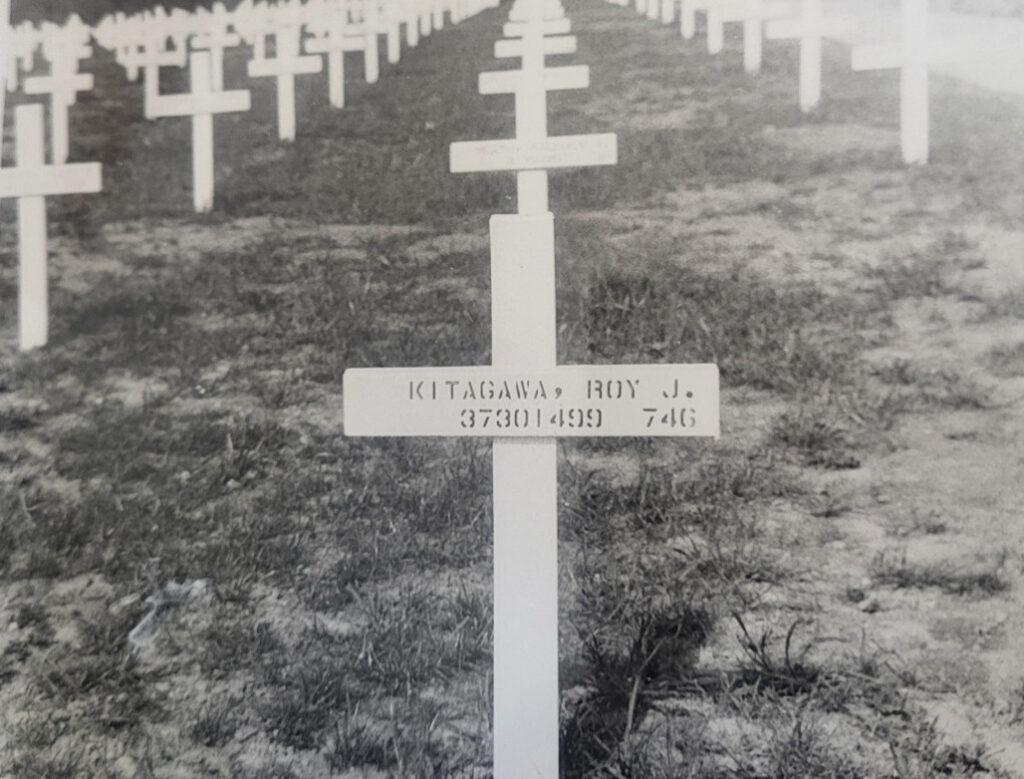
Above: Pfc. Kitakawa’s original grave at Épinal American Military Cemetery
Below: area at the cemetery where his grave was located
In 1947, the US government began a program of closing most of the overseas military cemeteries. Families were given the choice of having their loved one reburied in one of the cemeteries that would remain – or being returned home. Ben Kitagawa chose to have his son Roy brought home, although Épinal was among those cemeteries that would remain open.
On May 7, 1948, Kitagawa’s remains were among those of 4,183 war dead aboard the USAT Lawrence Victory that arrived at the Brooklyn Army Base at 58th Street and First Avenue in New York City. On board were the remains of 20 men from North Dakota. A dockside memorial service was held at 11:00 a.m. at Pier 3 for the hundreds of family and friends who were there to greet the ship. After the caskets were taken ashore, it took two to three weeks for the families to receive notice of the actual date that their loved one would reach their home. A military escort accompanied each casket on that final trip.
Pfc. Kitagawa was buried in Rose Hill Cemetery in Minot. The application for a military tombstone was signed by his father, Ben Kitagawa of 1016 Valley Street in Minot, on June 12, 1948. Survivors included his father Ben, brother Harry (Holly), sisters Jenny and May, and older half-sister Suano, who was a nun in the Sisters of Saint Francis order and known as Sister Bernadetta.
By 1950, Ben and his son Harry moved to Denver, Colorado. He eventually became a naturalized US citizen. Ben Bunhichi Kitagawa died at the age of 93 on May 7, 1969, in Denver. He was buried at Hampden Memorial Estates cemetery.
Roy’s brother Harry (Holly) served at Headquarters, MIS Language School in 1945-1946.
To read more of the Kitagawa family’s story, visit:
www.findagrave.com/memorial/185691858/ben_bunhichi-kitagawa
Researched and written by the Sons & Daughters of the 442nd Regimental Combat Team in 2026 with assistance by his niece.