Soldier Story: Rupert Yukio Arai
Soldier Story
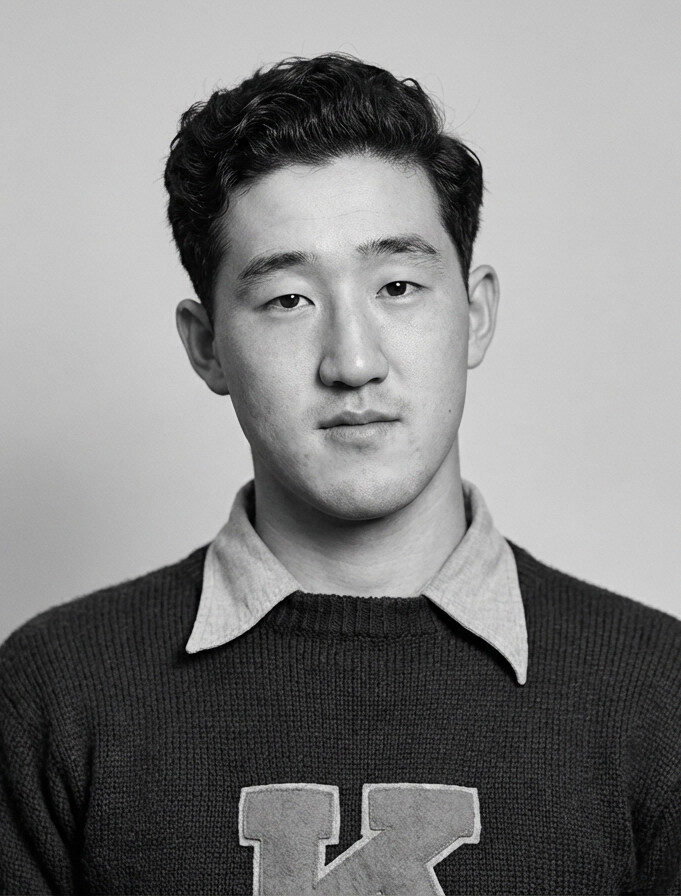
Rupert Yukio Arai
Private First Class
442nd Regimental Combat Team
522nd Field Artillery Battalion, Headquarters Battery
Yukio Arai was born on September 28, 1924, in Eatonville, Pierce County, Washington. He was the youngest child of Shigeji and Naru (Miyazaki) Arai. His siblings were brothers Toshio W., Haruo Harrison, and Yoshiaki Yoshio; and sister Janet Chiyoko.
Father Shigeji arrived in 1910 from Kagawa Prefecture, Japan. Mother Naru arrived on April 9, 1917, in Seattle on the Tamba Maru at the age of 18. She was born in the village of Takami, Nakata District, Kagawa Prefecture.
In 1930 the family lived in Japan Town, Eatonville. Father Shigeji worked at a local sawmill.
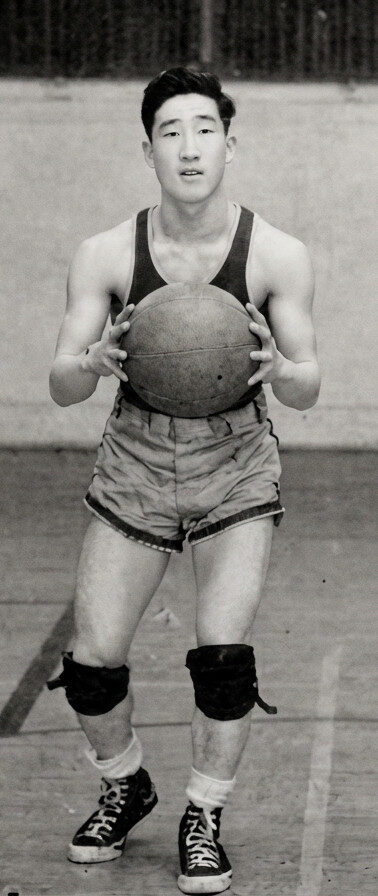
Yukio attended Kent-Meridian High School. He was in the junior class when the war broke out in December 1941. Yuki, as he was known, was a member of the K Club – for those who had lettered in sports – and its Sergeant-at-Arms his junior year. He was also on the school basketball team’s First Team.
Right: Yuki on basketball’s First Team, 1942
In the spring of 1942, the family was evacuated to the Pinedale WCCA Assembly Center in Fresno, California. They were then sent for incarceration at Tule Lake WRA Internment Camp, which opened on May 27, 1942. Tule Lake was located in Newell, Modoc County, California, near the Oregon border.
From there, the family was transferred to Minidoka WRA Internment Camp: Yukio and Chiyoko on December 7, 1942; and the rest of the family a year later in 1943: Haruo on December 14, and Toshio and their parents on December 15. Minidoka was located in Jerome, Hunt County, Idaho.
On December 23, 1942, shortly after arriving at Minidoka, Yukio Arai signed his draft registration card, Local Board No. 3, located in the National Bank Building of King County, Washington. His resident address was shown as Unit 6906-C at Tule Lake, and his home address was Route 3, Box 244A, Kent, King County, Washington. His point of contact was his father, who was at Tule Lake. He was a student, 5’3” tall, and weighed 125 pounds.
The family’s release dates from Minidoka were: Haruo on April 26, 1944, to work in Pocatello, Idaho; Yukio on May 8, 1944, to work in Boise, Idaho; Chiyoko on September 20, 1944, to work in New York, New York; Toshio on February 17, 1945, to Detroit, Michigan; and their parents on April 23, 1945, to Denver, Colorado.
It was reported in the June 10, 1944, issue of the Minidoka Irrigator newspaper that Yukio Arai and his brother Yoshiaki Arai, along with 106 other young internees had passed their pre-induction physical examination and were ordered to report on June 21 to the Minidoka hospital for induction into the U.S. Army. This was the first time no travel to Fort Douglas was required for physicals and induction.
After induction the young men stayed at Minidoka in ready reserve status as the authorities arranged for transportation to their basic training camp.
Yukio Arai enlisted in the U.S. Army on September 15, 1944, at Fort Douglas, Utah. His civilian occupation was listed as “Farmhands, vegetables.” He had completed high school and his residence was Jerome, Idaho. The location of Private Arai’s training was not found in our research.
The exact date of Private Yukio Arai’s arrival to the 442nd Combat Team was also not found in our research. After basic training, he was sent to Europe and joined the 442nd as a replacement during their time in southern France in the Rhineland-Maritime Alps Campaign. He was assigned to Headquarters Battery, 522nd Field Artillery Battalion.
The 522nd was in the area of Nice, Menton, and Sospel beginning on November 21. This was a time of regrouping and rebuilding the decimated ranks of the 442nd’s three infantry battalions and its 232nd Combat Engineer Company. For the 522nd, it was mostly a time of rest and recreation and the care and maintenance of materiel. It was aptly nicknamed the “Champagne Campaign.”
On March 9, 1945, the 522nd Field Artillery was detached from the 442nd Regimental Combat Team and attached to General Alexander Patch’s Seventh Army to add fire power for its assault on the Siegfried Line in Germany. The rest of the 442nd returned to Italy for the Po Valley Campaign.
The 522nd Field Artillery left Menton and convoyed north. They fired their first rounds into Germany at Kleinbittersdorf on the Saar River on March 12, 1945. The fast-moving 522nd gave chase to the retreating enemy across southern Germany toward the Austrian border. During the German campaign, the Battalion made 52 displacements. It was in the thick of the “rat race” that developed after the Siegfried Line was breached and the Rhine River was crossed.
The 522nd was successfully attached to as many as six different divisions and became recognized as the fastest and preeminent 105mm howitzer battalion. Not only that, they were routinely firing three separate fire missions simultaneously, with each battery assigned a separate target – a feat that other artillery battalions could not replicate. It took a very disciplined and competent organization operating at top-level alertness to do it.
After the surrender of the Germans on May 6 (effective on May 8), the 522nd Field Artillery Battalion moved from Schaftlach near the Austrian border on May 9 north 100 miles to the area of Donauwörth on the Danube River. On May 17, Headquarters Battery was stationed in Mertingen as part of the occupation forces. On July 18, they moved into Donauwörth.
Pfc. Yukio Arai was part of the SP Detachment (Security Police) formed on May 5 in Shaftlach. Once at Donauwörth, they guarded the control point in the Battalion area, the railroad bridge near Nordheim, and the Donauwörth Bridge crossing the Danube River.
For the next few months, men of the 522nd participated in Brigade baseball, track and field, and swimming competition. At the Battalion and battery levels, they enjoyed basketball, softball, pingpong, horseshoe pitching, and other sports. About 300 men furthered their education in USAFI courses and unit school programs. They also enjoyed passes to Nice, Paris, London, Brussels, Königsee, and Lausanne.
The 522nd was deactivated on October 5, 1945, and men with more than 70 “points” began preparing for the long journey home. The exact date of Pfc. Arai’s return to the US was not found in our research. He was discharged from the U.S. Army on July 3, 1946.
For his wartime service, Private First Class Rupert Yukio Arai was awarded the Good Conduct Medal, European-African-Middle Eastern Campaign Medal with four bronze stars, World War II Victory Medal, and Army of Occupation Medal. He was awarded the Congressional Gold Medal on October 5, 2010, along with the other veterans of the 442nd Regimental Combat Team. Conferred by the U.S. Congress, the award states: “The United States remains forever indebted to the bravery, valor, and dedication to country these men faced while fighting a two-fronted battle of discrimination at home and fascism abroad. Their commitment and sacrifice demonstrate a highly uncommon and commendable sense of patriotism and honor.”
In 1950, they were still at 3051 Lawrence Street. Brother Yoshio and his wife Tokay and son were also there.
After the war, Rupert went to his parents’ home in Denver. Rupert Yukio Arai signed his draft registration card again – for the buildup to the Korean War – on September 2, 1948, in Denver. He was employed as a radio technician at Modern Music Company, for their juke boxes distribution company, and lived with his family at 3051 Lawrence Street.
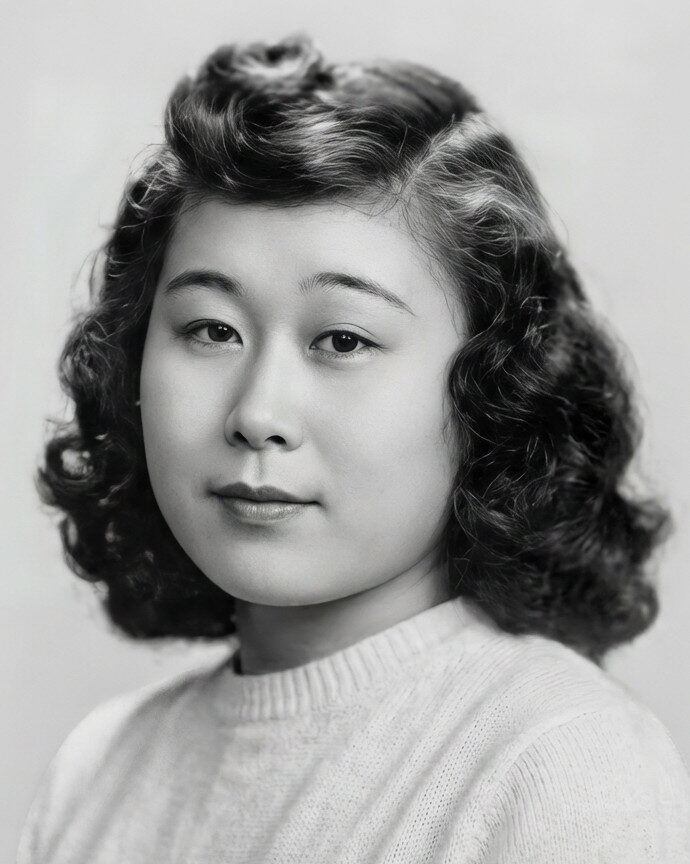
On August 21, 1954, Rupert married Ruby Tamiko Hayashi (born October 27, 1927), of North Platte, Nebraska. She was the daughter of Mr. and Mrs. Eijiro and Hana Hayashi. The couple remained in Denver and over the years raised a family of one son and one daughter.
Left: Ruby Hayashi, Senior Class, University of Nebraska, 1947
In 1966, the family was living at 3900 Wyandot Street and Rupert worked for D&J Music. His parents lived nearby at 3051 Lawrence Street where father Shigeji was a warehouseman at the Vincent Springs Company. Brother Yoshiaki lived at 1568 South Ivy Street and was a biochemist/research technician at Fitzsimmons (Army) General Hospital.
Rupe, as he came to be called, was an active member of the Midget Football League and played on its Bussei Blues team, the Denver Buddhist Church, and the Cathay American Legion Post. While was serving as the Post’s Vice President, he participated with other officers in a traditional “mortgage burning” ceremony in 1969.
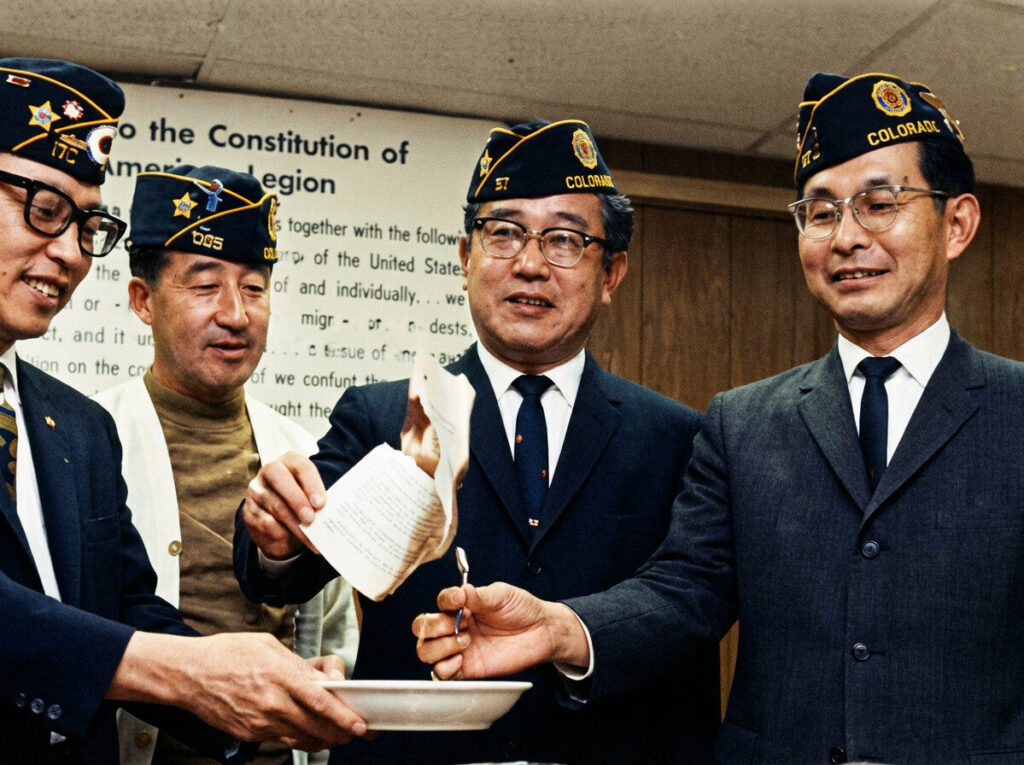
Above: left to right, Joe Sakato, Rupert Arai, John Noguchi, John Oya (photo by Tom Masamori)
On February 28, 1969, Rupert Yukio Arai was seriously injured in an automobile accident, subsequently dying on April 17. He was only 49 years old.
Survivors included his wife and children. Arai was buried at Fairmount Cemetery, in Block 35. Below his name on his tombstone is inscribed New York Pfc 522 Field Arty Bn World War II. Ruby Arai died on March 8, 1972, and was buried next to her husband.
His brother Yoshiaki Yoshi Arai served as a Medic in the 522nd Field Artillery Battalion, 442nd Regimental Combat Team.
Researched and written by the Sons & Daughters of the 442nd Regimental Combat Team in 2025.