Soldier Story: Shigeru Hamada
Soldier Story
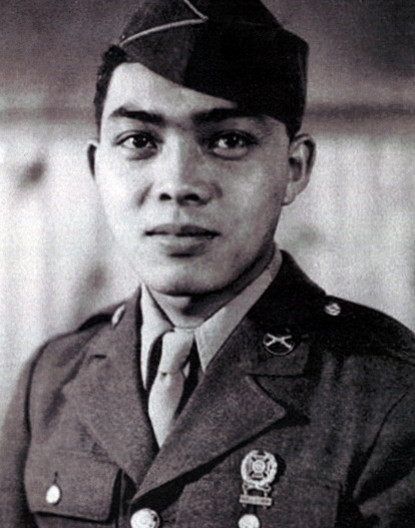
Dick Shigemi Hamada
Staff Sergeant
3rd Battalion Headquarters Company
442nd Regimental Combat Team
Military Intelligence Service
Shigemi Hamada was born on January 16, 1922, at Kukuihaele, Hawaii island, Territory of Hawaii. He was the son of Tokuichi and Shige (Yoshino) Hamada. His siblings were: brothers Shigeo (died 1914, age 3 days), and George Tokumi; and sisters Ayako, Asako, and Shizuka.
Father Tokuichi emigrated from the village of Jigozen, Hiroshima Prefecture, Japan, arriving on August 6, 1907, on the Hong Kong Maru. He stated that he was going to join his father Ikuzi Hamada in Hamakua District, Hawaii island.
In 1910, father Tokuichi was living in Camp No. 1, Kukuihaele Sugar Plantation. He was a field laborer on the plantation and lived with two partners – Miyamatsu Yamamoto and Ikuzi Hamada (age 45, arrived in 1896).
Mother Shige emigrated from Jigozen, the same village as her husband, arriving on February 12, 1912, on the S.S. Korea. She was a “picture bride” and was going to meet her husband. On July 31, 1917, Tokuichi signed his World War I draft card and was employed by Pacific Sugar Mill in Kukuihaele. He stated that his parents, wife, and child were dependent on him, and if called to arms by Japan, he would go. By 1920, he was a flume carpenter and lived with his family at Kukuihaele Camp.
In 1930, the family was living on the sugar plantation. In 1940, mother Shige was a widow living in Hamakua District with her three daughters, one of whom was employed on the sugar plantation.
By 1940, Shigemi and his older brother Tokumi had moved to Honolulu and were living at 2998 Kalei Road. They were both employed as carpenters for a building contractor. On December 7, 1941, he was at home in the Moiliili neighborhood of Honolulu when he witnessed the attack on Pearl Harbor. As he later recalled:
I felt betrayed and now feared for the worst to come to all American Japanese.
On June 30, 1942, Hamada signed his draft registration card at Local Board No. 3, National Guard Armory, Room 211. He lived at 2998 Kalei Road. His point of contact was his friend James Mitsuo Suenaga, who lived on Young Street opposite the Honolulu Bowling Alley. He was employed by Contractors P.N.A.B. on the Barbers Point Project. He was 5’6” tall and weighed 130 pounds.
On February 26, 1943, Shigemi officially changed his name to Dick Shigemi Hamada. The decree was signed by Ingram M. Stainback, Governor of the Territory of Hawaii.
Hamada enlisted in the Army on March 24, 1943. He had graduated from McKinley High School, and his civilian occupation was given as “Skilled chauffeurs and drivers.” He was sent to the “tent city” known as Boom Town at Schofield Barracks with the other new soldiers for the 442nd. They were given a farewell aloha ceremony by the community on March 28 at Iolani Palace.
On April 4, the new soldiers left on the S.S. Lurline for Oakland, California. After arrival they were sent across country by train to the 442nd Regimental Combat Team at Camp Shelby, Mississippi. Dick Hamada was assigned to 3rd Battalion Headquarters Company.
Hamada and the other men began basic training on May 10 and it lasted until August 23. At this point, some men were given a 2-week furlough to visit home, or such cities as New York, Chicago, Washington DC, New Orleans. On October 20, unit training began for companies and platoons and lasted about a month.
On November 20, 1943, it was announced in the Hawaii Tribune-Herald newspaper that Dick Hamada was among the 121 enlisted men at Camp Shelby who had recently been promoted. He was promoted to Corporal.
In November 1943, the Office of Strategic Services (OSS) arrived at Camp Shelby and solicited volunteers for a special mission in the Far East. Dick was one of 23 enlisted men who volunteered. They left Camp Shelby on December 29, 1943, for Camp McDowell, Illinois, for radio communications training. In early 1944, he was sent to Camp Savage, Minnesota, for five months of Military Intelligence training in Class 44-02.
Hamada shipped out of Camp Savage in August 1944 and landed on Catalina Island, California. He was attached to OSS Detachment 101 to go through guerrilla, ranger, and survival training there beginning in September. Also included was training in demolitions, beach landings, infiltration, and jungle survival.
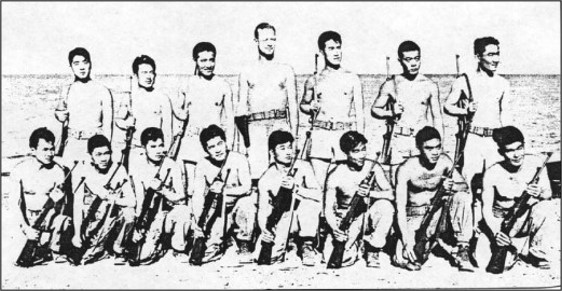
Above: Class 44-02 at Catalina Island. Front row L-R: Calvin Tottori, Sho Kurahashi, Fumio Kido, Wilbert Kishinami, Tad Nagaki (mainland), Takao Tanabe (mainland), Dick Hamada, Tom Baba. Back row L-R: Susumu Kazuhaya (mainland), Lt. Ralph Yempuku, Lt. Richard Betsui, Maj. Crowe, Lt. Junichi Buto, Lt. Chiyoki Ikeda, George Kobayashi (mainland)
In late October 1944, Hamada flew out of Miami, Florida, and reached OSS Headquarters in New Delhi, India. He was assigned to Detachment 101 guerrilla operations in Burma. Det. 101 consisted of Americans, British, and Burmese, as well as several thousand Kachin tribesmen. Among his first assignments was to decipher messages and report casualty figures. The mission of Det. 101 was to be dropped behind Japanese lines to supply and aid the guerrillas, to ambush, blow up bridges, cut communication lines, and generally harass the Japanese 34th Division in northern Burma, while Gen. Joseph Stilwell’s Chinese divisions and Merrill’s Marauders attacked frontally. Note: Stilwell was commander of the China-Burma-India (CBI) Theater. Merrill’s Marauders, officially known as the 5307th Composite Unit (Provisional), was a U.S. Army special operations force that conducted long-range penetration missions behind enemy lines in the CBI Theater. It was named for its commander, Brigadier General Frank D. Merrill.
On his first mission, Hamada was sent behind the lines in a single-engine airplane to interrogate Japanese prisoners. He found none, as the Japanese would shoot themselves or each other rather than be captured. Years later, Hamada’s son recalled playing as a child with part his father’s parachute that he had saved.
When peace followed the Hiroshima/Nagasaki A-bombing in August 1945, the OSS dropped three teams into Japanese prison camps in China on mercy missions to rescue Allied POWs. They parachuted from B-24s and were armed only with .45-caliber pistols. Hamada was a member of the Peiping (Beijing) team, whose codename was “Magpie.” Other team members were: Major Ray A. Nichols; Lt. Mahlon F. Perkins Jr.; Lt. Fontaine G. Jarman Jr.; Pfc. Nestor E. Jacot; and Pfc. Melvin Richter. Hamada later recalled that the team was surrounded by 12 Japanese soldiers with bayonets when they jumped onto the Peiping aerodrome on August 17. Next ensued a debate on whether the war was actually over. Eventually, the team rescued 317 Allied prisoners (some from ten other areas around Peiping) and moved some of them to the Wagon-Lits Hotel, including four of the flyers from the April 8, 1942, Doolittle raids over Tokyo. The fourth Doolittle crewman was too sick to be evacuated. Eight members of the Doolittle raid had been captured when their planes crashed. Several of them were executed. This was the first indication that all of the crew had not been executed.
Another of the humanitarian teams with the codename “Cardinals” was dropped into Mukden, Manchuria. It was led by Major James T. Hennessey of San Francisco and included Corporal Fumio Kido of Honolulu.
S/Sgt. Hamada also was dropped with a team onto Hainan Island off the southern coast of China, where they rescued mostly Australian and Dutch POWs and set up protective security, hospital facilities, and evacuation procedures.
For this “humanitarian mission,” Hamada was awarded the Soldier’s Medal along with other members of the rescue teams. The award was made on November 13, 1945. The citation reads in part:
At this time there was no assurance that American personnel would not receive hostile treatment from the Japanese, yet they readily accepted these dangers to bring aid to the many Allied prisoners and to assist in their early repatriation.
By their willingness to risk their lives in a gallant effort to bring comfort and assistance to Allied Prisoners of War, these individuals performed a service which reflects the highest credit upon themselves and upon the Armed Forces of the United States.
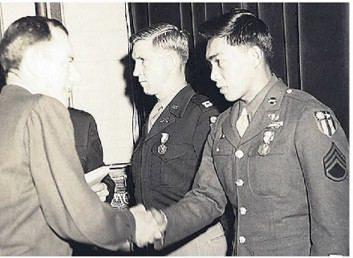
Left: S/Sgt. Hamada receives the Soldier’s Medal from General John Magruder, OSS Deputy Director, November 13, 1945. He is wearing the CBI shoulder patch.
S/Sgt. Hamada arrived in New York on December 5, 1945, in the first group of soldiers by ship from the CBI Theater. There were 3,097 veterans, including hospital evacuees and 15 Hawaii soldiers, aboard the ship, which made a 28-day voyage from Calcutta, India.
S/Sgt. Dick Shigemi Hamada was discharged from the U.S. Army on January 24, 1946.
For his military service, Dick Shigemi Hamada was awarded the following medals: Soldier’s Medal, Bronze Star Medal, Good Conduct Medal, American Campaign Medal, Asiatic-Pacific Campaign Medal, World War II Victory Medal, Army of Occupation Medal, Distinguished Unit Citation, and Combat Infantryman Badge. He was awarded the Congressional Gold Medal on October 5, 2010, along with the other veterans of the Military Intelligence Service. This is the highest Congressional Civilian Medal. The award states: “The United States remains forever indebted to the bravery, valor, and dedication to country these men faced while fighting a 2-fronted battle of discrimination at home and fascism abroad. Their commitment and sacrifice demonstrates a highly uncommon and commendable sense of patriotism and honor.” He also posthumously received on March 21, 2018, the Congressional Gold Medal awarded to the soldiers of OSS Detachment 101. S/Sgt Hamada is one of only four World War II soldiers to be awarded two Congressional Gold Medals.
Following the war, Hamada returned to Hawaii. He soon went to Kansas City, Missouri, to attend the Kansas City School of Watchmaking. On July 20, 1950, he married Irene Umeyo Akamine at Honpa Hongwanji Mission. Irene (born in 1924) was the daughter of Ushi and Maushi Akamine of Kapulena, Hamakua District, Hawaii island. At the time of their wedding, Dick was a watchmaker at Egholms.
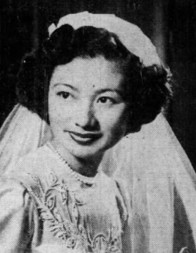
Right: Irene Akamine Hamada on her wedding day
Over the years the couple raised one son and one daughter. Dick became widely known around the Islands as a baseball and softball umpire. He was also interviewed for his oral history by the Hawaii Nisei Project of the University of Hawaii.
In May 2015, Hamada was posthumously inducted in the Army’s Military Intelligence Corps Hall of Fame at Fort Huachuca, Arizona.
Dick Shigemi Hamada passed away on May 27, 2014, at Avalon Care Home. His memorial service was held on June 22 at 4:30 p.m. at Hosoi Garden Mortuary. He was inurned at the National Memorial Cemetery of the Pacific at Punchbowl, in Columbaria C10-L, Row 100, Plot 152. His niche is inscribed “Until We Meet In Heaven.” He had retired from the Pearl Harbor Naval Shipyard as a Planner and Estimator Supervisor. Survivors included his wife, two children, four grandchildren, and sisters Bernice Stewart and Ruth Tsunoda.
Researched and written by the Sons & Daughters of the 442nd Regimental Combat Team in 2022; updated in 2026