Soldier Story: Tadashi T. Nagaki
Soldier Story
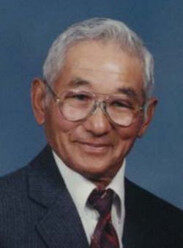
Tadashi Nagaki
Corporal
2nd Battalion, Headquarters Company
442nd Regimental Combat Team
Military Intelligence Service
Tadashi Nagaki was born on January 25, 1920, in Bayard, Morell County, Nebraska, to Minosuke and Shige (Kato) Nagaki. His siblings were: brothers Masakazu (Ma), Yoshio Frank, and Akira (Skeets); and sisters Mitsu and Hanako (died in infancy).
Father Minosuke (born February 9, 1881) emigrated from the village of Suma, Kumage District, Yamaguchi Prefecture, Japan. He arrived in Honolulu, Territory of Hawaii, on October 6, 1902, on the S.S. Coptic from Yokohama. In 1906 he moved to the mainland, arriving at Seattle, Washington. In 1910, Minosuke was working as a laborer on a sugar beet farm near Scottsbluff, Nebraska. Mother Shige (born April 27, 1887) emigrated from Yamaguchi Prefecture in 1916, where she married Minosuke on November 19 in the Buddhist Church, 1020 Main Street, in Seattle, Washington, shortly after her arrival. He took his bride to his farm near Scottsbluff.
The family lived on their farm near Scottsbluff where Minosuke grew sugar beets.
Tad, as he was known, attended Lake Alice School, and graduated from Minatare High School in 1938. He was an honor student and active in team sports. He was the fullback on the football team.
After high school, in 1939 Tad was sent to live with his uncle Gunnoshin Nagaki in Suma where he attended school. He returned to the US on the Kamakura Maru, arriving at San Francisco, California, on April 10, 1941.
On July 1, 1941, Tad Nagaki registered for the draft at Local Board No. 1, Alliance, Scottsbluff County, Nebraska. His father was his point of contact and he was employed on the family farm. He was 5’5” tall, and weighed 150 pounds.
Tad was drafted on November 18, 1941, in Scottsbluff County. He was on leave in New York City on December 7 when Pearl Harbor was attacked. As he later recalled:
We didn’t hear anything about it until the next day back in camp. A sergeant told the company about the attack and the declaration of war.
Nagaki was soon transferred to an Army post in Kentucky. In February 1943, however, he was transferred to the 442nd Regimental Combat Team at Camp Shelby, Mississippi, arriving with other small groups of mainland soldiers in late April to early May. He was assigned to 2nd Battalion, Headquarters Company.
Basic training began on May 10 and lasted until August 23. At this point, some men were given a 2-week furlough to visit home, or such cities as New York, Chicago, Washington DC, New Orleans. On October 20, unit training began for companies and platoons and lasted about a month.
In November 1943, the Office of Strategic Services (OSS) arrived at Camp Shelby and solicited volunteers for a special mission in the Far East. Tad was one of 20 enlisted men who volunteered, as he had spent a year in Japan and spoke some Japanese, although he was not fluent. He was sent to Camp McDowell, Illinois, to be trained in radio communications. In early 1944, he was sent to Camp Savage, Minnesota, for Military Intelligence training in Class 44-02.
Nagaki shipped out of Camp Savage in August 1944 and landed on Catalina Island, California. He was attached to OSS Detachment 101 to go through guerrilla, ranger, and survival training there beginning in September. Also included was training in demolitions, beach landings, infiltration, and jungle survival.
In late October 1944, Nagaki flew out of Miami, Florida, and reached OSS Headquarters in New Delhi, India. He was assigned to Detachment 101 guerrilla operations in Burma. Det. 101 consisted of a few Americans, British, and Burmese, as well as several thousand Kachin tribesmen. The mission was to be dropped behind Japanese lines to supply and aid the guerrillas, to ambush, blow up bridges, cut communication lines, and generally harass the Japanese 34th Division in northern Burma, while General Joseph Stilwell’s Chinese Divisions and Merrill’s Marauders attacked frontally. Note: Stilwell was commander of the China-Burma-India (CBI) Theater. Merrill’s Marauders, officially known as the 5307th Composite Unit (Provisional), was a U.S. Army special operations force that conducted long-range penetration missions behind enemy lines in the CBI Theater. It was named for its commander, Brigadier General Frank D. Merrill.
Nagaki later described some of his work in the CBI Theater, where he gathered information for the Allies:
Our job was to go into enemy territory in small groups of five to seven men to recruit and train the natives for combat. He said he was not in much danger: The Japanese were starting to pull back. In four months we only had two [skirmishes] with the enemy.
He did some interpreting for prisoners of war and in the final days in 1945 spent most of his time in China processing POWs.
When peace followed the Hiroshima/Nagasaki A-bombing in August 1945, the OSS dropped its units into Japanese prison camps in China and Korea on mercy missions to rescue Allied POWs. Nagaki was one of 16 members of three OSS teams that parachuted from B-24s into China, where they rescued thousands of American and Allied POWs being held at the Civilian Assembly Centers. They were armed only with .45-caliber pistols. Nagaki’s group parachuted into Weihsien. The team leader of Nagaki’s group, Major Stanley Staiger, later recalled:
I told the pilot to get us down just a little over the [corn] field. That meant less time for the Japanese to think. They ran into the guardhouse; they didn’t know it was just seven men. They offered no real resistance…We did our job, not knowing what would happen when we parachuted in…It just sickened my heart to see the condition they [the prisoners] were in. What they needed most was food. They had a starch diet for years, just bread. There was no milk, so they took to grinding up eggshells and eating them.
Nagaki’s team stayed a week or so, then moved on to set up an OSS camp on the China coast. They set up protective security, hospital facilities, and evacuation procedures. For this “humanitarian mission,” he was awarded the Soldier’s Medal. The citation reads in part:
At this time there was no assurance that American personnel would not receive hostile treatment from the Japanese, yet they readily accepted these dangers to bring aid to the many Allied prisoners and to assist in their early repatriation.
By their willingness to risk their lives in a gallant effort to bring comfort and assistance to Allied Prisoners of War, these individuals performed a service which reflects the highest credit upon themselves and upon the Armed Forces of the United States.
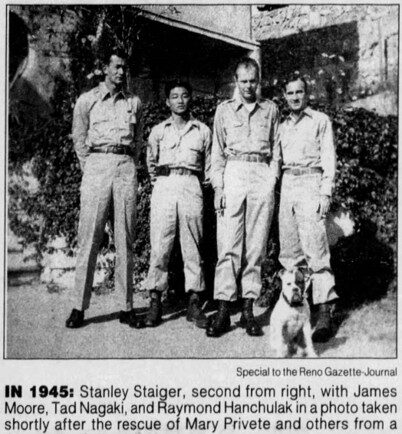
Above: L-R – James Moore, Tad Nagaki, Sgt. Stanley Staiger, Raymond Hanchulak, OSS team, August 1945
For his military service, Sergeant Tadashi Nagaki was awarded the Soldier’s Medal, Bronze Star Medal, Good Conduct Medal, American Campaign Medal, Asiatic-Pacific Campaign Medal, World War II Victory Medal, Army of Occupation Medal, and Combat Infantryman Badge. He was awarded the Congressional Gold Medal on October 5, 2010, along with the other veterans of the MIS and 442nd Regimental Combat Team. This is the highest Congressional Civilian Medal. The award states: “The United States remains forever indebted to the bravery, valor, and dedication to country these men faced while fighting a 2-fronted battle of discrimination at home and fascism abroad. Their commitment and sacrifice demonstrates a highly uncommon and commendable sense of patriotism and honor.”
Tad was discharged from the U.S. Army on February 15, 1947. He returned to his home area of Alliance, Nebraska, and farmed with his brothers. He had married Asako Darryle Nakazono two weeks earlier, on January 26. Asako was born on March 15, 1925, in Imperial, California, to Yaichi and Lakae Nakazono. The couple had three sons: Robert Wayne (died in infancy in 1948); Richard A. (died at age of 9 in 1949); and David T., who predeceased his father and was survived by two sons.
On August 30, 1963, Tad’s father Minosuke died. He had been a sugar beet farmer in Alliance since 1947. He was buried at Fairview Cemetery in Scottsbluff.
On February 3, 1970, Tad and his brothers were honored by the Bayard Factory District of the Great Western Sugar Co. at the 1969 High Producers Banquet at Scottsbluff Country Club. The brothers produced by themselves 1,498,967 pounds of sugar beets on 240.5 acres owned by Edward F. Jelinek, and 273,415 pounds on 46 acres they owned with their brother-in-law, sister Mitsue’s husband Harry Nakatsu. This was their second year in the top producer group.
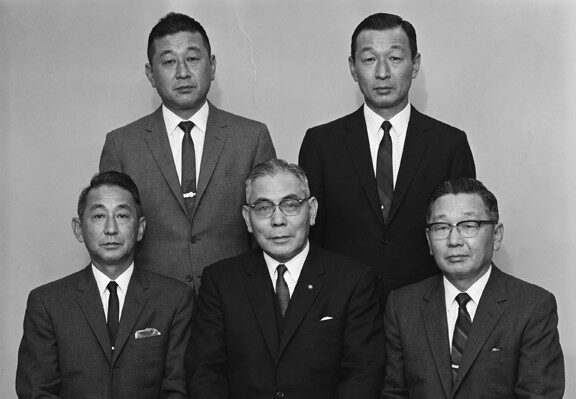
Above: L-R – Tadashi Nagaki, Masakazu Nagaki, Harry Nakatsu, Akira Nagaki, and Frank Nagaki
On February 20, 1970, Tad’s mother Shige Agaki died at the age of 82 in her home on Route 2 in Alliance. She was buried next to her husband in Scottsbluff.
Butch, as Tad’s wife Asako was known, died on May 20, 1996. She was buried in Alliance Cemetery, Box Butte County, Nebraska, Block 18, Sector 9.
Tadashi Nagaki died on April 22, 2013, at Broomfield, Colorado. He was buried next to his wife. Survivors included two grandchildren and six great-grandchildren.
Tad’s brother, Akira Nagaki, served as a Private First Class, 2nd Battalion, E Company, 442nd Regimental Combat Team.
Researched and written by the Sons & Daughters of the 442nd Regimental Combat Team in 2022; updated in 2026.