Soldier Story: Takeo Kaneichi
Soldier Story
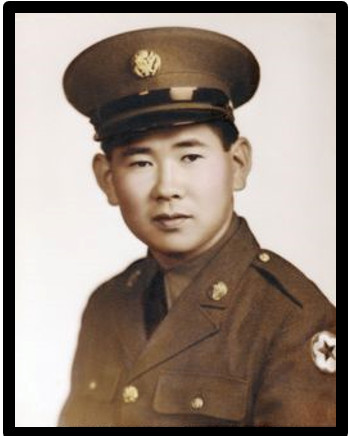
Takeo Kaneichi
Private First Class
442nd Regimental Combat Team
2nd Battalion, Company E
Takeo Kaneichi was born on March 2, 1919, in Fresno County, California, the third child of Kahei and Misao (Yokota) Kaneichi. His siblings were brother Yoshio Jerry, and sisters Shizuko Susie, Suzuko Ruth, Chiyoko (died age 14), and Harue Helen.
Kahei arrived in Seattle, Washington, on the S.S. Utopia on April 27, 1900, by way of Victoria, British Columbia, Canada. By June, he was in Fresno, California, and employed as a servant in the large household of Handre Diel, a Russian immigrant and farmer.
He returned to Japan in 1913 and married Misao Yokota, who arrived on the S.S. Korea in San Francisco, California, on August 21, 1914. In 1920, the family was living in Dakota Precinct of Fresno County. Father Kahei was employed as a farmer on a fruit ranch. In 1930, they were living on Shasta Avenue in Fresno, and both parents were employed as laborers in a vineyard. In 1937, Takeo graduated from Central High School where he was on the basketball and baseball teams. After high school he attended Armstrong Business College in Berkeley, California. In October 1938, he was elected Vice President of the Japanese Club for the fall quarter at Armstrong. He was enrolled in the college’s Higher Accounting course and was on the Honor Roll his freshman year. His home address was Route 9, Box 409-B.
In 1940, they lived on Monroe Street in Fresno and Kahei was a farmer.
Takeo signed his World War II draft card on October 1, 1940, Local Board No. 248, 11013 Corinth Avenue, West Los Angeles, California. He lived at 1935 Purdue Avenue in West Los Angeles, and his point of contact was his cousin Tokuichi Fujii of the same address. Takeo was employed by S. Maeda at Santa Monica Nursery. He was 5’8” tall and weighed 160 pounds.
Takeo Kaneichi enlisted in the U.S. Army on November 11, 1941, in Sacramento, California. He had completed two years of college. His civilian occupation was listed as “Nursery and landscaping laborer.” The Fresno Bee reported that he was among the 49 draftees who would leave the city at 10:00 p.m. in sleeping cars from the Southern Pacific Station on November 10. The young men were given a farewell concert at the station by the Roosevelt High School Band and each received a gift package. Kaneichi was a transfer from the Los Angeles Draft Board No. 248.
Private Kaneichi was sent for basic training to Fort Ord, California. He was later stationed at Camp Robinson, near North Little Rock, Arkansas, at some point in 1942-1943. Camp Robinson was an Infantry Replacement Training Center (IRTC). He also had some medical training in Company E, 106th MRTC (Medical Replacement Training Center) at Camp Robinson.
In May 1942, Takeo’s family was evacuated to the WCCA Assembly Center at the Fresno Fairgrounds. On October 26, they were incarcerated at Jerome WRA Internment Camp in Jerome, Arkansas. They lived there for 20 months until June 15, 1944, when Jerome was closed and they were transferred to Rohwer WRA Internment Camp in nearby McGehee, Arkansas. His parents and sister Helen lived in Unit 34-7-C, and brother Yoshio and his wife Sumiyo and daughter (born in 1943 at Jerome) were in Unit 34-7-A.
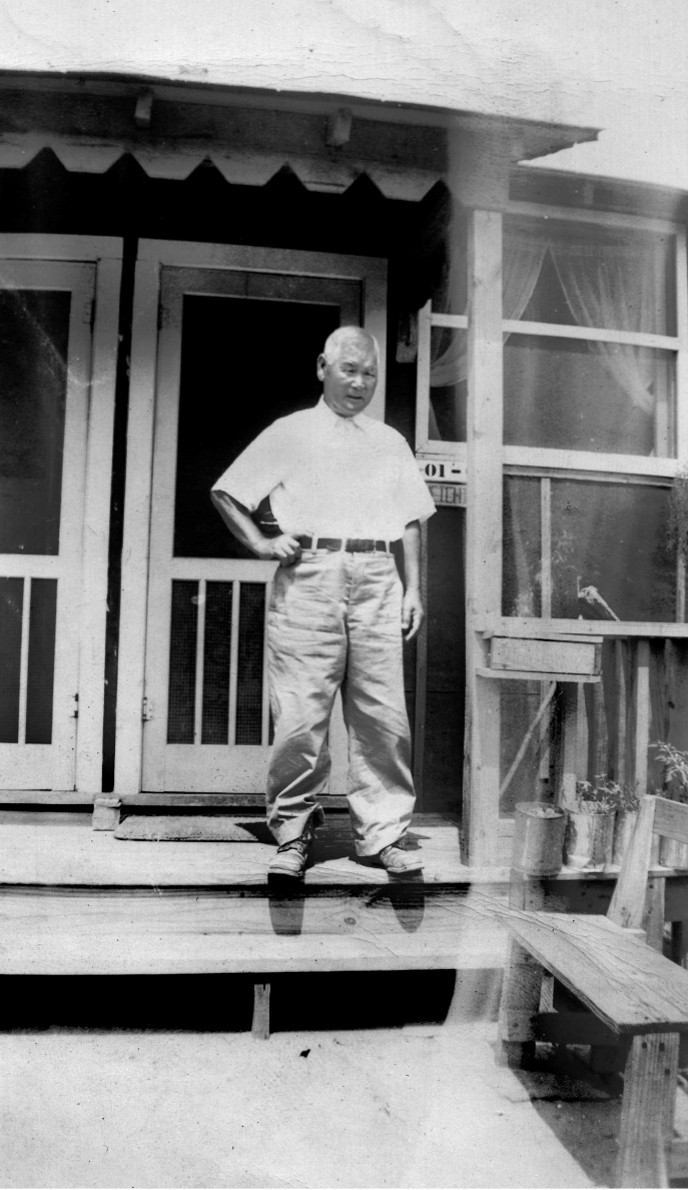
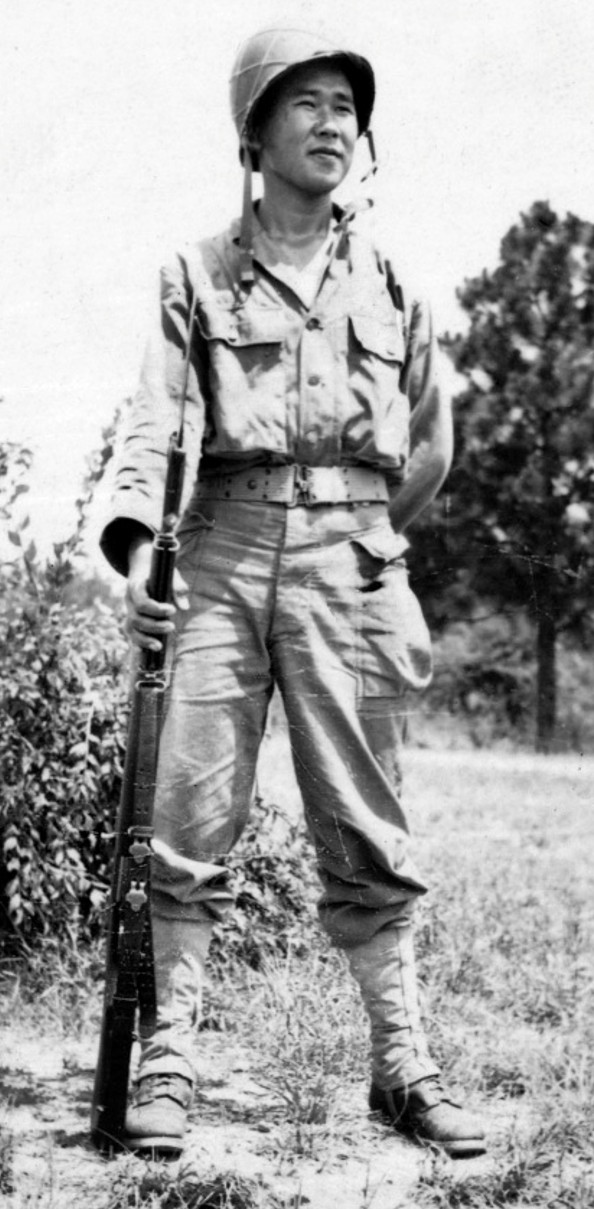
Left: Kahei Kaneichi at his Jerome barracks in Block 29, 1943/1944
Right: Pvt. Kaneichi in 1942/1943, possibly at Camp Robinson
Takeo Kaneichi left the US for the Mediterranean Theater of Operations in August 1944. He arrived to the 442nd RCT as one of 672 replacement troops, mostly from the continental US, on September 18 while they were in bivouac at the 2nd Replacement Depot near Naples. The new men were assigned to companies and underwent integration into the unit and last-minute combat training.
The RCT soon moved to Staging Area Number 1 at what had once been the University of Naples. On September 26-27 the troops boarded light assault boats and were shuttled to the waiting Navy transport ships. At noon on the 27th they sailed for Marseilles aboard USAT Thurston (522nd Field Artillery Battalion), USAT Joseph T. Dickman (2nd Battalion), USAT Samuel Chase, and USAT Henrico.
On September 30, the 442nd arrived at Marseilles. The next day, the men were moved by train to a staging area near Septèmes. After several days, all units were moved by truck – with the exception of 3rd Battalion by train – over a three-day period, north 500 miles along the Rhône Valley. They arrived at an assembly area in Charmois-devant-Bruyères on October 11 for fighting in the Rhineland-Vosges Campaign in October and November in northeast France. They were attached to the 36th Infantry Division, 7th Army.
The immediate mission was taking the important rail and road town of Bruyères. It lay in a valley bordered by four conical hills named Le Buémont, Le Château, Pointhaie, and L’Avison, which the Allies named A, B, C, and D, respectively. To take Bruyères, the 442nd had to take the hills.
On October 15, the 442nd launched their attack. The Germans had the terrain and the weather on their side. The mountains were more than 1,000’ high and covered with tall pines. The fog and the thick underbrush limited visibility to a dozen yards. It was cold and rainy and the men were still in their summer uniforms.
The two leading battalions moved out at 8:00 a.m. – 100th Battalion with the objective to take Hill A; and Kaneichi’s 2nd Battalion to take Hill B. No one was quite sure where the Germans were or in what strength due to the terrain and the dense underbrush. Resistance developed early and was too well dug-in to be knocked out quickly. That day, the 442nd gained only 500 yards and took 20 prisoners – from the 19th SS Police Regiment and the 223rd Grenadier Regiment. They talked freely that they had been ordered to “hold to the last man.”
On October 16, the 100th and 2nd Battalions again met heavy resistance. Companies E (with Kaneichi) and F occupied Hill 555/Helledraye, northwest of Bruyères. As they descended to cross the valley to Hill B, they were pinned to the ground by a tremendous volley of fire from Hill B. In the evening the Nazis mounted a counter-attack against 2nd Battalion. Fortunately, rounds of fire from the Combat Team’s 522nd Field Artillery Battalion broke the Nazi assault.
The next day, October 17, Companies E and F were again attacked on Hill 555. After bitter close-in fighting, the Nazis pulled back, only to attack again supported by their tanks. After forming six bazooka teams, 2nd Battalion finally beat off the armor. Immediately, the 100th and 2nd Battalions resumed the offensive. Captured prisoners said that additional German units were being called in.
On the fourth day, October 18, 3rd Battalion moved into position for a drive straight at Bruyères. After a 30-minute artillery barrage on the town and Hills A and B, the 442nd attacked again. Resistance was fierce, but after over six hours of fighting, the enemy’s defenses finally cracked. By the end of the day, Bruyères had fallen to the Americans.
October 19 saw 2nd and 3rd Battalions attacking Hill D, east of Bruyères, which was taken by noon. This left Hill C, cut off to the rear of the 442nd, strongly in enemy hands that had no disposition to surrender.
On October 20, the 100th began its attack on Hill C, which fell that day. However, a strong German force had infiltrated back to Hill D during the previous night and was raising havoc in the rear elements of 2nd and 3rd Battalions. The enemy had no intention of being driven off a second time. Progress was slow throughout the day. At 5:10 p.m. 2nd and 3rd Battalions attacked Hill D again after a 20-minute preparation by four battalions of artillery. They were able to cross the railroad embankment but were stopped by a field of German S-mines and dug-in enemy positions.
Early on October 21, 2nd and 3rd Battalions were to resume their frontal attack on Hill 505, a ridge on the other side of the railroad tracks held by the Germans. With a concerted effort including 522nd Artillery support, Hill 505 finally fell. That night, 2nd Battalion was pulled back into regimental reserve.
However, on October 21 Pfc. Takeo Kaneichi was severely wounded in the lower abdomen by an artillery shell on Hill D. He was taken to an aid station and later evacuated behind the lines. He ended up at the Army’s 46th General Hospital in Besançon, 90 miles south of Bruyères. After an operation to save his life, he died 19 days after being wounded – on November 8, 1944.
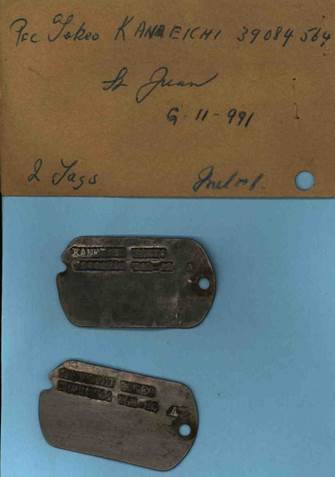
Pfc. Takeo Kaneichi was laid to rest at 4:00 p.m. on November 9 in an Army uniform and wrapped in a shroud in the St. Juan American Military Cemetery, 17 miles northeast of Besançon, Plot G, Row 11, Grave 991. He was buried between Pfc. Roy P. Phillips, Co. E, 141st (Texas) Infantry Regiment and a soldier named Reed. Buried with him were his identification tags (“dog tags”). A souvenir ring found on his body at the 46th General Hospital was later returned to his parents, along with other personal effects from his duffel bag, which had been in the 442nd Combat Team’s possession in the war zone: New Testament, pay book, 37 snapshot photographs, three personal letters, fountain pen, wallet, California driver’s permit, three coins, two knives with broken blades and rusty handles, “Y.M.” ornament, sunglasses, box of stationery, eight postcards, postal receipt, and U.S. Postal money order for $3.00. The Purple Heart Medal he was posthumously awarded was also separately sent to his parents.
Below: Takeo Kaneichi’s military ID tags, known as “dog tags”
For his service in World War II, Pfc. Takeo Kaneichi was awarded the following: Bronze Star Medal, Purple Heart Medal, Good Conduct Medal, American Defense Medal, American Campaign Medal, European-African-Middle Eastern Campaign Medal with one bronze service star, World War II Victory Medal, Distinguished Unit Badge, and Combat Infantryman Badge. He was posthumously awarded the Congressional Gold Medal on October 5, 2010, along with the other veterans of the 442nd Regimental Combat Team. Conferred by the U.S. Congress, the award states: “The United States remains forever indebted to the bravery, valor, and dedication to country these men faced while fighting a two-fronted battle of discrimination at home and fascism abroad. Their commitment and sacrifice demonstrate a highly uncommon and commendable sense of patriotism and honor.”
Below: Memorial Service for Pfc. Kaneichi, Rohwer, 1944
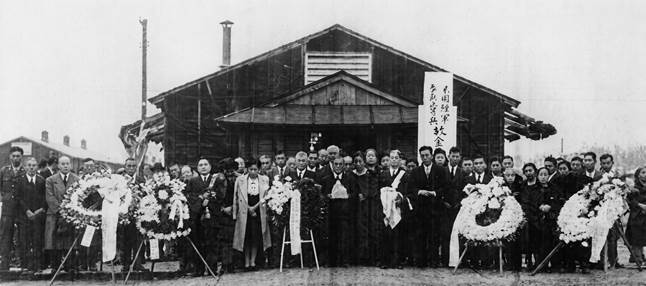
At the time of Takeo Kaneichi’s death, his family was incarcerated at Rohwer WRA Internment Camp. Survivors included Takeo’s parents, brother Yoshio, and sisters Mrs. Susie Nagamura, Ruth Suzuko (Mrs. George Y.) Itogawa, and Helen Kaneichi.
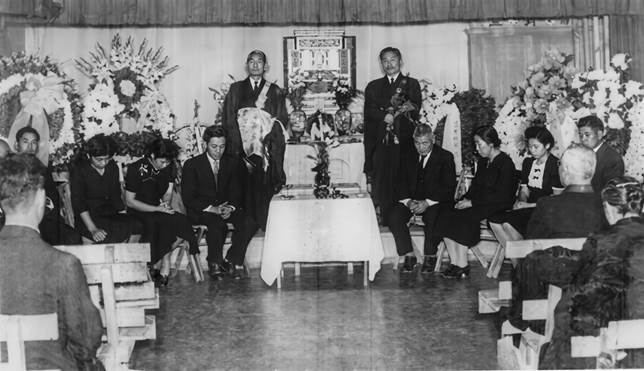
Above: Family seated in front, L-R – Ruth, Sumiyo, Yoshio, Kahei, Misao, Helen
The family held a memorial service for Takeo on November 8, 1944, at Rohwer. It was attended by over 50 people and five large floral wreaths were presented.
The Kaneichi family was released back to Fresno from Rohwer in July 1945 – Yoshio and family on the 16th and parents and Helen on the 26th.
Prior to deploying to combat, Takeo had taken out a $10,000 life insurance policy, naming his sister Helen as beneficiary. In 1945, Helen, age 16, requested the court to appoint her mother as her guardian to pursue her claim against the Veterans Administration (VA) for the insurance policy. The request was denied on the basis that Mrs. Kaneichi did not speak, read, or write English. The family, who was then residing in the rural district north of Fresno’s Roeding Park, filed a new petition naming her older brother Yoshio as guardian.
In 1946, the US began the first steps of the program to bring home our war dead, which took several years to accomplish. Families were given the choice of having their loved one returned home or reburied in one of the few cemeteries that would remain. The Kaneichi family consequently chose to have Takeo’s remains returned to the US.
On October 18, 1946, the Army’s Quartermaster General, Major General E.B. Larkin, sent a letter to Kahei Kaneichi advising him of the location of Takeo’s burial place. The letter also stated in part:
The War Department has now been authorized to comply, at Government expense, with the feasible wishes of the next of kin regarding final interment, here or abroad, of the remains of your loved one.…
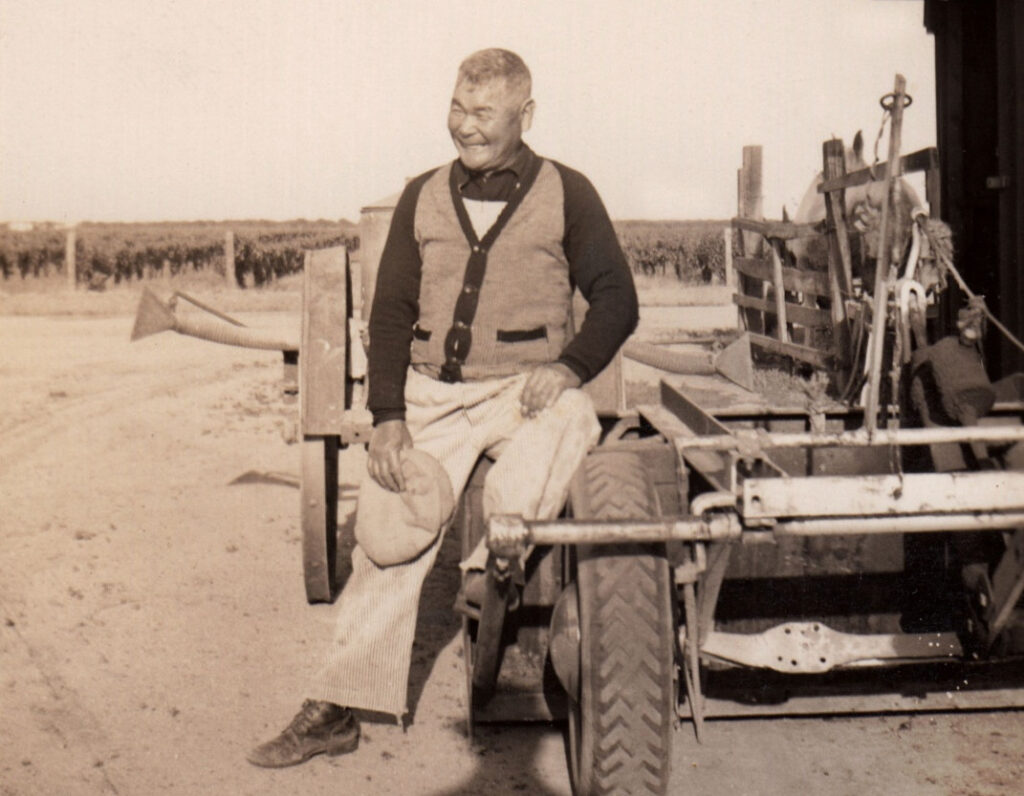
Below: Kahei Kaneichi next to his barn on the vineyard farm he and son Yoshio operated
On October 25, 1946, a dinner dance was held to honor several hundred local Japanese American veterans at the Fresno Memorial Auditorium, sponsored by the Central California Reception Committee for Nisei Veterans. Special honors were paid to 16 Nisei who were killed in military service, including Takeo Kaneichi. Tall yellow candles placed on the Gold Star Mothers table were lit by Mayor Z.S. Leymel in honor of the fallen heroes. Keynote speaker Lt. Col. J.C. Cairns, Assistant Chief of Staff of Sixth Army Headquarters, praised the record of the Japanese American soldiers in all the theaters of the war.
Following is a summary of the lengthy and well-documented path home for Pfc. Kaneichi taken from National Archives records:
1947
- June 30: His parents directed that his remains be cremated prior to transportation to the US
- October 29: Disinterment Directive was processed
- November 15: Disinterment Directive was issued
1948
- January 19: His remains were disinterred at St. Juan Military Cemetery
- March 2: His remains were prepared/embalmed and placed in a casket
- March: His casket was moved to the American Military Cemetery in Épinal, near Bruyères
- March 30: His casket was sent by train from Épinal 250 miles northwest to the OIC (Officer in Charge) in Antwerp, Belgium
- April 2: His casket arrived in Antwerp
- April 12: His casket was sent by truck from the AGRC (American Graves Registration Command) Antwerp to the U.S. Marine Corps at Henri-Chapelle American Military Cemetery, about 60 miles east (Note: Henri-Chapelle was a temporary and later permanent cemetery in Belgium)
- November 6: His casket was sent by truck from Henri-Chapelle to the Port of Antwerp, Pier 140
- November 18: His casket was sent to the Municipal Crematorium at St.-Gilles Cemetery in Uccle, Brussels, Belgium; after removing his identification tags (“dog tags”) his remains were cremated, and his ashes were placed in an Army-issued funeral urn, later engraved by the AGRC with his name, Army Serial Number, “U.S. Army,” and “1919-1944”
- November 20: His urn arrived back at the Antwerp Port, Pier 140
- December 7: His urn was placed aboard the USAT Barney Kirschbaum by the AGRC Antwerp
- December 18: Kahei was advised by Major Samuel G. O’Regan, Chief of the Quartermaster Division of the ARCG in Oakland, California, to furnish the name/address of the family’s chosen funeral home in Fresno
- December 29: USAT Barney Kirschbaum arrived in New York Harbor with the remains of 4,384 American war dead, including Pfc. Kaneichi and 211 other California soldiers
1949
- January 3: His urn was received by the New York Port of Embarkation (NYPE)
- January 4: His urn was sent from the NYPE to the Capt. P.J. McBroom, Quartermaster at ALC (illegible) #13
- February 4: His urn arrived at Fresno from Oakland on the ATSF (Atchison Topeka Santa Fe Railway) Train #2 at 3:30 p.m. accompanied by a personal military escort; Lisle Funeral Home had been directed to meet the train on arrival and accept the remains
- February 8: His father Kahei filed for reimbursement of $75.00 burial expenses
- June 2: His identification tags (“dog tags” were sent by the AGRC in Europe to the Quartermaster General in the US
The evening of Takeo Kaneichi’s arrival in Fresno a wake for him was held at 7:00 p.m. at the Buddhist Church, 1340 Kern Street. The funeral service was held at the church the next day, February 5, at 2:00 p.m. Over 200 people attended the funeral and 24 large floral wreaths were presented. The pallbearers were from his home area of Biola and were all war veterans: Nobe Miyamoto (2nd Battalion, Headquarters Company); Merit Isao Kodama (U.S. Army); Sgt. Yorio Arthur Kawamoto; Yutaka Kobori (MIS); Nariyoshi Yamanaka (MIS); Kosuke James Arakaki (100th Battalion, D Company); S/Sgt. Roy Kenji Uyeno (3rd Battalion, L Company); T/4 Narikiko Yamanaka; John Y. Arakaki (U.S. Army); and T/3 Takashi Morita (MIS).
Immediately afterwards, Takeo Kaneichi was buried with military honors conducted by American Legion Post 509 at Mountain View Cemetery.
His government headstone was ordered by his brother Yoshio Kaneichi of Route 9, Box 279-C, Fresno, on February 8, 1949, and shipped to Mountain View Cemetery.
On May 28, 1950, at 10:00 a.m. the Central district community of Fresno County dedicated a plaque at Union High School to the memory of the 28 local men, including Takeo Kaneichi, who lost their lives in World War II.
On May 30, 1951, a large memorial was dedicated in Roeding Park by the Nisei Liberty American Legion Post 5809, the Veterans of Foreign Wars, and the Japanese American community of Central California. Takeo Kaneichi’s name appears on the monument along with 26 other men who died in World War II and three added later from the war in Vietnam.
Postscript. On October 25, 1963, Yoshio Kaneichi, age 48 of Santa Monica, California, was killed in a collision near Tulare while driving to Fresno to make funeral arrangements for his 83-year-old father Kahei. Their joint funeral was held at the Fresno Buddhist Church annex on October 28 at 2:00 p.m. Yoshio was survived by his wife Sumiyo and two daughters. Kahei was survived by his wife Misao, and daughters Mrs. Shizuko Nagamura of Japan, Ruth (Mrs. George Y.) Itokawa of Sacramento, and Helen (Mrs. Ernest K.) Shirakawa of Fresno. Father and son had operated a vineyard at West Shields and Monroe Avenue where they grew Thompson grapes for many years.
Researched and written by the Sons & Daughters of the 442nd Regimental Combat Team in 2026