Soldier Story: Tokuichi Hayashi
Soldier Story
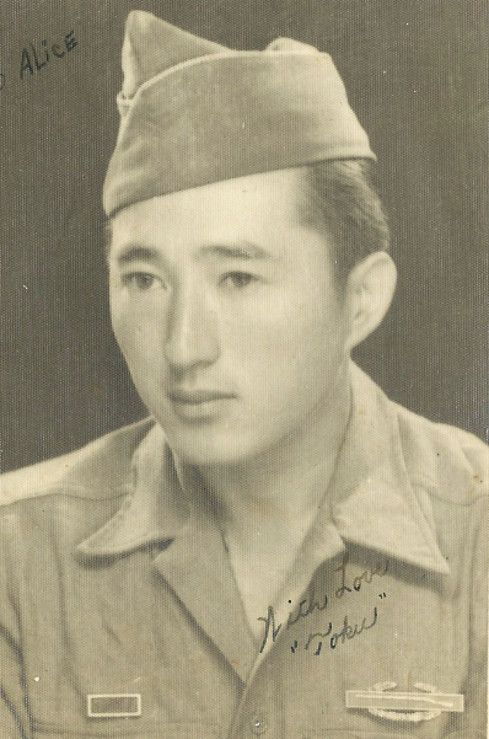
Tokuichi Hayashi
Technician 4th Grade
442nd Regimental Combat Team
100th Battalion, A Company
Tokuichi Hayashi was born on October 30, 1915, in Honolulu, Territory of Hawaii. He was the son of Rikichi and Kinu (Inouye) Hayashi, who emigrated from Yamaguchi Prefecture, Japan. Rikichi arrived on August 15, 1899, from the village of Tamioka. Kinu arrived in 1904 from Tomita and married Rikichi in 1905. They raised a family of five children: sons Toshichi, Tokuichi, Steve Saburo, and Richard Joichi; and daughter Violet Matsue.
In 1910, Rikichi and Kinu lived with their first child Toshichi in Aiea where they both were employed on the Honolulu (Sugar) Plantation. In October 1915, Rikichi returned to Yamaguchi for a visit with Kamekichi Hayashi in Tanda-machi. He arrived back in Honolulu on December 18, 1915, aboard the Persia Maru.
The family continued to live on the plantation in Aiea at New Mill Camp where Rikichi worked. He held various positions from laborer to teamster to yard man. By 1930, son Toshichi also began working for the plantation. In late April 1931, Kinu took her three youngest children, Matsue, Saburo, and Joichi, to Japan for a visit. They arrived back in Honolulu aboard the Shinyo Maru on August 7.
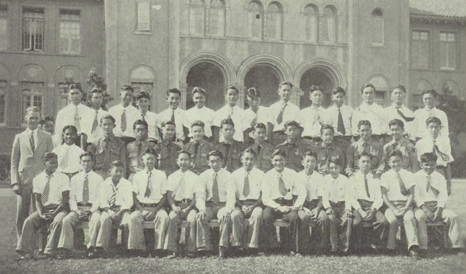
Toku, as Tokuichi was known, attended McKinley High School, where he was a member of Chapter 2, Future Farmers of America (FFA). After graduating in 1934, he began working on Aiea Plantation as a heavy machine operator.
Right: McKinley’s FFA Chapter, 1933, Toku is top row, far right
On October 26, 1940, Hayashi registered for the draft, Local Board No. 9, at the Waipahu Fire Station. His point of contact was his father Rikichi and their address was Box 77 in Aiea, New Mill Camp, Houses 18 and 17, respectively. He was 5’4-1/2” tall and weighed 123 pounds. At the time, he was employed by Honolulu (Sugar) Plantation Company in Aiea.
In early December 1940, the Selective Service draft quota for his Local Board No. 9 was 45 men and Tokuichi volunteered rather than waiting to be called up. He was classified 1-A and eligible for immediate service. Two days later he was awaiting instructions for the date to appear at his draft board for transportation by bus to a welcome ceremony at Iolani Palace and then on to Schofield Barracks.
Hayashi enlisted on December 10, 1940. He was assigned to Company A, 298th Infantry Regiment, Hawaii National Guard, stationed at Schofield Barracks. While there, in addition to other military training and duties, he attended Cooks and Bakers School.
On December 7, 1941, during the early morning attack on Pearl Harbor, the Japanese Mitsubishi A6M “Zero” planes flew right over the Hayashi family home in Aiea. A bullet pierced through the right hand of Toku’s father Rikichi as he sat on the bed. At the time, Toku was on guard duty on the shoreline at Makapuu on Oahu’s east side.
On March 17, 1942, Toku married Fusae Alice Arakaki. She was born on January 25, 1919, to Kame and Makato (Oshiro) Arakaki of Ewa Village, west of Honolulu.
Toku was among the 1,432 Japanese American soldiers, the Hawaiian Provisional Battalion, who were sent first to the mainland in June 1942 for further Army training. A fellow soldier later recalled that their departure had been kept a secret and there was only “one elderly Japanese mother waving good-bye to us” when the train left Schofield Barracks, and a “handful of Nisei girls waved from the pier as the S.S. Maui pulled away from the dock” on June 5, 1942.
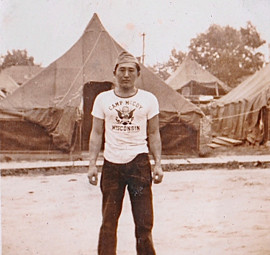
Upon arrival in Oakland, California, they were designated the 100th Infantry Battalion (Separate) and sent to Camp McCoy, Wisconsin, for basic training. Hayashi was assigned to A Company, Company Headquarters. He also had received training on the BAR (Browning Automatic Rifle).
Left: Hayashi at Camp McCoy, 1942
After their time in Wisconsin, the 100th left Camp McCoy on June 6, 1943, for Camp Shelby, Mississippi. They went through even more training there, including “D” Series maneuvers, field exercises, and intense firing practice at Camp Claiborne, Louisiana.
Finally, the 100th left for Camp Kilmer, New Jersey, on August 11, 1943. On August 21, they traveled on to Brooklyn, New York, and then ferried to Staten Island, where they immediately boarded the S.S. James Parker for their Atlantic crossing to the Theater of War. The ship was packed to twice its capacity and the men were only fed two meals per day.
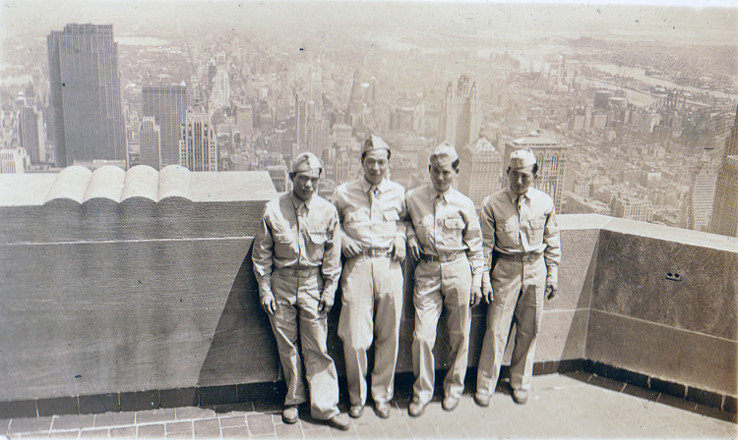
Below: Pvt. Hayashi (far right) with friends visiting New York City while on leave, 1943; he also visited Washington DC
After entering the Mediterranean, the Parker docked on September 2 at Oran, Algeria. The 100th was initially assigned to guard supply trains on the Casablanca to Tunisia route. However, Colonel Farrant L. Turner, the 100th commander, rejected this as he knew his men wanted frontline combat duty. As a result, the 100th Battalion was assigned to the 34th (“Red Bull”) Infantry Division as its “2nd” Battalion (which had been assigned to guard General Dwight D. Eisenhower’s headquarters in Oran).
On September 19, 1943, the 100th departed Oran on the S.S. Frederick Funston as part of the 133rd Infantry Regiment, 34th Division, a unit of General Mark W. Clark’s Fifth Army. They arrived on September 22 at Salerno, Italy.
The 100th entered the combat zone in the Naples-Foggia Campaign the next day, September 23. Hayashi was there for all of the 100th’s action as they fought their way inland and northward toward Rome: Benevento, three Volturno River crossings, Alife, Rapido River, Pozzilli, Monte Cassino, and the breakout from Anzio on May 23, 1944. Afterwards, the 100th fought in the drive to Rome. They were ordered to stop just a few miles short and were sent in a truck convoy through the newly-liberated capital city on June 5, about 60 miles north, to Civitavecchia.
At a large bivouac near Civitavecchia, the 100th (Separate) met up with the 442nd Regimental Combat Team. The 442nd had arrived from Camp Shelby on May 28. On June 11 the 100th (Separate) was assigned to the 442nd as its “1st” Battalion, which had been decimated (and left behind at Camp Shelby) by sending fresh soldiers over to Italy to replace the 100’s high battle casualties in the preceding months.
On June 26, 1944, the 100th and 442nd RCT moved forward to the front lines for their first combat engagement together. Over the summer, they were in heavy fighting as they liberated towns from the enemy. Their fiercest battle was at Hill 140, just north of the Cecina River.
On August 10, the 100th Infantry Battalion (Separate) was redesignated the 100th Battalion, 442nd Regiment. It was in essence the “1st” Battalion, but kept its “100th” name out of honor to its outstanding training and combat record, which had been a key factor in the decision to activate the 442nd RCT.
After driving the enemy north to the Arno River, it was decided by the Supreme Allied Command in early September that the 442nd would be sent to the Seventh Army in France. They were transported to the port of Piombino on September 10 and left the same day on Liberty ships for Naples, arriving the next day. While there, they were bivouacked in an area of olive groves and the men were given day passes to Pompeii and Naples.
The Combat Team left Italy for France on September 27. They arrived at Marseilles after a two-day voyage, and bivouacked at nearby Septèmes prior to traveling over 500 miles north by truck (or rail boxcars for 3rd Battalion) to the Vosges Mountains in northeast France to fight in the Rhineland-Vosges Campaign. They arrived at Charmant-devant-Bruyères on October 11. During this campaign, the 442nd was attached to the 36th Division, Seventh Army.
The mission of the 442nd was the liberation of the important rail and road junction of Bruyères and neighboring Biffontaine. The weather was cold, wet, snowy, and miserable as the men fought in the heavily wooded forests still in their summer uniforms. They were subjected to living in foxholes, and incoming artillery raining down on them in “tree bursts.” After eight days of heavy fighting, the 442nd was taken off the front lines and given a rest break in nearby Belmont. Their rest was cut short when on October 26, after just two days of rest, they were ordered to the “Rescue of the Lost Battalion” – the 1st Battalion, 141st (Texas) Infantry that had advanced beyond the lines and was surrounded on three sides by the enemy.
After the especially fierce fighting in the Vosges, the 442nd was at half strength, and was sent to the south of France. There, they could rebuild to full combat strength while participating in the Rhineland-Maritime Alps Campaign, which was mostly a defensive position guarding the French-Italian border from attack by the German Army in Italy.
Throughout their time in southern France, the men were often given day passes to Nice where they could enjoy the nightlife and the Army Rest Centers that had opened up. For this reason, their sojourn there was nicknamed the “Champagne Campaign.”
The 442nd was there from November 23, 1944, until March 15, 1945, when they were relieved and moved in relays to the new staging area at Marseilles. On March 20-22, the 442nd (without its 522nd Field Artillery Battalion who were sent to fight in Germany) left France to fight in the Po Valley Campaign for the final push to defeat the Nazis in Italy. They arrived at the Peninsular Base Section in Pisa on March 25 and were assigned to Fifth Army.
The objective of the 442nd was to execute a surprise diversionary attack on the western anchor of the German Gothic Line. This elaborate system of fortifications had been attacked in the fall of 1944, but no one had yet been able to pry the Germans loose from the western end. The Gothic Line in this area was hewn out of solid rock, reinforced with concrete, and constructed to give all-around protection and observation. The Germans were dug into mountain peaks rising almost sheer from the coastal plain, save for scanty scrub growth after being stripped bare of vegetation by the Germans.
The 442nd successfully pushed the Germans from their start-off point at Mt. Folgorito and Mt. Carchio, while on April 4 the 100th took the hill mass designated “Florida.” They then moved on to the “Georgia” peak, which had been attacked over a five-month period but had never been taken. It took the Combat Team exactly 32 minutes to accomplish the mission.
During all the days in active combat, T/4 Toku Hayashi performed the additional duty of being a litter bearer when he was not directly involved in his cooking duties. This was true for many soldiers not in a rifle or heavy weapons company. Carrying the litters of wounded soldiers was especially challenging during the Po Valley Campaign given the high mountain areas of combat. It often took relays of litter bearers to evacuate wounded soldiers to treatment areas.
Over the coming days, the Combat Team moved north, taking from the enemy the peaks of “Ohio” and Mt. Belvedere and the towns of Altagnana, Pariana, and Massa; crossing the Frigido River; an 8-hour march by the 100th over a mountain trail to take Colonnata; taking Carrara, Mt. Pizzacuto, Gragnana and Fosdinovo, and Mt. Nebbione – the last dominant terrain before the vital road center of Aulla. The town fell to the 442nd on April 25. On April 28 the German general in Genoa surrendered the city and his 14,000 troops.
The 100th Battalion reached Busalla, located 16 miles north of Genoa. They then outposted the nearby town of Isola del Cantone with tanks and infantry, after which the 100th halted and waited to see what would happen next. On April 29, 2nd Battalion rolled on in borrowed trucks to the city of Alessandria in the Po Valley, where about 1,000 Germans gave up without a struggle. All over the area the enemy was surrendering by companies, battalions, and regiments. What to do with all the prisoners was a huge problem.
The German forces in Italy surrendered on May 2, 1945. The 442nd regrouped in bivouac at Novi Ligure, south of Alessandria. The men transitioned from combat duty to garrison duty. On May 16, they were ordered to Ghedi Air Field, north near the town of Brescia. After establishing tent bivouac, they were given the duty of processing, searching, and guarding thousands of German prisoners of war.
Beginning on May 31 men were sent home according to the number of “points” they had accumulated, based on such criteria as wounds received, length of time in theater, number of dependents at home, etc. Although Tec/4 Hayashi had accrued 114 points (85 points was the minimum needed), he chose to stay on and continue to serve.
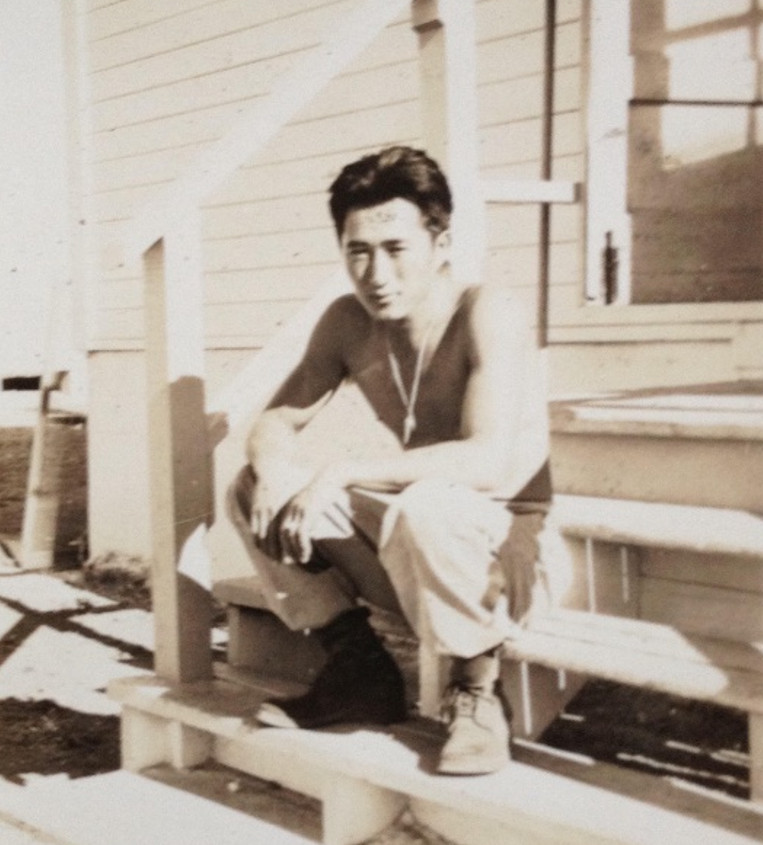
He did, however, leave Italy for the US on June 28.
Left: Hayashi at Camp Beale, July 1945
He flew to Camp Beale, near Marysville, California, 40 miles north of Sacramento. On August 19 he arrived in Hawaii, according to his discharge record. His official discharge date from the U.S. Army was October 18, 1945, at the Fort Kamehameha Separation Center.
For his wartime service, Technician 4th Grade Tokuichi Hayashi received the following awards: Bronze Star Medal, Good Conduct Medal, Asia-Pacific Campaign Medal, American Campaign Medal, European-African-Middle Eastern Campaign Medal with one silver star (for five campaigns), World War II Victory Medal, Distinguished Unit Badge with oak leaf cluster, and Combat Infantryman Badge.
He was awarded the Congressional Gold Medal on October 5, 2010, along with the other veterans of the 100th Infantry Battalion (Separate) and the 442nd Regimental Combat Team. Conferred by the U.S. Congress, the award states: “The United States remains forever indebted to the bravery, valor, and dedication to country these men faced while fighting a two-fronted battle of discrimination at home and fascism abroad. Their commitment and sacrifice demonstrate a highly uncommon and commendable sense of patriotism and honor.”
After the war, Toku used the GI Bill to study the field of electronics. He became an electronic mechanic and was employed at the Pearl Harbor Naval Base in Shop 67, working on radar and sonar systems in nuclear submarines. After retiring as a U.S. Navy civil servant, he worked at Kems Electric and developed back-up radar for the Hōkūleʻa – the canoe for the Polynesian Voyaging Society, which used only the stars for navigation. Toku’s invention was used in emergency situations that saved lives.
By 1950, the family was still living at the New Mill Camp in Aiea and his parents lived with them. Toku was employed at the Pearl Harbor Navy Yard as an electronics helper.
Over the years Toku and Alice raised a family of three children: Patrick, Edwin, and Kathleen.
Hayashi was an active member of the 100th Infantry Battalion Veterans organization, known as Club 100, where he served as President in 1978. He was also on the collation team for the Puka Puka Parade, the 100th monthly newsletter. In addition, he was President of Able Chapter (for Company A) and he helped to fix any mechanical or electronic issues at the Club 100 building.
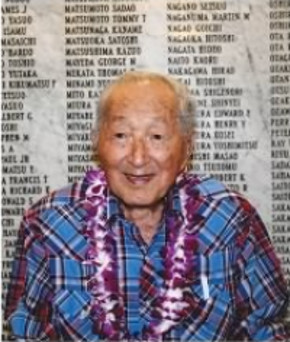
He was also an active member of the Kailua Community Methodist Church as one of its charter members; the Windward YMCA Men’s Club; and the Veterans of Foreign Wars (VFW) Post 3824. He was a Trustee for the Aiea United Methodist Church, where he and his wife Alice were deemed “Living Treasures.”
Right: Toku in later years in front of the Honor Roll at Club 100
Toku participated for decades, until his death, in the Kuakini Hospital Hawaii Heart program, which was one of the longest longitudinal studies resulting in breakthroughs in such fields as cholesterol, Alzheimer’s research, nutrition labeling, etc. His life was one of giving and he gave until the end. Toku made the arrangements to donate his brain and spinal cord to the Kuakini Hospital Honolulu Heart Program for Alzheimer’s research.
Alice Hayashi died on February 11, 2014. She was buried at the National Memorial Cemetery of the Pacific at Punchbowl in Section V, Site 876-A.
Tokuichi Hayashi died on February 11, 2015, at the age of 99, exactly one year after his wife. He was survived by one son, one daughter, nine grandchildren, four great-grandchildren, and his brother Steve. Son Edwin had predeceased him. His Memorial Service was held at 4:30 p.m. on March 8 at the Aiea Methodist Church. He was buried at the National Memorial Cemetery of the Pacific at Punchbowl next to his wife Alice in Section V, Site 876-A. Their gravestone is inscribed “Always in our Hearts.”
Researched and written in 2026 by the Sons & Daughters of the 442nd Regimental Combat Team with assistance by his daughter Kathi Hayashi, who is President of the 100th Infantry Battalion Veterans Club.