Soldier Story: Yoshito John Miyamura
Soldier Story
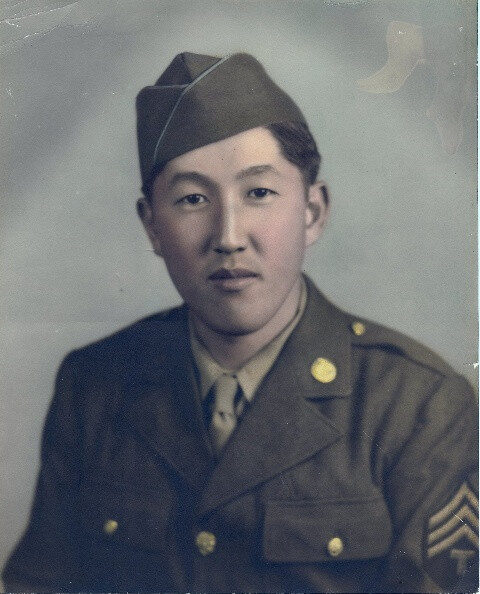
Yoshito John Miyamura
Technician 4th Grade
442nd Regimental Combat Team
2nd Battalion, H Company
Yoshito John Miyamura was born on March 15, 1920, in Auburn, California. He was the second son and second child of five children of Kazuma and Masami (Hatada) Miyamura. His siblings were: brothers Kazuto K., Masato, and Tommy Tomito; and sister Haruye.
Parents Kazuma and Masami emigrated from Kumamoto Prefecture, Japan, in 1900 and 1917, respectively. He arrived at Vancouver, British Columbia, Canada, age 20 years and nine months before sailing on the steamer North Pacific to Seattle on May 15. Kazuma’s father had paid for his passage. Kazuma was 15 years older than Masami and they married shortly after her arrival in the US.
Kazuma proceeded from Seattle to Placer County, California, where he bought a small piece of marginal farmland on the rugged fringe of Loomis Basin. He cleared the woods and ripped out tree trunks with the aid of a horse, until he was able to plant an orchard of fruit trees. Kazuma was later considered one of the early farmers who earned Placer County the nickname of “fruit basket of the world” after the turn of the century.
In 1930, father Kazuma was the manager of a fruit farm in Placer County.
Growing up, Yoshito attended schools in Penryn, Loomis, and Auburn. While a student at Placer Union High School, Class of 1940, he was on the Honor Roll and on the basketball team where he played in the position of guard.
In 1940, the family lived in Penryn, Placer County. Kazuto was helping their father on the fruit farm and Yoshito had just started to help with the farming after graduating from high school.
Miyamura signed his draft registration card on July 1, 1941, Local Board No. 30 at the Sacramento City Hall. His point of contact was his older brother Kazuto, known as Kay. They lived at home, which was “opposite Sicily Mine in Penryn.” Their mailing address was P.O. Box 523. Yoshito was employed by the California Fruit Exchange, Loomis Branch, and specifically at a fruit stand in Penryn. He was 5’7” tall and weighed 150 pounds.
In the Placer Herald on July 19, 1941, Yoshito J. Miyamura’s name was No. 50 on the draft list of 177 local men subject to the draft drawing that was done in Washington DC two days earlier.
John, as Yoshito was also known, was among the Placer County draftees who gathered at the Freeman Hotel in Auburn early on October 15 for the bus ride to Sacramento where they were inducted later that day. A large group of family and friends gathered to see them off. In the December 8 Auburn Journal he was listed as one of 204 Placer County men who had been inducted since the draft was instituted the previous year.
It was reported in the November 22 Sacramento Bee that Private Miyamura was among the Placer County men sent for 17 weeks of basic training to Fort Riley, Kansas, known as the cavalry replacement training center. It was also reported that they were receiving training in horse or mechanized cavalry.
Where Miyamura was stationed during 1942 was not found in our research. However, according to his Army discharge form, he received eight weeks of basic motor mechanic training at the Army’s Motor Training School.
In late May 1942, his family was evacuated from their home in Penryn to the nearby Marysville WCCA Assembly Center after the issuance of Executive Order 9066. On June 29 the family was incarcerated at Tule Lake WRA Internment Camp in Modoc County, California, near the Oregon border. They were released as follows: father Kazuma died July 31, 1943; Tommy on September 21, 1945, to Buffalo, New York; mother Masami and Kazuto Kay on October 24, 1945, to return home; Masato on October 29, 1945, to Buffalo, New York; and Haruye on November 5, 1945, to Oakland, California.
After the 442nd RCT was activated in early 1943, Miyamura was sent to join them at Camp Shelby, Mississippi. He was assigned to 2nd Battalion, H Company. He was assigned as an automotive mechanic.
Miyamura then underwent a year of basic, unit, and combat training, including field maneuvers. He left Camp Shelby with the 442nd on April 22, 1944, and arrived at Camp Patrick Henry, Virginia. They departed on May 2 from nearby Hampton Roads in a convoy of over 100 ships. Most of the 2nd Battalion, including Miyamura and Company H, was aboard the USAT Elbridge Gerry.
After entering the Mediterranean, the USAT Elbridge Gerry was diverted to the port of Oran, Algeria, in North Africa to offload cargo, arriving on May 21.
Meanwhile, the rest of the 442nd continued on to Italy, arriving at Naples on May 28. From Naples, the men of the 442nd marched to the train station and were taken to Staging Area No. 4 at nearby Bagnoli.
On June 6, the 442nd left on LSTs for Anzio, leaving E Company behind in Bagnoli to await the arrival of the rest of 2nd Battalion from Oran. From Anzio, the 442nd went by truck convoy through Rome and arrived at a large bivouac 50 miles northwest of Rome near Civitavecchia.
The 2nd Battalion left Oran on the British ship HMT Samaria on June 5 and arrived at Naples on June 9. They went to the bivouac area in nearby Bagnoli, where they met up with E Company. While there, some of the men were issued day passes to visit Rome or Pompeii. The entire 2nd Battalion finally left Naples by LSTs on July 15 and went directly to Civitavecchia, bypassing Anzio. They arrived at the large Civitavecchia bivouac on June 17, where they met up with the rest of the 442nd.
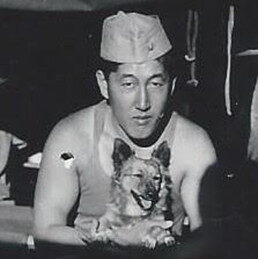
Miyamura first entered combat on June 26, when the Regiment engaged German forces near Suvereto. Second and Third Battalions were the first to engage the enemy in a fierce firefight.
Right: Miyamura in Italy, 1944
For the next month the 442nd encountered heavy resistance from each town as they pushed north toward the Arno River. The 442 suffered casualties of 1,272 men (17 missing, 44 non-combat injuries, 972 wounded, and 239 killed) in the process, a distance of only 40 miles.
The Combat Team was pulled from the front lines and sent to the seaside rest area at Vada on July 25. While there, a decoration ceremony was held and many 442nd men received their Combat Infantryman Badge, including Miyamura. On August 15, the 442nd moved back to the front to patrol the Arno. Crossing the Arno on August 31 was relatively uneventful, as they were guarding the north side of the river in order for bridges to be built.
On September 11, the 442nd was detached from the Fifth Army and then attached to the 36th Infantry Division of the Seventh Army. The Regiment was again pulled from the front lines and sent to Naples for transport to France. After leaving Naples, the 442nd landed in Marseilles, France, on September 30. They traveled 500 miles north through the Rhône Valley, by truck and by rail boxcar, until October 13. This began their participation in the Rhineland-Vosges Campaign.
On October 14, 1944, the 442nd began moving into position to take the important rail and road town of Bruyères. After liberating Bruyères, the Regiment went on to liberate Biffontaine and Belmont. They were then pulled off the front and sent to reserve status in Belmont to rest and recuperate. After less than two days in reserve, the 442nd was ordered to attempt the rescue of the “Lost Battalion,” two miles east of Biffontaine. This battalion, the 1st Battalion of the 141st (Texas) Infantry, had advanced beyond its supply lines and was unable to extricate itself. The rescue was successful on October 30. The 442nd continued to push on to the high ground above La Houssière and the Corcieux Valley (Hill 595). The 2nd Battalion remained in position in the valley around Halley and Grebefosse. Fighting continued around the area of St.-Dié.
On November 17, following the tough battles through the Vosges Mountains, the 442nd was below combat strength and was ordered to the south of France for fighting in the Rhineland-Maritime Alps Campaign. This was mostly a defensive position as the 442nd guarded and patrolled a 12- to 14-mile front line segment of the French-Italian border. The 442nd experienced additional losses as patrols sometimes ran into enemy patrols, or sometimes soldiers stepped on enemy and Allied land mines.
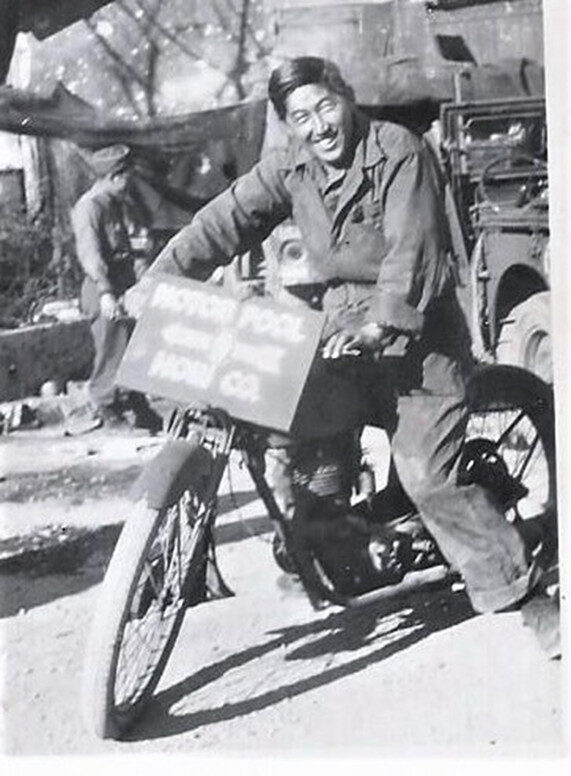
Left: Miyamura in southern France, with sign pointing to H Co. motor pool on his bicycle
Occasionally, soldiers of the 442nd captured spies and saboteurs. Soldiers were given day passes to enjoy the beach and night life of Nice, giving this time the nickname the “Champagne Campaign.”
On March 23, 1945, the 442nd shipped out from Marseilles and traveled to Pisa, Italy, where they were attached to the 92nd Division for their final action of the war – the Po Valley Campaign. Their mission was intended to be a diversionary attack up the west side of the Italian peninsula – as the Allies fought on the east side in the main push against the Nazis. The 442nd made continuous progress against the German Army in the heavily fortified and defended Apennine Mountains. Here, the 442nd saw some of its most intense fighting.
Their success was so complete that what was initially intended as a diversionary attack ended on May 2 when the Germans in Italy surrendered, followed six days later by surrender of the rest of the German Army in Europe.
While he was serving in Europe during the war, Miyamura subscribed to the Auburn Journal newspaper, as was revealed by a letter to the newspaper editor from H Company Lieutenant Frank S. Okusako who enjoyed the news from home.
During occupation duties in Italy, T/4 Miyamura was with the Combat Team in May and June first in bivouac at Novi Ligure, then at Ghedi Air Field near Brescia processing German POWs. From there, they moved to Lake Garlate and had a brief respite to enjoy the countryside. In late July, the 442nd moved south for further duty guarding German POWs and military installations in the Livorno/Florence/Pisa area.
T/4 Yoshito John Miyamura left Europe on October 31, 1945, and arrived in the US on November 21. He was discharged from the U.S. Army at the Separation Center located at Camp Beale, California, on November 28, 1945. His discharge form gave his home address as 163 West Hurn Street, Buffalo, New York – where his brothers Masato and Tommy had been released to from Tule Lake in the two previous months. According to the Auburn Journal of December 13, Miyamura was “recently discharged” and had returned home to Penryn.
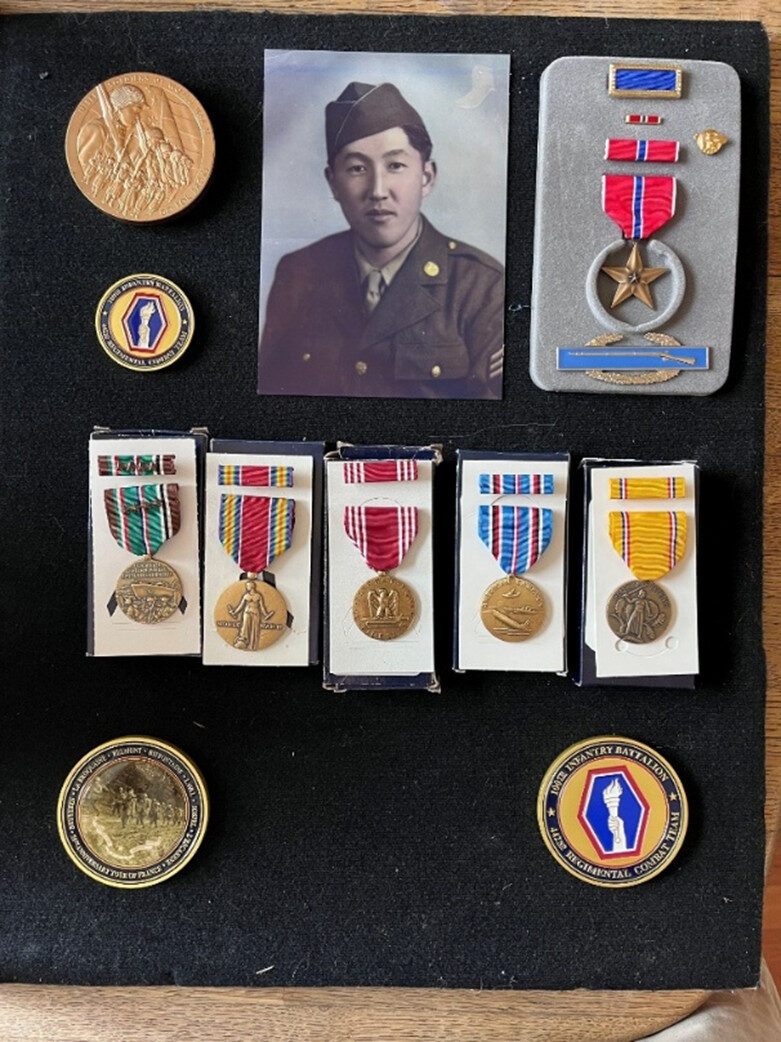
For his military service in World War II, T/4 Yoshito John Miyamura was awarded the Bronze Star Medal, Good Conduct Medal, American Defense Campaign Medal, American Campaign Medal, European-African-Middle Eastern Campaign Medal with four bronze stars, World War II Victory Medal, Army of Occupation Medal, Distinguished Unit Badge with one oak leaf cluster, and Combat Infantryman Badge. Miyamura was posthumously awarded the Congressional Gold Medal on October 5, 2010, along with the other veterans of the 442nd Regimental Combat Team. Conferred by the U.S. Congress, the award states: “The United States remains forever indebted to the bravery, valor, and dedication to country these men faced while fighting a two-fronted battle of discrimination at home and fascism abroad. Their commitment and sacrifice demonstrate a highly uncommon and commendable sense of patriotism and honor.”
John married Grace Tamako Sakai (born June 8, 1924) in April 1948, as it was reported in the Sacramento Union on April 20 that they had applied for their marriage license. Grace was the daughter of Mr. and Mrs. Gonzo and Toki (Shinmoto) Sakai, emigrants from Kumamoto Prefecture who lived in Clarksburg, Yolo County, just south of Sacramento.
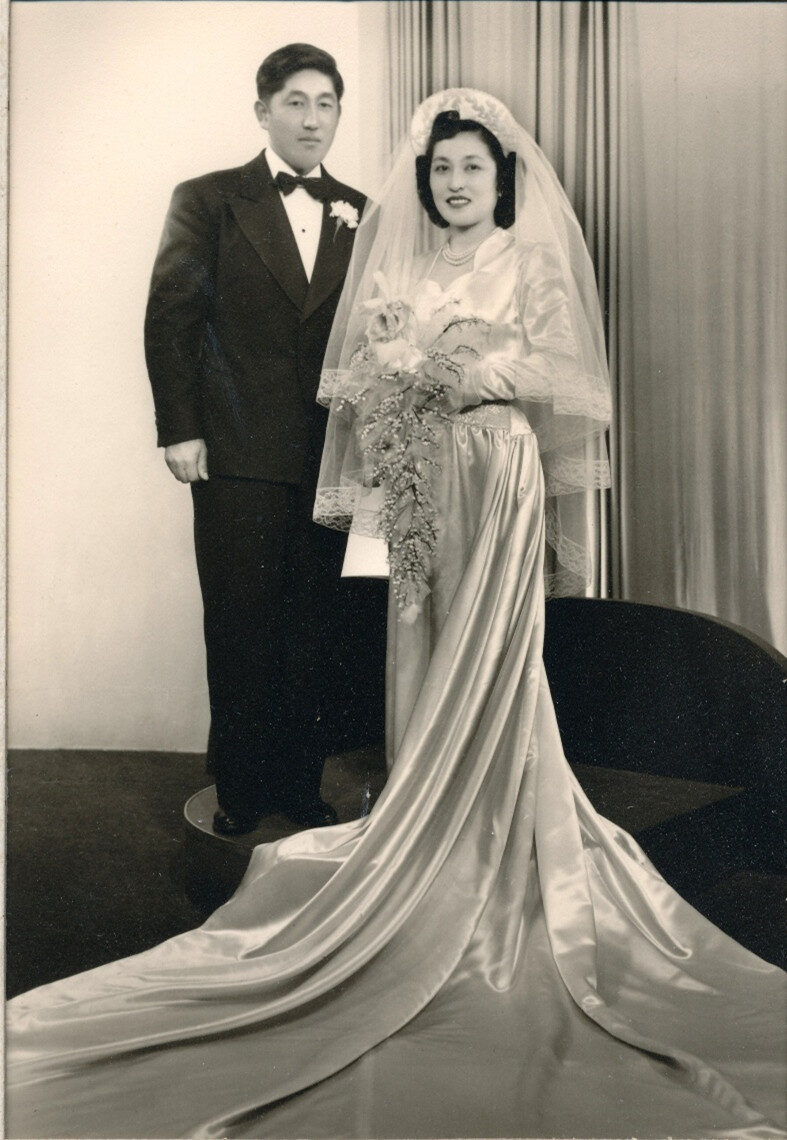
Above: Wedding of John and Grace, 1948
John and Grace settled in Sacramento and over the years raised a family of two daughters and one son.
In October 1949, John enrolled in the Placer County veterans farm training program held at Placer Evening College. He and brother Kay also purchased land to start a fruit orchard together. John was able to use his G.I. Bill benefits to help financially with these two ventures.
On April 20, 1956, the Colfax Weekly reported that Miyamura had completed an additional mainline irrigation installation on his 30-acre orchard land located 1½ miles northwest of Penryn. He also had just signed a cooperative agreement with the Placer County Soil Conservation District, which would provide assistance in planning and applying soil and water conservation practices on his orchard land and eventually install a sprinkler irrigation system.
His family described John’s interests as fishing and playing the slot machines in Las Vegas.
Below: Framed photo, medals, and 442nd commemorative coins created by his son
When his mother Masumi died in 1984, her survivors included sons Kay of Penryn, John of Sacramento, and Masato of San Leandro, and daughter Mrs. Haruye Sakamoto of Sacramento.
Yoshito John Miyamura died at the age of 68 on March 4, 1989. He was a former fruit farmer and a retired produce clerk for Sacramento’s Farmers Markets, with 19 years of employment. He was also a member of the Retail Clerks Union and the Veterans of Foreign Wars (VFW). His survivors included his wife, three children, and one granddaughter.
Four days later Miyamura’s funeral was held at 4:00 p.m. on March 8 in the Sacramento Memorial Garden Chapel, 6100 Stockton Boulevard. He was inurned at Sacramento Memorial Lawn.
Grace Tamako Miyamura died on February 20, 2004, and was inurned with her husband. She was survived by a son, two daughters, one granddaughter, and one grandson.
Researched and written by the Sons & Daughters of the 442nd Regimental Combat Team with assistance by his son, who is a member of the Sons & Daughters, in 2025.