Soldier Story: Yukio Sato
Soldier Story
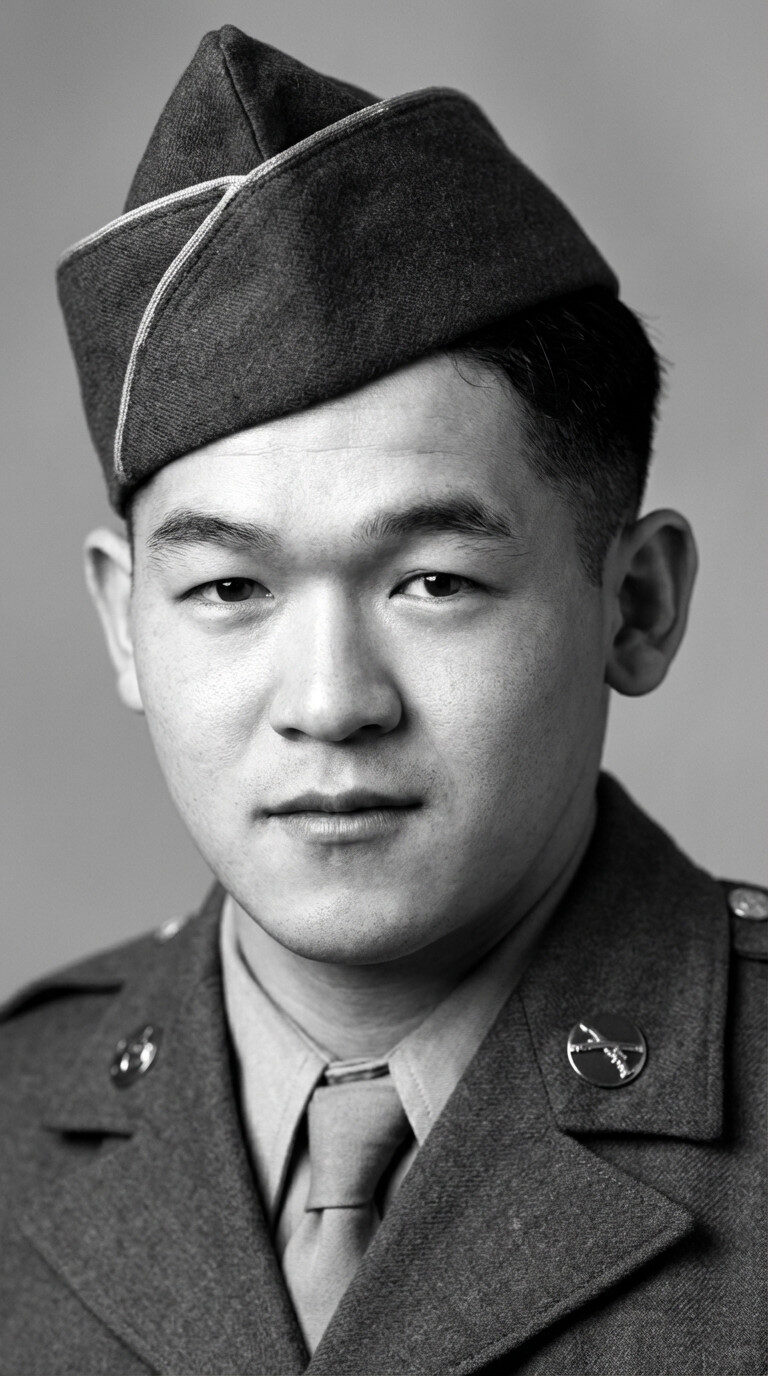
Yukio Sato
Private First Class
442nd Regimental Combat Team
3rd Battalion, I Company
Yukio Sato was born on December 12, 1919, in Seattle, Washington, to Chusuke and Nami (Susuki) Sato. He was the oldest of four sons: Yukio, Tadao, Frank, and Kazuo. His father emigrated from Kawafusa, Fukushima Prefecture, Japan, arriving in Seattle on October 19, 1907, on the Aki Maru. Chusuke and Nami were married in Fukushima on January 26, 1917. Nami subsequently emigrated from the village of Odaka, Soma District, Fukushima Prefecture, arriving on February 24, 1919.
In 1920, they were living at 7th Street South with their first child, Yukio. Chusuke was a cashier at a retail store. In 1930, the family lived at 325 Nob Hill in Seattle and operated a retail grocery store.
In 1940, the family lived at 303 John Street in Seattle, and they ran a retail grocery store.
Yukio attended Warren Avenue Elementary School and graduated from Queen Anne High School. He was a member of Seattle Dojo, the oldest judo club in the United States.
He registered for the draft on July 1, 1941, at Local Board No. 5 in Seattle. He was employed as a track worker for the Great Northern Railroad, Spokane Division, in Chelan. His father was his point of contact and they lived at 325 John Street. Yukio was 5’2” tall and weighed 115 pounds.
In May 1942, the family was evacuated to the Puyallup WCCA Assembly Center located on the Puyallup Fairgrounds property. They were incarcerated on August 18, 1942, in the Minidoka WRA Relocation Center in Jerome County, Idaho.
While at Minidoka Camp, Yukio volunteered in February 1943 to serve his country. He left Minidoka on May 21, 1943, and enlisted in the Army on May 22 at Fort Douglas, Utah. He traveled by train with 14 other new volunteers to Camp Shelby, stopping in Kansas City’s Union Station where they made the news. Their group leader explained the interval between volunteering and being inducted, “We had to be checked over by the FBI.”
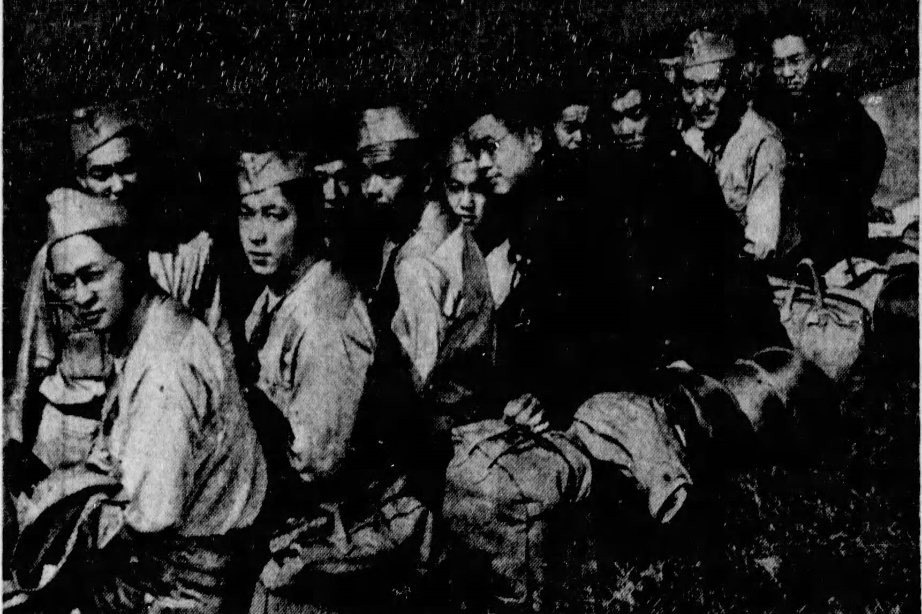
Above: Yukio and other Minidoka volunteers in transit by train to Camp Shelby; group leader Pvt. Tadashi Fujioka is 7th from the left
After basic training, Yukio was assigned to 3rd Battalion, I Company. He was 2nd Platoon radioman and a runner, acting as a liaison between his platoon and the I Company command post.
After a year of training, the 442nd left Camp Shelby for Camp Patrick Henry, Virginia, on April 22, 1944. They shipped out from nearby Hampton Roads to the Mediterranean Theater of Operations in a large convoy of troop ships on May 2 and arrived at Naples, Italy, on May 28.
After a week at a bivouac in nearby Bagnoli, the RCT moved by LSTs to the Anzio beachhead. From there, they were trucked through the recently liberated city of Rome to a large bivouac near Civitavecchia, about 50 miles north. Here, they made final preparations to move to the front. The 442nd entered combat on June 26 near Suvereto.
The push of the 442nd up the west side of the Italian peninsula was relentless. Yukio and the 442nd saw heavy combat at Hill 140, and continued to move the enemy north.
On July 18, 1944, the battle to take Livorno from the Germans was successful. The 2nd and 3rd Battalions continued to pursue the enemy’s disorganized rear guard.
The town of Colle Salvetti, situated on the last high ground before the Arno River, was seized the next day – July 19, 1944. Yukio was killed by sniper fire during this engagement.
Private First Class Yukio Sato was buried in the U.S. Military Cemetery at Follonica, Section K, Row 113, Grave 1354.
For his military service, Private First Class Yukio Sato was awarded the Bronze Star Medal, Purple Heart Medal, Good Conduct Medal, American Campaign Medal, European-African-Middle Eastern Campaign Medal with one bronze star, World War II Victory Medal, and Combat Infantryman Badge. Yukio was awarded the Congressional Gold Medal on October 5, 2010, along with the other veterans of the 100th/442nd Regimental Combat Team. . Conferred by the U.S. Congress, the award states: “The United States remains forever indebted to the bravery, valor, and dedication to country these men faced while fighting a two-fronted battle of discrimination at home and fascism abroad. Their commitment and sacrifice demonstrate a highly uncommon and commendable sense of patriotism and honor.”
Yukio’s mother, Nami Sato, died at Minidoka on June 10, 1945. His father, Chusuke, was released from Minidoka on July 26 to go to Chicago, Illinois. Younger brother Tadao Sato was serving as a Private First Class in the 442nd’s Cannon Company. At the time, he was serving in the occupation of Italy and attending a University of Florence Study Center program for 442nd soldiers. While returning to his unit from Florence, he was involved in a jeep accident and died from his injuries on August 26, 1945. Pfc. Tadao Sato was buried at the U.S. Military Cemetery at Castelfiorentino.
In 1947, many war dead were returned home from military cemeteries in Europe, if the family so wished. Consequently, both brothers were returned to the US.
On December 11, 1948, the funeral service for Pfc. Tadao Sato, his brother, Pfc. Yukio Sato, and four other 442nd soldiers was held in the Bukkyo-Kai Buddhist Auditorium 14th Avenue South and Main Street. Four clergymen alternately conducted the Buddhist and Christian rites in Japanese and English. The eulogy was delivered by Robert A. Yothers, State Commander of the Veterans of Foreign Wars (VFW). He ended with, “The highest tribute that we the living can pay to these men is to apply to our own lives the faith and undaunted courage which were theirs and to now dedicate ourselves in service to the living – that we now resolve that these Americans shall not have died in vain.”
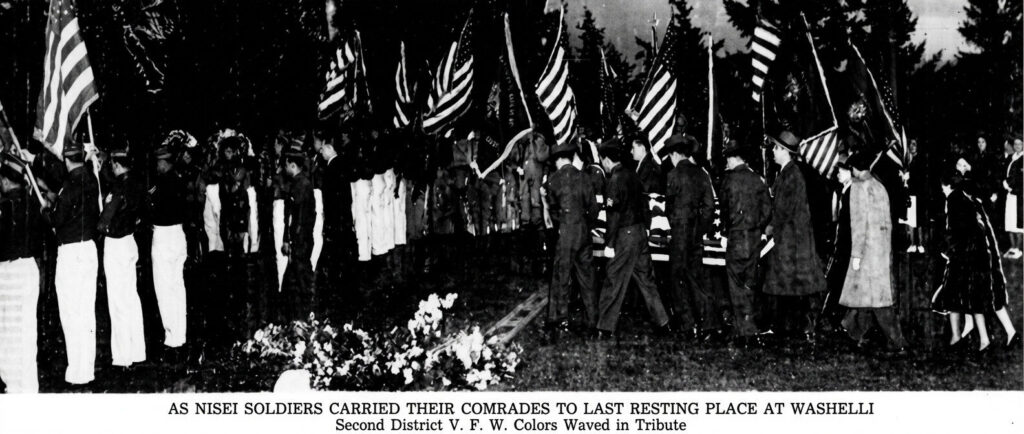
Members of nine VFW posts attended along with 1,200 people. A procession of 307 cars, believed to be the longest ever seen in Seattle, drove from the church to the Evergreen-Washelli Memorial Park where the brothers were buried in the Veterans Section along with Pfc. Akira Kanzaki, Pfc. William Kenzo Nakamura, Pfc. Hisashi Iwai, and Pvt. Isao Okazaki. A color guard from the Greenwood Memorial VFW Post 5864 fired three volleys in salute, followed by Taps.
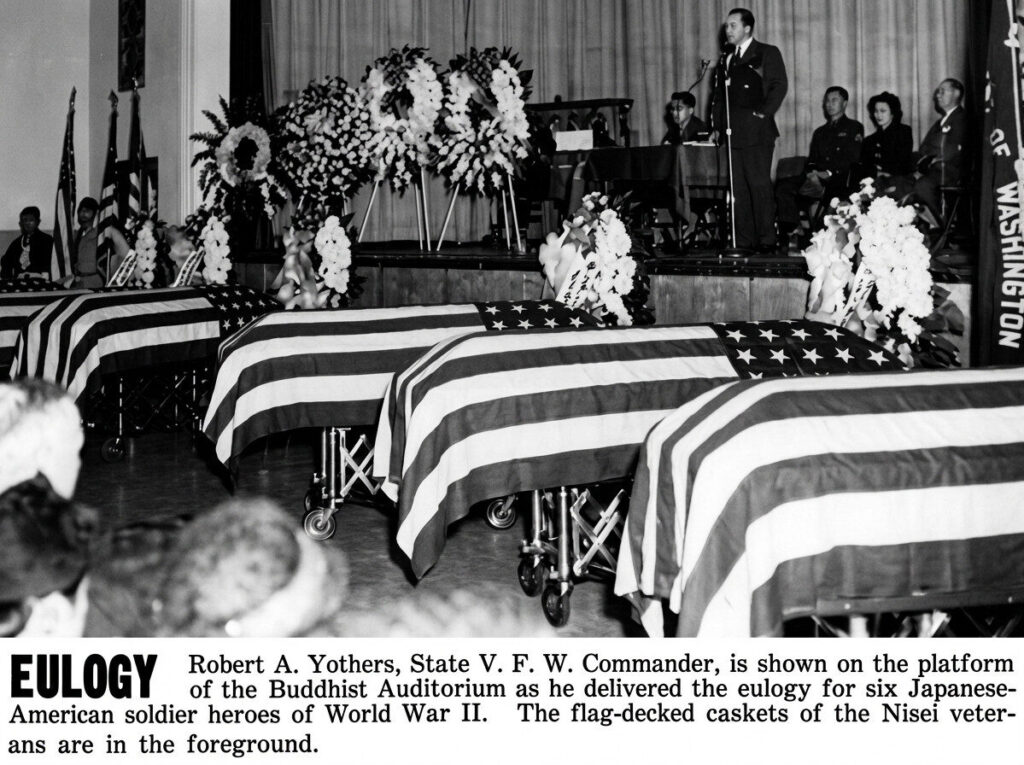
Above: Funeral service for the Sato brothers and four other 442nd soldiers
Below: Evergreen-Washelli Memorial Park, December 11, 1948
Postscript. On April 20, 1954, father Chusuke Sato, became a U.S. citizen in the Court of Northern Illinois in Chicago.. His residence was 4642 South Lake Park in Chicago, where he had remained after the war. He was a widower and son Kazuo also lived in Chicago. Son Yoshio was serving in the U.S. Air Force.
Researched and written by the Sons and Daughters of the 442nd Regimental Combat Team in 2021. Updated in 2025.