Soldier Story: Tadao Sato
Soldier Story
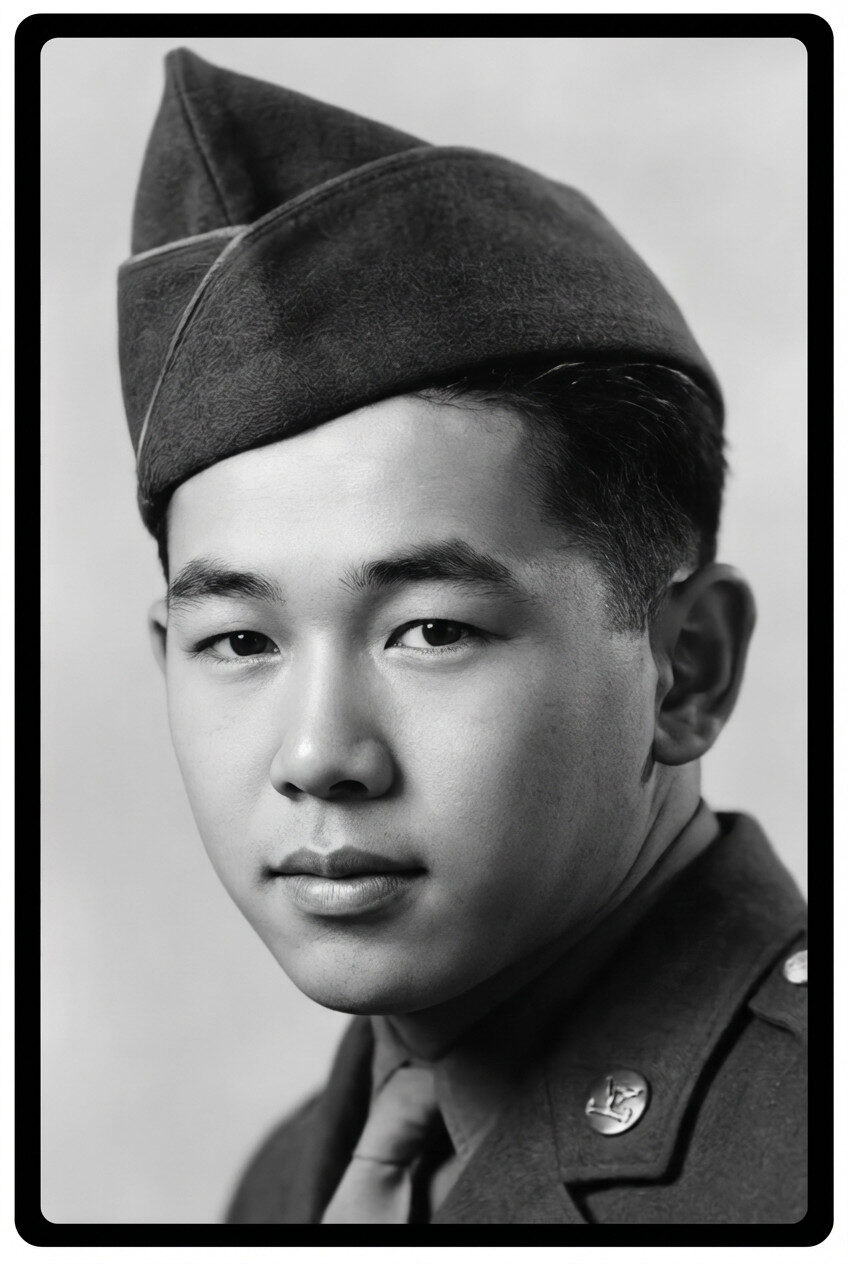
Tadao Sato
Private First Class
442nd Regimental Combat Team
Cannon Company
Tadao Sato was born on July 11, 1921, in Seattle, Washington, to Chusuke and Nami (Susuki) Sato. He was the third of four sons: Yukio, Tadao, Frank, and Kazuo.
Father Chusuke emigrated from Kawafusa, Fukushima Prefecture, Japan, arriving in Seattle on October 19, 1907, on the Aki Maru. Mother Nami emigrated from the village of Odaka, Soma District, Fukushima Prefecture, arriving on February 24, 1919. Chusuke and Nami had been married in Japan on January 26, 1917. In 1920, they were living on 7th Street South with their first child, Yukio. Chusuke was a cashier at a retail store.
In 1930, the family lived at 325 Nob Hill in Seattle and operated a retail grocery store.
In 1940, the family lived at 303 John Street in Seattle’s city center and they ran a retail grocery store.
Tadao signed his draft registration card on February 16, 1942, Local Board No. 5 at 3705 Harrison Street. His point of contact was Carl Langsted of 1819 8th Avenue. He was employed by his older brother Yukio who lived at 325 John Street, which was also Tadao’s address. He was 5’4” tall and weighed 125 pounds.
In May 1942, the family was evacuated to the Puyallup WCCA Assembly Center located on the Puyallup Fairgrounds property. They were incarcerated on August 18, 1942, in the Minidoka WRA Relocation Center in Jerome County, Idaho.
While at Minidoka, Tadao and brother Yukio volunteered to serve their country. They were released from Minidoka on May 21, 1943, to Fort Douglas, Utah. Brother Kazuo Sato was released on February 13, 1945, to Chicago, Illinois. Mother Nami died at Minidoka on June 10, 1945. Father Chusuke and youngest brother Yoshio were released from Minidoka on July 26 to join Kazuo in Chicago.
Tad, as Tadao was known, and Yukio enlisted in the U.S. Army on May 22, 1943, at Camp Douglas. His residence was shown as Jerome, Idaho. He had completed four years of high school and was employed as a sales clerk.
Below: Tad Sato after enlisting; L to R: Tak Hori, Bob Ikeda, Sato, Norio Mitsuoka, Minidoka, 1943
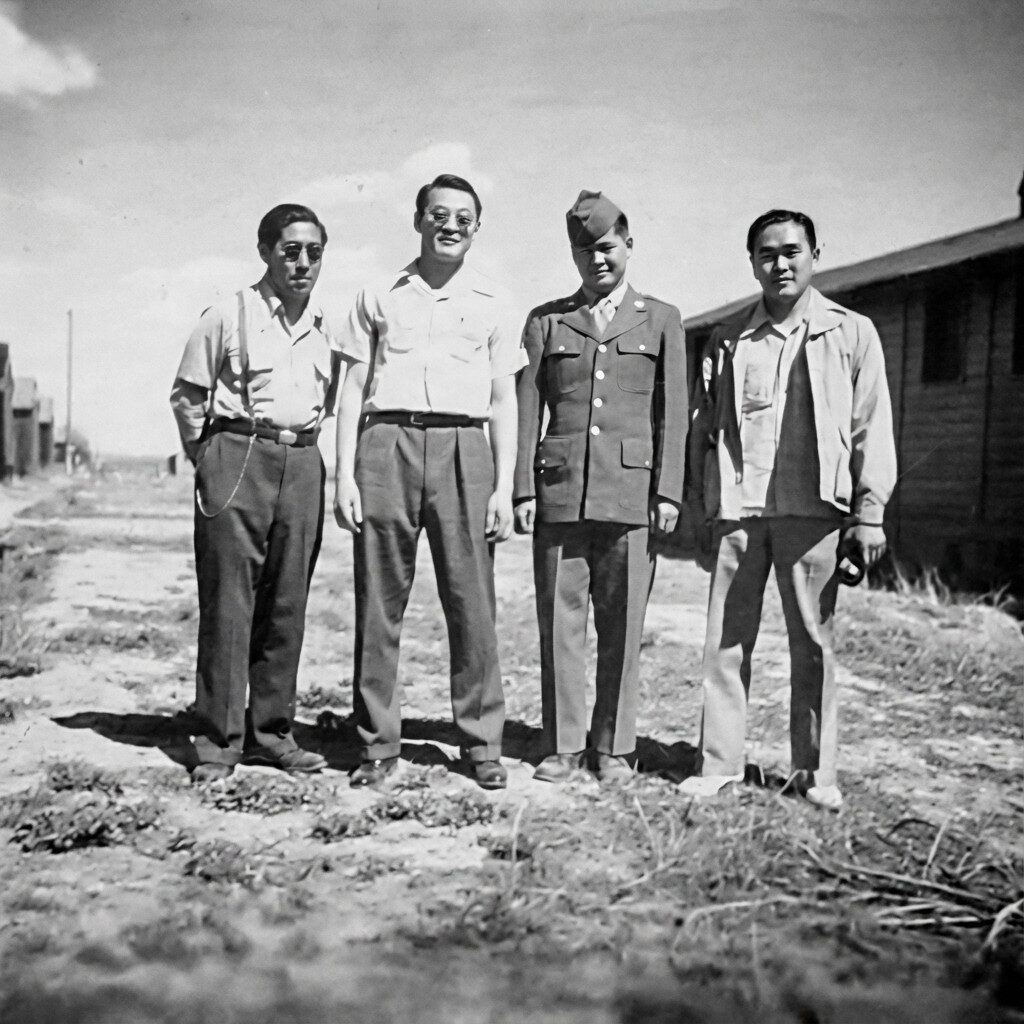
After processing at Fort Douglas, the two Sato brothers were sent back to Minidoka, where the above photo was taken. Once transportation was arranged to Camp Shelby, Mississippi, they went back to Fort Douglas and left by train They were in a group with 13 other new volunteers, stopping briefly in Kansas City’s Union Station on June 3 where they made the local news. Their group leader, Private Tadashi Fujioka, was interviewed. They reluctantly posed for a photo. . Yukio was mentioned in the newspaper article as prompting Fujioka to tell the reporter about himself and how dusty the Minidoka camp was.
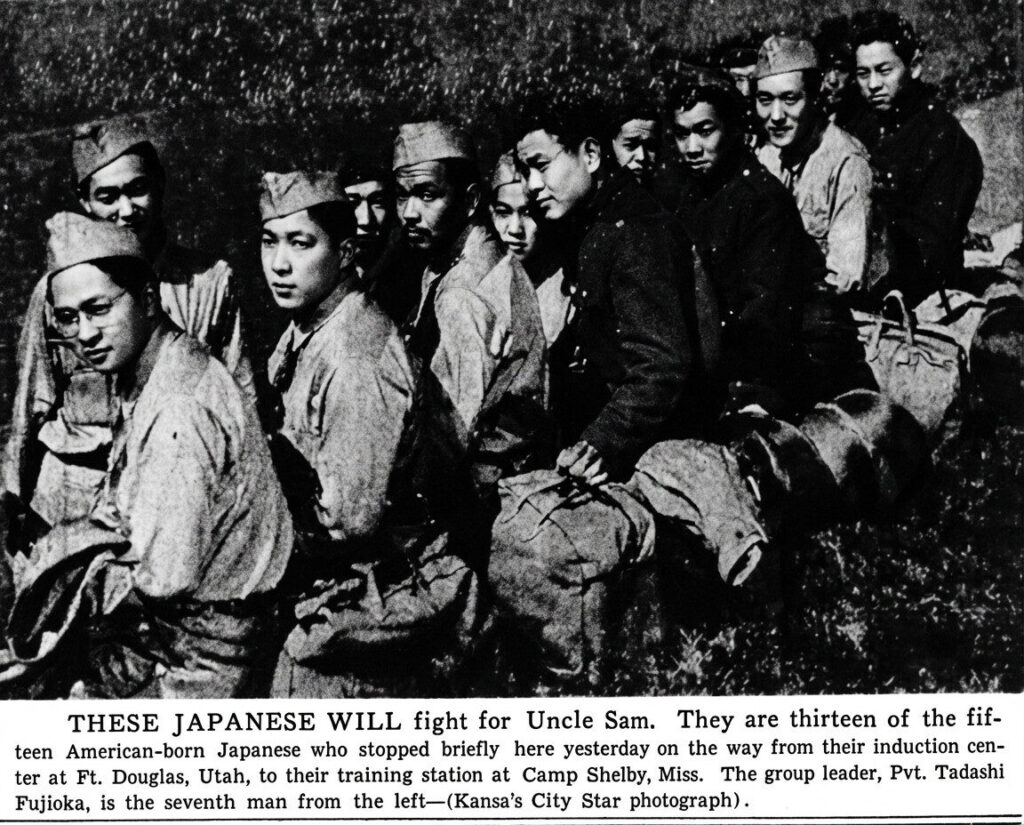
They soon arrived to the 442nd Regimental Combat Team in Mississippi, whose initial contingent of trainees from Hawaii had arrived on April 13 and started basic training on May 10.
After Tad and Yukio’s arrival in early June, they went through the entire basic training course with other small groups of men arriving from WRA centers. These men were assigned to companies but took most of their training with a recruit detachment.
After basic training ended on August 23 for the bulk of the soldiers, there was a brief break so they had time for short passes and furloughs. When the men returned, unit training was set to begin according to each soldier’s unit within the Combat Team.
While the men were on their short furlough, however, the 442nd had decided to activate a Cannon Company at the regimental level, and this occurred on September 3. Six officers were chosen, and they selected 150 men from other companies – including Pvt. Tadao Sato –to transfer to the new Cannon Company. Sato’s initial company was not identified in our research.
Cannon Company consisted of six light, truck-drawn, 105mm howitzers. This gave the regimental commander his own artillery that he could use when the Combat Team’s 522nd Field Artillery Battalion was firing another mission or needed additional support. Cannon Company could also shoot under the direction of the 522nd’s Fire Direction Center as an extra firing battery. Cannon Company’s six howitzers were divided equally to support the three infantry battalions of the Combat Team.
After nearly a year of training and field maneuvers, the 442nd left Camp Shelby on April 22, 1944, by train for Camp Patrick Henry, Virginia. On May 2, they sailed from nearby Hampton Roads in a convoy of over 100 ships bound for the Theater of War.
After a lengthy crossing, the 442nd arrived at Naples, Italy, on May 28 to join in the Rome-Arno Campaign. The Combat Team spent the next two weeks at a bivouac at Staging Area No. 4 in nearby Bagnoli. While there, some of the men took advantage of the opportunity to visit the ruins of nearby Pompeii. The 442nd then left on LSTs and LCIs on June 6 and arrived at the recently liberated Anzio beachhead the next day. Finally, on June 9 they headed out in a convoy through the city of Rome, which had just been liberated on June 4, for a large bivouac in Civitavecchia, about 50 miles north. There they made final preparations to advance to the front lines.
Tadao and Yukio entered combat in the Rome-Arno Campaign with the 442nd on June 26 near Suvereto, north of Civitavecchia. They encountered some heavy fighting as they continuously pushed the Germans up the Italian peninsula. During this time, they saw their heaviest fighting at the battle for Hill 140 just north of the Cecina River.
Tadao’s elder brother Yukio was killed on July 18, 1944, by sniper fire during the engagement to capture the town of Colle Salvetti, situated on the last high ground before the Arno River. He was buried at the U.S. Military Cemetery at Follonica.
After driving the enemy north to the Arno River, Private Tadao Sato and the Combat Team were pulled from the lines and sent to Naples for shipment to France on September 26-27, where they joined in the Rhineland-Vosges Campaign. They arrived at Marseilles on September 29 after a 2-day voyage, and bivouacked at nearby Septèmes prior to traveling over 500 miles north by truck or rail boxcars to the Vosges.
Private Sato was in combat for the next month during the bitter fighting to liberate the important rail junction of Bruyères, neighboring Biffontaine and Belmont, and the “Rescue of the Lost Battalion,” the 1st Battalion, 141st (Texas) Infantry that had advanced beyond the lines and was surrounded on three sides by the enemy. The weather was cold, wet, snowy, and miserable, as the men fought in the heavily wooded forests still in their summer uniforms. They were subjected to living in foxholes, and incoming artillery raining down on them in “tree bursts.”
After the fierce fighting in the Vosges, the 442nd was now at half strength, and was sent to the south of France. There, they could rebuild to full combat strength while fighting in the Rhineland-Maritime Alps Campaign, which was mostly a defensive position guarding the French-Italian border from attack by the German Army in Italy.
The 442nd was in southern France from November 23, 1944, until March 15, 1945, when they were relieved and moved in relays to the new staging area at Marseilles. On March 20-22, the 442nd (without its 522nd Field Artillery Battalion who were sent to Germany) left France to fight in the Po Valley Campaign for the final push to defeat the Nazis in Italy. They arrived at the Peninsular Base Section in Pisa on March 25 and were assigned to Fifth Army.
The objective of the 442nd was to execute a surprise diversionary attack on the western anchor of the German Gothic Line. This elaborate system of fortifications had been attacked in the fall of 1944, but no one had yet been able to pry the Germans loose from the western end. The Gothic Line in this area was hewn out of solid rock, reinforced with concrete, and constructed to give all-around protection and observation. The Germans were dug into mountain peaks rising almost sheer from the coastal plain, bare of vegetation save for scanty scrub growth.
The Combat Team left their initial staging area and moved to a bivouac at San Martino, near the walled city of Lucca. Starting on April 3, the 442nd set off in the mountainous area of the west coast of northern Italy with the mission of cracking the western anchor of the Gothic Line. In what was ordered as a diversionary attack to draw off critical German army units from the Gothic Line center, the 442nd RCT rapidly crushed the German defenses, and continued on the attack, turning the planned diversion into a full-scale breakthrough of the vaunted Gothic Line, liberating the west of Italy all the way to Turin.
Despite orders from Hitler to fight on, the German forces in Italy surrendered on May 2, 1945, a week before the rest of the German forces in Europe surrendered.
Pfc. Tadao Sato was was with the 442nd while in occupation first at Novi Ligure, then at Ghedi Airport guarding and processing German prisoners, and next at Lecco where they enjoyed the countryside and Lake Garlate. They returned to the Livorno/Pisa/Florence area on July 12 for further guard duty.”
In August, Pfc. Tadao Sato was enrolled in a program for 442nd soldiers to attend courses at the University of Florence Study Center. Tragically, while returning to his unit from Florence, the jeep in which he was a passenger overturned and he was injured. He died from his injuries on August 26, 1945.
Pfc. Tadao Sato was buried at the U.S. Military Cemetery at Castelfiorentino.
For his military service, Private First Class Tadao Sato was awarded the Bronze Star Medal, Good Conduct Medal, American Campaign Medal, European-African-Middle Eastern Campaign Medal with four bronze stars, World War II Victory Medal, Army of Occupation Medal, Distinguished Unit Badge, and Combat Infantryman Badge. He was posthumously awarded the Congressional Gold Medal on October 5, 2010, along with the other veterans of the 442nd Regimental Combat Team. Conferred by the U.S. Congress, the award states: “The United States remains forever indebted to the bravery, valor, and dedication to country these men faced while fighting a two-fronted battle of discrimination at home and fascism abroad. Their commitment and sacrifice demonstrate a highly uncommon and commendable sense of patriotism and honor.”
In 1947 the US began a program to close many of the overseas wartime military cemeteries. Families were given the choice of having their loved one’s remains reburied at one of the few cemeteries that would remain – or being returned to the US. The Sato family decided to have both of their sons brought home – Yukio of I Company killed in combat in 1944, and Tadao killed in an accident in 1945. Consequently, both brothers were returned to the US.
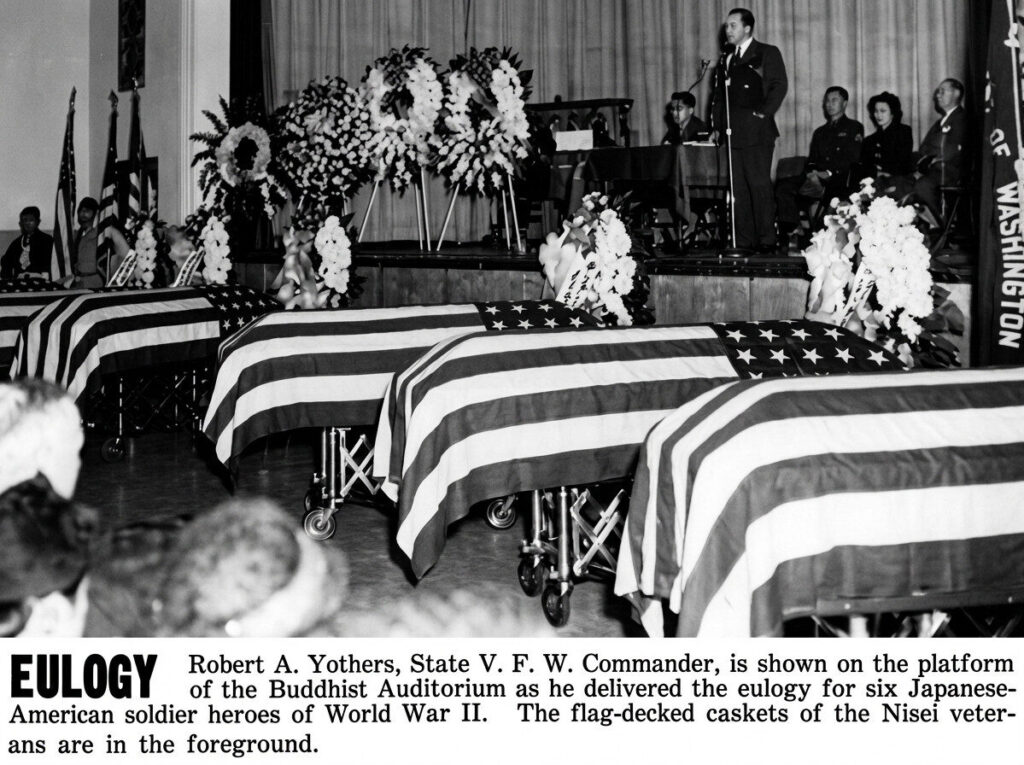
Above: Funeral service for the Sato brothers and four other 442nd soldiers
On December 11, 1947, the funeral service for Pfc. Tadao Sato, his brother Pfc. Yukio Sato, and four other 442nd soldiers was held in the Bukkyo-Kai Buddhist Auditorium at 14th Avenue South and Main Street. Four clergymen alternately conducted the Buddhist and Christian rites in Japanese and English. The eulogy was delivered by Robert A. Yothers, State Commander of the Veterans of Foreign Wars (VFW). He ended with, “The highest tribute that we the living can pay to these men is to apply to our own lives the faith and undaunted courage which were theirs and to now dedicate ourselves in service to the living – that we now resolve that these Americans shall not have died in vain.”
Members of nine VFW posts attended along with 1,200 people. A procession of 307 cars, believed to be the longest ever seen in Seattle, drove from the church to the Evergreen-Washelli Memorial Park where the brothers were buried in the Veterans Section along with Pfc. Akira Kanzaki, Pfc. William Kenzo Nakamura, Pfc. Hisashi Iwai, and Pvt. Isao Okazaki. A color guard from the Greenwood Memorial VFW Post 5864 fired three volleys in salute, followed by Taps.
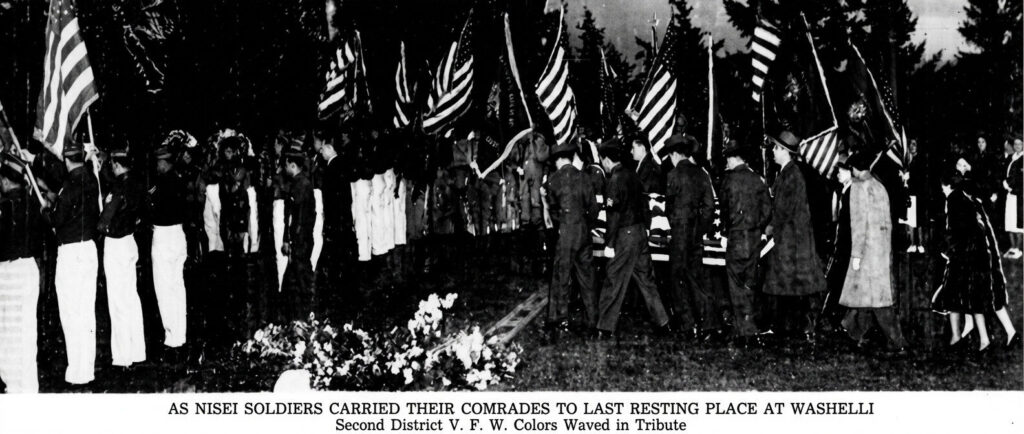
Above: Evergreen-Washelli Memorial Park, December 11, 1948
Postscript. On April 20, 1954, father Chusuke Sato became a U.S. citizen in the Court of Northern Illinois in Chicago. His residence was at 4642 South Lake Park in Chicago, where he had remained after the war. He was a widower and son Kazuo also lived in Chicago. Son Yoshio was serving in the U.S. Air Force.
His brother Yukio Sato served in the 442nd RCT, I Company.
Researched and written by the Sons and Daughters of the 442nd Regimental Combat Team in 2021. Updated in 2025.